


What makes people different from other animals?
It’s not language: That’s shared by all kinds of social creatures, from prairie dogs to dolphins. It’s not agriculture: Some ants also farm. It’s not tools: Our primate cousins use them, and so do dolphins. Not medicine: Again, primates self-medicate.
The aim of Hannah Holmes’ The Well-Dressed Ape: A Natural History of Myself is to remind us how integrated into the natural world we are, and she succeeds on most counts.
When scientists encounter something new, they describe its qualities: preferred food, physical traits, habitat, mating habits. Holmes cleverly applies this type of description to humans.
We begin with a tour of the body — what colors and shapes one can expect a human to come in, what the differences are between men and women. She peppers her exploration with cocktail-party-ready factoids: Pale skin is probably an adaptation to allow for more vitamin D to be produced. Our mouths are toxic, and a human bite can kill.
Though we aren’t the fastest sprinters, there aren’t many marathoner species besides us, Holmes says. Our strange, two-legged body is ideal for distance running, and few animals can keep going for as long as we can.
And then there is our strange trek up the food chain. We started as cat food, hunted on the savannah by tigers and lions. Once we got good with the tools, we started killing our former predators for fur. We’re the apex predators now — and it might be the best anti-predator adaptation the world has yet seen.
There is, too, our propensity to guard our territory. Holmes notes that guests often indicate submission before entering an apartment: By knocking and waiting to be received, they show that they understand whose domain it is.
Our relationship with food is also worth considering. About six million children under the age of 5 die of malnutrition every year, but in developed countries, slenderness is an indicator of desirability. This might have something to do with our obsession with status, an obsession we share with most social animals.
Given all her quirky observations, I wish Holmes had resisted over-writing and trusted her material more. Sometimes, in a quest to be poetic, she writes sentences that don’t even make sense: “If the jaws of our ancestors can only mumble that I’m equipped to eat anything, then I’d at least like to know how much — of whatever — I should consume today.”
I think this is supposed to be a reflection on how the shape of our jaws allows us to eat omnivorously. But it just interrupts a perfectly interesting examination of the human diet.
This is particularly frustrating because Holmes’ sharp observations can easily stand alone. For example, it certainly is weird that we, as a species, tend toward body modification: hair dye, makeup, tattoos, plastic surgery. It makes sense that the invisible hand of evolution is at work, and yet I hadn’t considered it.
So what makes us human? While other social animals seem to show some moral tendencies, few reach the level of people. Rather than being nasty and brutish, we’re remarkably empathetic — not only of each other, but toward other animals. Environmentalism is uniquely human, Holmes suggests. She notes that there are few animals that would allow their former predators — big cats like cougars — back onto their land in order to preserve the habitat.
Perhaps this seems like a politically expedient answer. I’d suggest religion, art and long-term abstract thought are also unique. Still, empathy, particularly cross-species empathy, isn’t a bad contender. It’s certainly a flattering one.

Taiwan has next to no political engagement in Myanmar, either with the ruling military junta nor the dozens of armed groups who’ve in the last five years taken over around two-thirds of the nation’s territory in a sprawling, patchwork civil war. But early last month, the leader of one relatively minor Burmese revolutionary faction, General Nerdah Bomya, who is also an alleged war criminal, made a low key visit to Taipei, where he met with a member of President William Lai’s (賴清德) staff, a retired Taiwanese military official and several academics. “I feel like Taiwan is a good example of
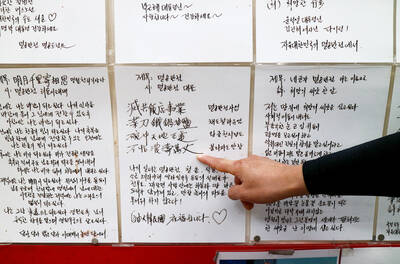
“M yeolgong jajangmyeon (anti-communism zhajiangmian, 滅共炸醬麵), let’s all shout together — myeolgong!” a chef at a Chinese restaurant in Dongtan, located about 35km south of Seoul, South Korea, calls out before serving a bowl of Korean-style zhajiangmian —black bean noodles. Diners repeat the phrase before tucking in. This political-themed restaurant, named Myeolgong Banjeom (滅共飯館, “anti-communism restaurant”), is operated by a single person and does not take reservations; therefore long queues form regularly outside, and most customers appear sympathetic to its political theme. Photos of conservative public figures hang on the walls, alongside political slogans and poems written in Chinese characters; South

Institutions signalling a fresh beginning and new spirit often adopt new slogans, symbols and marketing materials, and the Chinese Nationalist Party (KMT) is no exception. Cheng Li-wun (鄭麗文), soon after taking office as KMT chair, released a new slogan that plays on the party’s acronym: “Kind Mindfulness Team.” The party recently released a graphic prominently featuring the red, white and blue of the flag with a Chinese slogan “establishing peace, blessings and fortune marching forth” (締造和平,幸福前行). One part of the graphic also features two hands in blue and white grasping olive branches in a stylized shape of Taiwan. Bonus points for

Taipei Mayor Chiang Wan-an (蔣萬安) announced last week a city policy to get businesses to reduce working hours to seven hours per day for employees with children 12 and under at home. The city promised to subsidize 80 percent of the employees’ wage loss. Taipei can do this, since the Celestial Dragon Kingdom (天龍國), as it is sardonically known to the denizens of Taiwan’s less fortunate regions, has an outsize grip on the government budget. Like most subsidies, this will likely have little effect on Taiwan’s catastrophic birth rates, though it may be a relief to the shrinking number of


 RSS
RSS