


The inside of Beader Venice (彼得威尼斯) near the Shida night market looks like a candy shop filled with sweets in different flavors and colors. But the wares within are all Venetian glass jewelry, handmade in Taipei out of raw materials imported from Italy.
Crystal-clear pendants shaped like spiralini pasta and accented with ocean blue or deep plum swirls hang from silver chains, while longer necklaces are made of strands of beads that shine with gold foil. Rings sparkle like disco balls with a dusting of silver glitter trapped in the glass. More whimsical selections include tiny glass pandas, fish and daisies.
Designer Louis Chiang (江奕辰) opened the store last summer after 12 years as a glassmaker creating jewelry and collectibles for clients including Sogo, Eslite and the National Palace Museum. The technique Chiang uses to make his Venetian glass beads, pendants and charms is called lampworking and has a history that stretches back more than seven centuries. Most of the store’s glass jewelry is made in Beader Venice’s workshop in Zhonghe by Chiang and his team of eight glassmakers, but customers can catch a glimpse of the process at a workbench in the store where staff create jewelry prototypes in between serving patrons.
Venetian glass (also known as Murano glass) is characterized by bright, clear colors, fluid shapes, raised motifs and patterns on the surface of the glass, and layered effects such as metallic foil trapped in the center of each bead. First, the glassmaker selects a glass cane from a rainbow-colored assortment imported from Italy. A blowtorch clamped to the side of the table shoots out a steady flame, into which one end of the cane is exposed. The molten glass is spun around the end of a metal rod and held near the flame to keep it supple as it is sculpted or twisted into different shapes; colors are added by carefully touching the ends of other glass canes to the bead’s surface.
Chiang founded his company in 2001 as Jader Art (覺得藝術中心). In 2005, he first traveled to Murano, an island near Venice that is considered the center of Italy’s glass trade. Chiang had studied glassmaking at Liuli Gongfang, a Taiwanese company that specializes in traditional Chinese glassware, and joined the International Guild of Glass Artists, but he says his trip to Murano and Venice first opened his eyes to the possibilities of art glass.
“I already had a strong interest in glassmaking, but I thought of it as a craft. Then I went to Venice. I’d never seen anything as beautiful as the glass there. Before that, I’d never really thought about how glassmaking was related to fashion and art,” says Chiang, who renamed his company Beader Venice last year.
Chiang’s design philosophy is influenced by his mother, who was a dressmaker for 40 years, and his master’s in business administration from National Chengchi University’s Graduate Institute of Technology and Innovation Management (政治大學科技管理研究所).
“Business school was good training. Artists sometimes don’t think about marketing and what their niche is, but I know we have to focus on those things to be successful,” says Chiang. “And what I learned from my mother is how to communicate with a customer so you can make something that suits their style.”
Chiang infuses many of his accessories with local flavor, drawing on motifs from Taiwanese and Chinese culture. The shop’s best sellers include cell phone charms in the shape of gold ingots, zongzi (粽子, a glutinous rice dumpling wrapped in leaves, which is a traditional good luck symbol for students), carp and Chinese radishes (NT$220). A new series of jewelry called Beader Garden (彼得花園) will feature beads embellished with lotus and peony blossoms, as well as butterflies and koi.
Other designs put a contemporary spin on a centuries-old art. One recent series picked up on the fad for leopard print. Chiang and his staff studied photos and went to the Taipei Zoo to see the animals in action before spending 10 months perfecting the process of translating the leopard’s coat into glass. The results are beads with delicate brown and sienna colored spots on the surface lit up from within with a layer of gold foil.
Other items at Beader Venice include heart-shaped perfume bottle pendants, which have a cork stopper and a ceramic core that soaks up a few drops of essential oil (NT$1,900) and rings topped with glass daisies or glittery beads (NT$490 to NT$880). More elaborate items include a long necklace of beads in different designs and textures linked with a chain (NT$3,280) and a bracelet of leopard-spotted and rose-colored beads (NT$1,780).
“I want to make things that don’t just catch a customer’s fancy now, but that they can wear for years,” says Chiang.
BEADER VENICE (彼得威尼斯)
ADDRESS: 102 Longquan St, Taipei City (台北市龍泉街102號), near Shida Road, Lane 105 (師大路105巷)
TELEPHONE: (02) 2364-6563
ON THE NET: www.beadervenice.com

In late October of 1873 the government of Japan decided against sending a military expedition to Korea to force that nation to open trade relations. Across the government supporters of the expedition resigned immediately. The spectacle of revolt by disaffected samurai began to loom over Japanese politics. In January of 1874 disaffected samurai attacked a senior minister in Tokyo. A month later, a group of pro-Korea expedition and anti-foreign elements from Saga prefecture in Kyushu revolted, driven in part by high food prices stemming from poor harvests. Their leader, according to Edward Drea’s classic Japan’s Imperial Army, was a samurai

The following three paragraphs are just some of what the local Chinese-language press is reporting on breathlessly and following every twist and turn with the eagerness of a soap opera fan. For many English-language readers, it probably comes across as incomprehensibly opaque, so bear with me briefly dear reader: To the surprise of many, former pop singer and Democratic Progressive Party (DPP) ex-lawmaker Yu Tien (余天) of the Taiwan Normal Country Promotion Association (TNCPA) at the last minute dropped out of the running for committee chair of the DPP’s New Taipei City chapter, paving the way for DPP legislator Su

It’s hard to know where to begin with Mark Tovell’s Taiwan: Roads Above the Clouds. Having published a travelogue myself, as well as having contributed to several guidebooks, at first glance Tovell’s book appears to inhabit a middle ground — the kind of hard-to-sell nowheresville publishers detest. Leaf through the pages and you’ll find them suffuse with the purple prose best associated with travel literature: “When the sun is low on a warm, clear morning, and with the heat already rising, we stand at the riverside bike path leading south from Sanxia’s old cobble streets.” Hardly the stuff of your
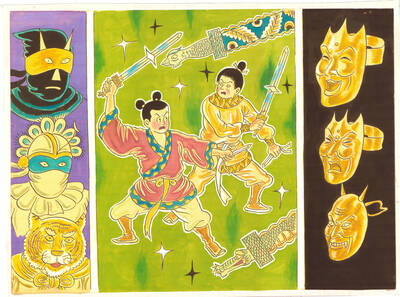
April 22 to April 28 The true identity of the mastermind behind the Demon Gang (魔鬼黨) was undoubtedly on the minds of countless schoolchildren in late 1958. In the days leading up to the big reveal, more than 10,000 guesses were sent to Ta Hwa Publishing Co (大華文化社) for a chance to win prizes. The smash success of the comic series Great Battle Against the Demon Gang (大戰魔鬼黨) came as a surprise to author Yeh Hung-chia (葉宏甲), who had long given up on his dream after being jailed for 10 months in 1947 over political cartoons. Protagonist


 RSS
RSS