


Compagnie Philippe Genty’s productions are the stuff that dreams are made of. And nightmares, especially the Freudian kind.
They combine puppetry, dance, optical illusions and mime to explore the unconscious and conscious worlds.
In La Fin des Terres (Land’s End), which opened at the National Theater last night, there are surrealistic landscapes, giant puppets with plastic baby faces, huge penises, a pair of legs that become scissor blades, a praying mantis with a human face, huge plastic bubbles that float like jellyfish, a King Kong-sized hand, several trap doors and lots of men in trench coats and fedoras.
The imagery comes from the mind of 71-year-old French artist/puppeteer/director Philippe Genty, in collaboration with his choreographer and wife Mary Underwood.
Genty trained to be a graphic designer, but got involved with puppetry because he found it easier to communicate through puppets than face-to-face. In 1961, he parlayed a grant from the UN Educational, Scientific and Cultural Organization (UNESCO) to make a film about puppet troupes into a four-year-long globetrotting journey that allowed him to stage his own puppet shows. In 1968, he started the company, and Underwood, a classically trained dancer, was one of its original members.
While Genty no longer travels with his troupe, his productions still traverse the world. The company was last in Taiwan 16 years ago and was supposed to return in 1999, but the September earthquake that year scuppered the visit.
La Fin des Terres, which premiered in 2004, centers on a couple who meet because of a letter. Their meeting, parting and search for one another are played out in parallel tracks, one “real” and one “dream.”
As with other Genty works, there is no narrative flow to the 90-minute long La Fin des Terres; people, images and fantastic creatures appear and disappear like they do when we dream. Just as dreams allow our minds to fantasize and our most elemental fears to surface, Genty has a knack of creating scenes of unbelievable beauty as well as ones that can make his audiences squirm.
A sequence with scissor blades is guaranteed to leave most men feeling uncomfortable, while a human-faced bug — who dances a delicate, exquisite pas de deux with a young woman before wrapping her up in a web — is sure to give at least some female audience members nightmares.
The sexual imagery and references have led to the production being slapped with a “not suitable for children” label in several countries. The Compagnie Philippe Genty’s seven actors may excel at interacting with huge puppets, but this is no Muppets show.
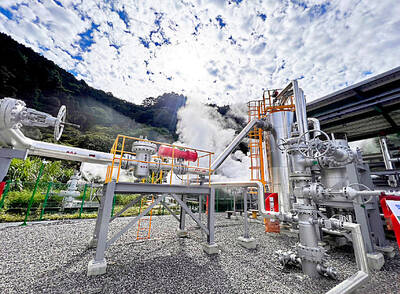
Taiwan’s semiconductor industry consumes electricity at rates that would strain most national grids. Taiwan Semiconductor Manufacturing Co (TSMC) alone accounted for more than 9 percent, or 2,590 megawatts (MW), of the nation’s power demand last year. The factories that produce chips for the world’s phones and servers run around the clock. They cannot tolerate blackouts. Yet Taiwan imports 97 percent of its energy, with liquefied natural gas reserves measured in days. Underground, Taiwan has options. Studies from National Taiwan University estimate recoverable geothermal resources at more than 33,000 MW. Current installed capacity stands below 10 MW. OBSTACLES Despite Taiwan’s significant geothermal potential, the

In our discussions of tourism in Taiwan we often criticize the government’s addiction to promoting food and shopping, while ignoring Taiwan’s underdeveloped trekking and adventure travel opportunities. This discussion, however, is decidedly land-focused. When was the last time a port entered into it? Last week I encountered journalist and travel writer Cameron Dueck, who had sailed to Taiwan in 2023-24, and was full of tales. Like everyone who visits, he and his partner Fiona Ching loved our island nation and had nothing but wonderful experiences on land. But he had little positive to say about the way Taiwan has organized its
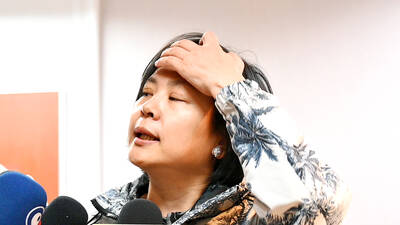
The entire Li Zhenxiu (李貞秀) saga has been an ugly, complicated mess. Born in China’s Hunan Province, she moved to work in Shenzhen, where she met her future Taiwanese husband. Most accounts have her arriving in Taiwan and marrying somewhere between 1993 and 1999. She built a successful career in Taiwan in the tech industry before founding her own company. She also served in high-ranking positions on various environmentally-focused tech associations. She says she was inspired by the founding of the Taiwan People’s Party (TPP) in 2019 by Ko Wen-je (柯文哲), and began volunteering for the party soon after. Ko
Chinese Nationalist Party (KMT) Chair Cheng Li-wun (鄭麗文) returned from her trip to meet People’s Republic of China (PRC) dictator Xi Jinping (習近平) bearing “a gift” for the people of Taiwan: 10 measures the PRC proposed to “facilitate the peaceful development of cross-strait relations.” “China on Sunday unveiled 10 new incentive measures for Taiwan,” wrote Reuters, wrongly. The PRC’s longstanding habit with Taiwan relations is to repackage already extant or once-existing policies and declare that they are “new.” The list forwarded by Cheng reflects that practice. NEW MEASURES? Note the first item: establishing regular communication mechanisms between the Chinese Communist Party


 RSS
RSS