


It feels strange to be washing windows in my pajamas, perched in slippered feet on a small wooden veranda. My view through the suddenly clean glass is even stranger: roughly chopped cedar wood neatly piled beside intricate woven baskets, a thickly rusted black kettle swinging over the embers of last night’s fire.
Job complete, I slide the glass open, step through a paper door daubed with swirling calligraphy and start to make my breakfast. It’s just another morning at Chiiori, a 16th-century Japanese farmhouse, and my holiday home.
Hidden deep in the steep valleys and misty hillsides of Shikoku, the smallest and least populated of Japan’s four main islands, this is a house with a purpose. Its four walls are one man’s attempt to preserve Japan’s rural heritage, to stem the tide of concrete development that has swept through much of the country.
In 1973, American writer Alex Kerr, author of a controversial book of essays, Lost Japan, began to renovate a thatched farmhouse in the rapidly depopulating Iya Valley. He named it Chiiori, or House of the Flute. Fast forward 35 years, and though Alex now lives in Thailand, his project is still going strong.
My journey had begun five days earlier in Matsuyama, Shikoku’s main port. I quickly discover that my boyfriend and I are not the only ones on a mission. Everywhere we see Henro-san, white-clad individuals making Japan’s famous 88 Temple pilgrimage. With a wooden walking staff, a wagesa (scarf) and a conical straw hat, they travel, traditionally on foot, on a 1,400km circuit established by followers of the Buddhist scholar Kobo Daishi.
After soaking in the hot spring waters of Matsuyama’s Dogo Onsen resort, we follow them to Ishite-ji, number 51 on the temple circuit. Like many things in Shikoku, this temple has a strange twist. As well as soaring stupas (domes holding Buddhist relics) and thick clouds of incense, we find long dimly lit tunnels through the rock, where hundreds of tiny statues are strung together with rope, motion sensors setting off occasional insane bursts of flashing fairy lights.
The sense of the surreal continues as we leave the city behind. Uwajima, 92km south, is famous for its Taga Jinja shrine. Giant phalluses, long believed to aid fertility, are scattered through the grounds attracting many couples, who come here to make offerings. The attached museum has three floors of historical pornographic prints and strange sex toys.
The stress of city living now far behind us, it’s time to head to Chiiori. The four-hour drive to the Iya Valley is spectacular, with twisting vine bridges crossing the crashing water and the last of the fall colors still bright. The final stretch, a steep winding road with vertiginous drops, is not for the faint-hearted. When eventually we arrive and step cautiously down the steep pathway I remember a condition of staying at Chiiori. This isn’t a traditional guesthouse; every visitor contributes to the home’s upkeep, from gardening and cleaning to manure making and maintenance.
As we get our first glimpse of the house, it’s clear what our job will be. A handful of men have erected a rudimentary wooden scaffold around the house and, bundles of thatch in hand, are patching up a roof that has clearly seen better days. Paul, co-manager of Chiiori, is our designated welcoming committee. Introductions made and local tea in hand, we’re soon relaxing on a wooden bench in front of the house, gazing at the view of soaring hills and valleys almost untouched by modern development.
Through gently falling pieces of thatch we enter the house, sliding open the dark wooden doors to step into a well-stocked kitchen. Swapping our shoes for slippers we’re shown the facilities — gas cooker, fridge and sink — where all the guests help with cooking and cleaning. It’s both simple and dramatic, filled with beautiful objects.
A set of shoji (sliding paper doors) open on to the main room, where guests sleep communally on futons. But given the sudden drop in temperature and the fact that we are the only visitors, my boyfriend and I will sleep in a subdivided corner, behind more sliding doors. Despite the gas heater I suddenly regret not bringing my thermals.
Luckily one of the daytime visitors is Mr Ueda, manager of the Iya Onsen Hotel, where riverside hot springs are reached from the hotel by funicular railway. Thirty minutes and one hair-raising ride later I am sinking into the cloudy sulfurous waters with Misa, another Chiiori staff member. As happens with onsen baths, we are immediately best friends, floating around naked, gossiping about men and having an impassioned discussion about the National Trust. “We don’t treasure old buildings like you do,” she says sadly. “We must do more.”
Back at Chiiori, now warm, we gather around the fire, sipping soup and listening to the rain. With the rural darkness now thick, the lanterns are lit, throwing pools of warm light on the polished floor. I’m amazed at the number of antiques here, at the century-old cabinets filled with condiments and cutlery. Isn’t Alex afraid there will be damage?
“One of Alex’s philosophies is ‘use it,’” Paul says. “There isn’t a divide between for use and for best. If we just store an antique away it doesn’t exist any more.”
Despite Paul’s belief that the best way to enjoy Chiiori is to “relax and take lots of naps,” the next morning I want to get my hands dirty. We take a soba lesson, making the buckwheat noodles famous in this region. Our attempts at rolling the dough and cutting it create such laughter I am sure we have helped cross-cultural relations.
Guests come and go at Chiiori: an American accountant, a British volunteer-turned-local who comes to share the fire, and a gang of five American teachers. Together we cook delicious okonomiyaki (pancakes) with cabbage and curl up on our futons.
On our final morning there is still one task left. Swallowing my fear of heights I clamber up the scaffolding and reach for a handful of thatch. Under Paul’s patient instruction I find myself fixing the roof, genuinely enjoying the sun on my back and the blue sky above my head.
There are plans to expand Chiiori, to create a new type of tourism that celebrates the local and traditional. It would be easy to knock Chiiori down and build a modern, draught-free guesthouse. “But,” Paul says, “we want to remind people of the value of things that already exist. In the old days this was one of the poorest places in Japan, but they managed to do things beautifully.”
As we drive away I’m mentally rifling through our cupboards at home, thinking of Paul’s final remark: “These things exist, and we should use them. I want people to ask: how can the things I have be used in a more beautiful way?”
I may not be able to live without central heating or hot water, but Chiiori-inspired interior design? Yes please.
On the Net: insidejapantours.com

In late October of 1873 the government of Japan decided against sending a military expedition to Korea to force that nation to open trade relations. Across the government supporters of the expedition resigned immediately. The spectacle of revolt by disaffected samurai began to loom over Japanese politics. In January of 1874 disaffected samurai attacked a senior minister in Tokyo. A month later, a group of pro-Korea expedition and anti-foreign elements from Saga prefecture in Kyushu revolted, driven in part by high food prices stemming from poor harvests. Their leader, according to Edward Drea’s classic Japan’s Imperial Army, was a samurai

The following three paragraphs are just some of what the local Chinese-language press is reporting on breathlessly and following every twist and turn with the eagerness of a soap opera fan. For many English-language readers, it probably comes across as incomprehensibly opaque, so bear with me briefly dear reader: To the surprise of many, former pop singer and Democratic Progressive Party (DPP) ex-lawmaker Yu Tien (余天) of the Taiwan Normal Country Promotion Association (TNCPA) at the last minute dropped out of the running for committee chair of the DPP’s New Taipei City chapter, paving the way for DPP legislator Su
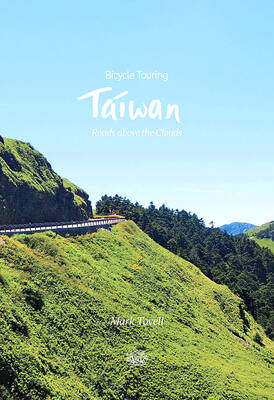
It’s hard to know where to begin with Mark Tovell’s Taiwan: Roads Above the Clouds. Having published a travelogue myself, as well as having contributed to several guidebooks, at first glance Tovell’s book appears to inhabit a middle ground — the kind of hard-to-sell nowheresville publishers detest. Leaf through the pages and you’ll find them suffuse with the purple prose best associated with travel literature: “When the sun is low on a warm, clear morning, and with the heat already rising, we stand at the riverside bike path leading south from Sanxia’s old cobble streets.” Hardly the stuff of your
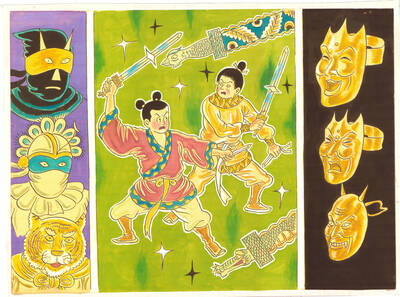
April 22 to April 28 The true identity of the mastermind behind the Demon Gang (魔鬼黨) was undoubtedly on the minds of countless schoolchildren in late 1958. In the days leading up to the big reveal, more than 10,000 guesses were sent to Ta Hwa Publishing Co (大華文化社) for a chance to win prizes. The smash success of the comic series Great Battle Against the Demon Gang (大戰魔鬼黨) came as a surprise to author Yeh Hung-chia (葉宏甲), who had long given up on his dream after being jailed for 10 months in 1947 over political cartoons. Protagonist


 RSS
RSS