


Of all my CDs, the one I listen to most often, and by far, is Philip Glass’ Glassworks, released in its original form in 1982. It provides a bridge between my own classical interests and the more popular enthusiasms of most of my friends. And this, I think, is Glass’ main claim to fame, that he has built on his classical education at New York’s Juilliard School of Music to create a style almost entirely his own that has won millions of followers. He may owe a lot to Johann Sebastian Bach and other Baroque composers, but he has become a kind of savior, reinvigorating a tradition that the abstract modernists were busy condemning to a tiny following, and then quite possibly to eventual oblivion, and opening it up instead to vast audiences.
Indeed, it’s unclear whether he’s really a classical composer at all, or an immensely versatile popular artist. But what do such definitions matter? Glass is in many ways a unique phenomenon, striding across landscapes and scattering his glittering sounds down onto a grateful and often adoring public.
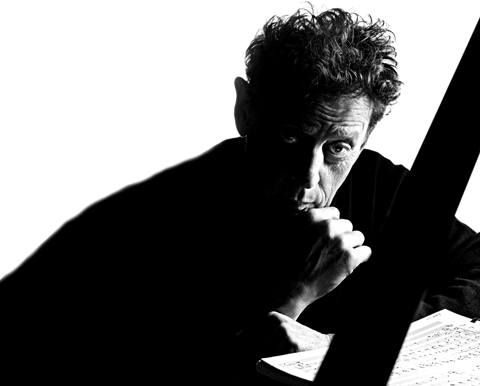
He’s been hugely productive, like the 18th-century composers themselves, writing operas, film music, themed albums, items in classical format (such as his highly acclaimed 2001 Concerto for Cello), and performing his creations with his own lineup, just like a pop idol — or, looked at from another perspective, like Mozart, who delighted in playing his recently-completed piano concertos.
It’s been hard to keep up with Glass, and my own experience has been of hearing him emerge unexpectedly, shooting a new production skywards like a surfacing whale — the opera Satyagraha in 1990, the film music for Koyaanisqatsi: Life Out of Balance in 1998, and more recently his sumptuous music for the 2006 Cate Blanchett and Judi Dench film Notes on a Scandal, for which he received his third Academy Award nomination. But there’s been an enormous amount more.
Glass’s Book of Longing is a setting of 22 poems by Canadian singer-songwriter Leonard Cohen. It features four vocalists and seven instrumentalists, including Glass himself on keyboard. In addition, Cohen’s artwork from his published poem-and-song collection of the same name will be screened, and use will also be made of his pre-recorded voice.
This isn’t a new work — it premiered in Canada in June 2007. But it has subsequently toured widely, and its emergence this weekend here in Taipei, with Glass in person leading the instrumentalists,
is a major event, and should easily sell out for its
two performances.
Glass and Cohen have a lot in common. Each is of Jewish/Eastern European ancestry, each is in his early 70s, each is deeply interested in Buddhism, and each is a composer.
“There’s not a lot of polyphonic writing in the ensemble because that would have destroyed the ability to hear the words,” Glass told John Rockwell on the occasion of the work’s premiere.
“One of the hallmarks of the whole singer-songwriter, folk, rock era was to replace a kind of ornate expressivity in the way people sang with a kind of natural declamatory [style of singing],” he said then.
Cohen added that Glass’ version of Book of Longing was characterized by a way of singing
that wasn’t cabaret, wasn’t opera, and wasn’t West End or Broadway. “I’d call it glassic,” Cohen observed laconically.
Glass first saw the poems almost a decade ago, he said, and thought they were a mixture of ballads, love poems, what he called “Dharma poems” and rhymes or lyrics. He subsequently framed a stage work in five cycles, each containing one representative poem of each type, with instrumental solos interspersed that were independent of the five main cycles.
“I was deeply interested in how Philip would treat these lyrics. It was as simple as that,” said Cohen. “I gave [him] a book and he presented me with this really stunning evening of theater … It wasn’t really a collaboration. It was a kind of ... collision, and something very beautiful has emerged that I think is better than both of us.”
In theory it shouldn’t have worked, he said. It was like the bumblebee — aerodynamically it shouldn’t be able to fly at all, but it can, and does.
Glass, too, was clearly pleased with the outcome, saying that Cohen wasn’t just a poet, but a poet who understood the human voice.
“What you get,” he added, “the gift of age, along with fatigue and disease and all the other things ... the great gift ... is the technique and knowledge of how things can work together.
“To be fully human is to be both in the world of the senses and to be in the world of the imagination at the same time.”
Tickets for this weekend’s performances, then, should be seized with both hands. Will it be like hearing Mozart or Bach in person, or like attending a pop concert by a widely-loved veteran performer? It’s not important. It’s the great Philip Glass, and he’s here in person in Taiwan. That’s what really matters.

In late October of 1873 the government of Japan decided against sending a military expedition to Korea to force that nation to open trade relations. Across the government supporters of the expedition resigned immediately. The spectacle of revolt by disaffected samurai began to loom over Japanese politics. In January of 1874 disaffected samurai attacked a senior minister in Tokyo. A month later, a group of pro-Korea expedition and anti-foreign elements from Saga prefecture in Kyushu revolted, driven in part by high food prices stemming from poor harvests. Their leader, according to Edward Drea’s classic Japan’s Imperial Army, was a samurai

The following three paragraphs are just some of what the local Chinese-language press is reporting on breathlessly and following every twist and turn with the eagerness of a soap opera fan. For many English-language readers, it probably comes across as incomprehensibly opaque, so bear with me briefly dear reader: To the surprise of many, former pop singer and Democratic Progressive Party (DPP) ex-lawmaker Yu Tien (余天) of the Taiwan Normal Country Promotion Association (TNCPA) at the last minute dropped out of the running for committee chair of the DPP’s New Taipei City chapter, paving the way for DPP legislator Su

It’s hard to know where to begin with Mark Tovell’s Taiwan: Roads Above the Clouds. Having published a travelogue myself, as well as having contributed to several guidebooks, at first glance Tovell’s book appears to inhabit a middle ground — the kind of hard-to-sell nowheresville publishers detest. Leaf through the pages and you’ll find them suffuse with the purple prose best associated with travel literature: “When the sun is low on a warm, clear morning, and with the heat already rising, we stand at the riverside bike path leading south from Sanxia’s old cobble streets.” Hardly the stuff of your
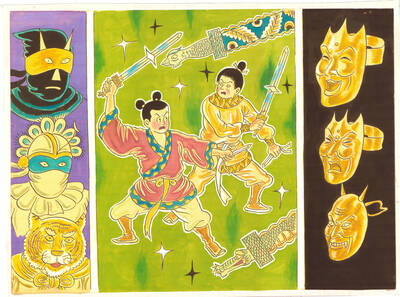
April 22 to April 28 The true identity of the mastermind behind the Demon Gang (魔鬼黨) was undoubtedly on the minds of countless schoolchildren in late 1958. In the days leading up to the big reveal, more than 10,000 guesses were sent to Ta Hwa Publishing Co (大華文化社) for a chance to win prizes. The smash success of the comic series Great Battle Against the Demon Gang (大戰魔鬼黨) came as a surprise to author Yeh Hung-chia (葉宏甲), who had long given up on his dream after being jailed for 10 months in 1947 over political cartoons. Protagonist


 RSS
RSS