


The US should honor its commitment in providing Taiwan the necessary capability to defend itself, Representative Shelley Berkley, co-chairperson of the US House of Representatives’ Taiwan Caucus, said yesterday in Taipei.
“I believe the US must honor its commitment to Taiwan, a very reliable ally and democracy. The commitment regarding arms sales must be honored both by the former and the new administration,” she said.
Recent reports from Washington speculated that Beijing could try to strong arm US Secretary of State Hillary Clinton during her visit China, which begins on Friday, to negotiate for a freer hand with Tibet and Taiwan in exchange for a pledge to cut greenhouse gas emissions.
Berkley said Clinton would never be bullied into anything.
Berkley was named as co-chairperson of the 147-member Taiwan Caucus, an informal congressional organization comprised of lawmakers with an interest in boosting Taiwan-US relations, in January 2007.
The Nevada Democrat is in Taiwan at the invitation of Fu Jen Catholic University to participate in events marking the 30th anniversary of the Taiwan Relations Act (TRA), a US law that is the backbone of US-Taiwan relations.
Berkley plans to propose a House resolution to commemorate the TRA’s anniversary.
President Ma Ying-jeou (馬英九) met Berkley yesterday morning and urged the US government to follow the British government’s recent move to include Taiwan in its visa-waiver program.
Extending such privileges to Taiwan would boost tourism to the US, the persident said, noting that Japan saw an increase of Taiwanese tourists after it granted Taiwanese a 90-day visa free privilege two years ago.
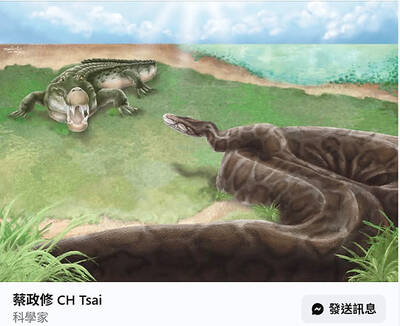
Taiwanese paleontologists have discovered fossil evidence that pythons up to 4m long inhabited Taiwan during the Pleistocene epoch, reporting their findings in the international scientific journal Historical Biology. National Taiwan University (NTU) Institute of Ecology and Evolutionary Biology associate professor Tsai Cheng-hsiu (蔡政修) led the team that discovered the largest snake fossil ever found in Taiwan. The single trunk vertebra was discovered in Tainan at the Chiting Formation, dated to between 400,000 and 800,000 years ago in the Middle Pleistocene, the paper said. The area also produced Taiwan’s first avian fossil, as well as crocodile, mammoth, saber-toothed cat and rhinoceros fossils, it said. Discoveries

Taiwanese paleontologists have discovered fossil evidence that pythons up to 4m long inhabited Taiwan during the Pleistocene epoch, reporting their findings in the international scientific journal Historical Biology. National Taiwan University (NTU) Institute of Ecology and Evolutionary Biology associate professor Tsai Cheng-hsiu (蔡政修) led the team that discovered the largest snake fossil ever found in Taiwan. A single trunk vertebra was discovered in Tainan at the Chiting Formation, dated to between 800,000 to 400,000 years ago in the Middle Pleistocene, the paper said. The area also produced Taiwan’s first avian fossil, as well as crocodile, mammoth, sabre-toothed cat and rhinoceros fossils, it said. Discoveries
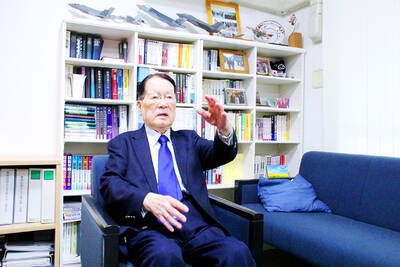
Whether Japan would help defend Taiwan in case of a cross-strait conflict would depend on the US and the extent to which Japan would be allowed to act under the US-Japan Security Treaty, former Japanese minister of defense Satoshi Morimoto said. As China has not given up on the idea of invading Taiwan by force, to what extent Japan could support US military action would hinge on Washington’s intention and its negotiation with Tokyo, Morimoto said in an interview with the Liberty Times (sister paper of the Taipei Times) yesterday. There has to be sufficient mutual recognition of how Japan could provide
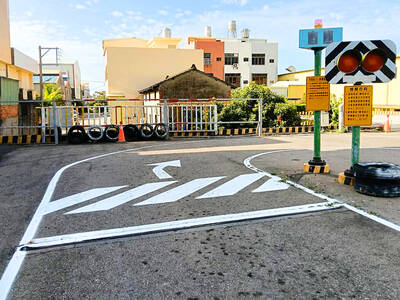
UPDATED TEST: The new rules aim to assess drivers’ awareness of risky behaviors and how they respond under certain circumstances, the Highway Bureau said Driver’s license applicants who fail to yield to pedestrians at intersections or to check blind spots, or omit pointing-and-calling procedures would fail the driving test, the Highway Bureau said yesterday. The change is set to be implemented at the end of the month, and is part of the bureau’s reform of the driving portion of the test, which has been criticized for failing to assess whether drivers can operate vehicles safely. Sedan drivers would be tested regarding yielding to pedestrians and turning their heads to check blind spots, while drivers of large vehicles would be tested on their familiarity with pointing-and-calling


 RSS
RSS