


Charles Darwin’s ideas on evolution changed the face of science forever, but he was a modest, shy man who preferred to stay at home with his work and family than revel in celebrity.
“I have no great quickness of apprehension or wit,” he once wrote. “My power to follow a long abstract train of thought is very limited ... my memory is extensive but hazy.”
Darwin was born on Feb. 12 1809 in Shrewsbury, western England, to a wealthy family — his father was a doctor, one grandfather, Erasmus Darwin, was a noted natural philosopher and another, Josiah Wedgwood, set up a famous pottery.
He was a reluctant student. After school, he went to Edinburgh University to study medicine like his grandfather, father and brother but was bored by lectures and horrified by watching surgery without anesthetic.
He started studying natural history in his own time, taking long walks on beaches near Edinburgh, where he hunted for shells and watched wildlife.
Darwin quit medicine and his furious father sent him to Cambridge University where he studied to be a clergyman, but it was the same story: he was more interested in collecting beetles than hitting the books.
Then his life — and, in no small measure, the history of the world — was turned on its head.
One of his professors recommended him to Robert FitzRoy, captain of HMS Beagle, who wanted a companion for a two-year, round-the-world surveying mission.
The Beagle set sail in 1831, when Darwin was aged 22. The voyage extended to five years, taking in places like Brazil, the Galapagos Islands, Tahiti, New Zealand and Australia.
Despite chronic seasickness, the young man was thrilled.
“My mind has been, since leaving England, in a perfect hurricane of delight and astonishment,” he wrote.
Darwin collected a mountain of flora and fauna specimens, all of which were carefully tagged, and resolved to write a book on his discoveries when he returned home.
The Beagle docked in Britain in 1836 and Darwin, who never ventured abroad again, buried himself in work.
He published Journal of Researches Into the Geology and Natural History of the Various Countries Visited by HMS Beagle, the book which made him famous, in 1839.
But stress began to take its toll and the ill health which dogged him for the rest of his life took hold.
He agonized over whether to get married to ease his anxiety and drew up a list of pros (“constant companion ... better than a dog, anyhow”) and cons (“terrible loss of time”) before concluding he must wed.
He married his cousin Emma Wedgwood in 1839 after a quick courtship. Theirs was a contented union that produced 10 children.
After his Beagle voyage, Darwin became more and more convinced that species were not static but evolved, and that this process was molded by individuals who had adapted best to their habitat.
He was finally forced to make his ideas public after another naturalist, Alfred Russel Wallace, wrote to him in 1858 outlining ideas similar to his own.
Darwin was stunned, but it was decided that the two men’s theories should be made public side-by-side at a London scientific society.
He then condensed his theories into On the Origin of Species, published in 1859.
The book was a massive popular success, prompting widespread debate, angry opposition from theologians and references to Darwin in a slew of cartoons, songs and advertisements.
His fame grew further with The Descent of Man in 1871. It argued that Man and ape shared a common ancestor and expounded on the theory of sexual selection — that certain traits such as strength and good looks improve an individual’s success at mating.
Darwin was endowed with extraordinary patience and diligence, as well as a mental agility enabling him to see both fine detail and the big picture.
But he also had the luck to have independent wealth, which gave him the time to research and reflect, and to be living in Victorian England, within a train ride from academies and institutions in London, then the world’s scientific hub.
“He was a quintessential British amateur in the best possible sense,” said German historian Wilfried Rogasch. “He had the means and the time and the intellectual capacity to follow what was going on.”
Darwin died in 1882, aged 73. Typically, he wanted to be buried near his beloved home, Down House in Kent, southeast of London, but his contemporaries campaigned for a grander send-off.
His funeral was at London’s Westminster Abbey, also his final resting place.

In late October of 1873 the government of Japan decided against sending a military expedition to Korea to force that nation to open trade relations. Across the government supporters of the expedition resigned immediately. The spectacle of revolt by disaffected samurai began to loom over Japanese politics. In January of 1874 disaffected samurai attacked a senior minister in Tokyo. A month later, a group of pro-Korea expedition and anti-foreign elements from Saga prefecture in Kyushu revolted, driven in part by high food prices stemming from poor harvests. Their leader, according to Edward Drea’s classic Japan’s Imperial Army, was a samurai

The following three paragraphs are just some of what the local Chinese-language press is reporting on breathlessly and following every twist and turn with the eagerness of a soap opera fan. For many English-language readers, it probably comes across as incomprehensibly opaque, so bear with me briefly dear reader: To the surprise of many, former pop singer and Democratic Progressive Party (DPP) ex-lawmaker Yu Tien (余天) of the Taiwan Normal Country Promotion Association (TNCPA) at the last minute dropped out of the running for committee chair of the DPP’s New Taipei City chapter, paving the way for DPP legislator Su

It’s hard to know where to begin with Mark Tovell’s Taiwan: Roads Above the Clouds. Having published a travelogue myself, as well as having contributed to several guidebooks, at first glance Tovell’s book appears to inhabit a middle ground — the kind of hard-to-sell nowheresville publishers detest. Leaf through the pages and you’ll find them suffuse with the purple prose best associated with travel literature: “When the sun is low on a warm, clear morning, and with the heat already rising, we stand at the riverside bike path leading south from Sanxia’s old cobble streets.” Hardly the stuff of your
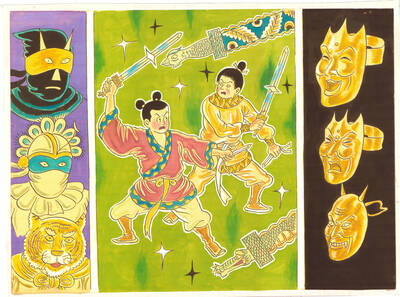
April 22 to April 28 The true identity of the mastermind behind the Demon Gang (魔鬼黨) was undoubtedly on the minds of countless schoolchildren in late 1958. In the days leading up to the big reveal, more than 10,000 guesses were sent to Ta Hwa Publishing Co (大華文化社) for a chance to win prizes. The smash success of the comic series Great Battle Against the Demon Gang (大戰魔鬼黨) came as a surprise to author Yeh Hung-chia (葉宏甲), who had long given up on his dream after being jailed for 10 months in 1947 over political cartoons. Protagonist


 RSS
RSS