


Hacienda Napoles was once the playground of the world’s most notorious drug lord, a bacchanalian expression of criminal wealth and power, but today it stands as a monument to his extinction.
Pablo Escobar used this 1,500-hectare ranch in central Colombia in the 1980s to host wild parties and strike business deals, as well as to house his collection of exotic animals — and fake, life-size dinosaurs.
Colombian authorities hunted down and killed the billionaire narco-trafficker in 1993 and now the hacienda embodies his downfall. The mansion is gutted, the swimming pools are empty and the site has been turned into a heritage park and zoo. Tourists flock here to gawk at the ruins of one man’s hubris.
An exhibition of photographs, culminating in Escobar’s bloodied, chubby corpse sprawled on a Medellin rooftop, is titled Triumph of the State. A museum narrative tells how Colombia overthrew the drug lord and was reborn with “new values.”
In a surreal touch, speakers hidden in tree stumps fill the air with dinosaur moans and roars. The message is clear: Escobar and his kind are gone.
“That’s all history now. I’m actually more interested in seeing the animals than Escobar’s old stuff,” said Eduardo Torres, 22, a tourist, while feeding carrots to a hippo.
Recent events, however, suggest Escobar’s legacy is far from extinct. A new generation of narco-traffickers has emerged and energetically applied his strategy of corrupting politicians and security forces to smooth cocaine’s passage overseas.
“After the death of Pablo Escobar we were told that the days of the big capos were over. That was clearly a lie,” said Gustavo Duncan, a political analyst and researcher into the social and political impact of drug trafficking in Colombia.
A host of investigations is under way into politicians’ links with the lucrative trade, a corrupt web that reportedly reaches senior government ranks.
This month a US congressional report concluded that nearly US$5 billion in aid to Bogota, a central plank in Washington’s “war on drugs,” had failed in its goal of halving illegal narcotic production in Colombia. Coca cultivation rose by 15 percent and cocaine production rose by 4 percent from 2000 to 2006. The South American nation remained the source of 90 percent of cocaine in the US.
“I think it’s very, very important that a US agency has now said that the US drug war has failed in Colombia,” Adam Isacson, of the Centre for International Policy, a Washington-based thinktank, told the Associated Press.
Escobar’s heirs have learned from his mistake in openly challenging the state. Whereas Escobar flaunted his wealth and intimidated opponents with car bombs, massacres and high-profile assassinations, his successors are lower-profile.
Cocaine barons such as Daniel Rendon (known as Don Mario) and Daniel Barrera (El Loco) account for much if not most of the 600 tonnes shipped annually, a scale that matches the heyday of Medellin’s most infamous son.
The capacity to move that volume “can only exist where there is high-level corruption,”
said Duncan.
The evidence is mounting. In September, in a huge embarrassment to the government, Medellin’s top prosecutor, Guillermo Valencia Cossio, was arrested on charges of colluding with Don Mario. Valencia happened to be the brother of the justice minister.
Earlier this month President Alvaro Uribe, under pressure to crack down, questioned the army’s lack of progress against El Loco’s organization. “I ask is the army capable of capturing [him] or if it is protecting him.”
The scandals have cast a shadow over Colombia’s success in taming the violence that once made its cities synonymous with mayhem. Urban regeneration projects have transformed slums and won international plaudits. The turnaround is expressed in a tourism campaign slogan: “The only risk is that you’ll stay.”
Medellin, Escobar’s former fiefdom, is supposed to be the Renaissance jewel: a safe city with an impressive new cable-car system and daring architecture. “My God, things are so much quieter now. It’s a lovely place to live,” said Sonia Vargas, 34, who sells snacks in a once-notorious hillside slum.
But analysts said the violence subsided in recent years largely because a cocaine baron, Diego Murillo, won undisputed control through government-linked paramilitary groups.
Murillo was extradited to the US in May, leaving a vacuum which his rival, Don Mario, has tried to fill, triggering a renewed wave of violence. By September murders were up 35.5 percent to 735 from the same period last year, according to the mayor’s office. Rattled, the authorities have launched a media campaign with a slogan which sounds like a plea: “Violence will not return to my city.”
The city retains a sneaking regard for the one-time car thief who rose to became a charismatic, if psychotic, billionaire. It is not forgotten that Escobar built houses for the poor and distributed Christmas toys.
Taxi drivers display stickers with the familiar, chubby features and most people refer to him as Pablo. Flower-sellers do brisk business on the anniversary of his death, Dec. 2, when crowds visit the grave.
Out at Hacienda Napoles, his rural retreat, nostalgia is blossoming. At the entrance, Escobar used to display, on a pedestal, the single-engine Piper Cub plane that flew his first cocaine shipments. It disappeared long ago but earlier this month a replica took its place.
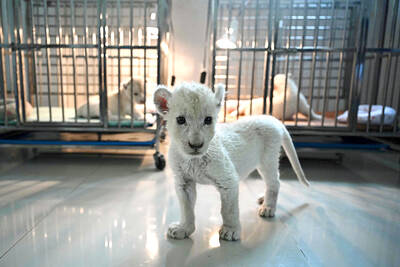
Behind a car repair business on a nondescript Thai street are the cherished pets of a rising TikTok animal influencer: two lions and a 200-kilogram lion-tiger hybrid called “Big George.” Lion ownership is legal in Thailand, and Tharnuwarht Plengkemratch is an enthusiastic advocate, posting updates on his feline companions to nearly three million followers. “They’re playful and affectionate, just like dogs or cats,” he said from inside their cage complex at his home in the northern city of Chiang Mai. Thailand’s captive lion population has exploded in recent years, with nearly 500 registered in zoos, breeding farms, petting cafes and homes. Experts warn the

The unexpected collapse of the recall campaigns is being viewed through many lenses, most of them skewed and self-absorbed. The international media unsurprisingly focuses on what they perceive as the message that Taiwanese voters were sending in the failure of the mass recall, especially to China, the US and to friendly Western nations. This made some sense prior to early last month. One of the main arguments used by recall campaigners for recalling Chinese Nationalist Party (KMT) lawmakers was that they were too pro-China, and by extension not to be trusted with defending the nation. Also by extension, that argument could be
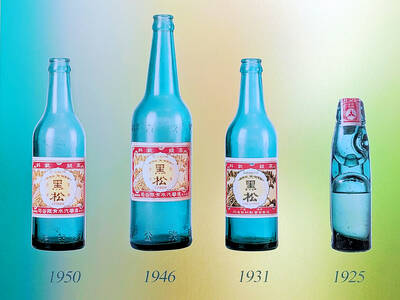
Aug. 4 to Aug. 10 When Coca-Cola finally pushed its way into Taiwan’s market in 1968, it allegedly vowed to wipe out its major domestic rival Hey Song within five years. But Hey Song, which began as a manual operation in a family cow shed in 1925, had proven its resilience, surviving numerous setbacks — including the loss of autonomy and nearly all its assets due to the Japanese colonial government’s wartime economic policy. By the 1960s, Hey Song had risen to the top of Taiwan’s beverage industry. This success was driven not only by president Chang Wen-chi’s

Last week, on the heels of the recall election that turned out so badly for Taiwan, came the news that US President Donald Trump had blocked the transit of President William Lai (賴清德) through the US on his way to Latin America. A few days later the international media reported that in June a scheduled visit by Minister of National Defense Wellington Koo (顧立雄) for high level meetings was canceled by the US after China’s President Xi Jinping (習近平) asked Trump to curb US engagement with Taiwan during a June phone call. The cancellation of Lai’s transit was a gaudy


 RSS
RSS