

Like Korean barbeque and hot-pot restaurants, GinzaCha-Ya (銀座茶屋), located in the food court of Sogo’s Fuxing branch, gives diners the satisfying feeling of having a hand in the creation of their own meal. The do-it-yourself process at GinzaCha-Ya is much more simple, however, and does not require grills or open flames — perfect if you want a fairly quick meal or are dining with a pyromaniac who you do not want to expose to temptation. Most dishes on the menu come in sets called huai shi cha shan (懷石茶膳), a poetic phrase that literally translates into “tea-bowl meal.”
GinzaCha-Ya’s tea-bowl sets are served in pretty Japanese-style ceramic dishware neatly laid out on a wooden tray. Each bowl is filled with an elegantly presented assortment of rice, meat or fish, veggies and other ingredients, and accompanied by a teapot filled with a savory broth that has a very delicate tea aroma, a small dish of seasonal pickled fruit or vegetables, and a slice of silky tofu in a tangy sesame oil and vinegar sauce.
Your server will instruct you to pour as much broth into the bowl as you like, add slices of scallion and bits of wasabi paste for seasoning, and then gently mix the contents with a small wooden stirring spoon. The result resembles Taiwanese congee, or zhou (粥), which is thinner than its porridge-like Cantonese cousin. The difference between congee and GinzaCha-Ya’s tea bowl sets, however, is the novelty and the quality of the ingredients.
My dining companion ordered the chicken and wild greens set (雞野菜茶膳, NT$180), which comes with lightly-seasoned white rice, chicken stuffed with imitation crab and carrots, a slice of soft, sweet fish tempura, a small piece of egg omelet and an assortment of green vegetables and mushrooms. After the broth was poured in, the mixture resembled (as one would expect) chicken soup. The flavor was richer and more savory than my selection, the mentaiko set (明太子水茶膳, NT$190) — two seasoned rice balls, slightly browned so that the outsides are crispy; several spoonfuls of coral-colored mentaiko, the paste-like marinated roe of pollock fish; vegetables; and seafood-flavored broth. I emptied my entire teapot into the bowl and was sorry because the delightfully salty little eggs of the mentaiko were cast adrift in the broth and therefore hard to taste. Aside from that culinary tragedy, I enjoyed the crisped rice, which became satisfyingly firm to the bite when soaked. Seafood lovers should also try the grilled salmon set (燒鮭魚肚茶膳), which at NT$280 is GinzaCha-Ya’s most expensive tea-bowl set, but comes with generous helpings of fish and salmon roe.
For an extra NT$70, we got a pot of oolong tea and a creme brulee-like custard at the end of our meal. The very rich and very creamy custard was delicious, but if you have a less-pronounced sweet tooth, you might find it too heavy a finish to the delicate flavors in GinzaCha-Ya’s tea bowls. Meal portions are relatively light and diners should not expect to emerge stuffed — which is a plus if you plan to go shopping in Sogo’s boutiques.
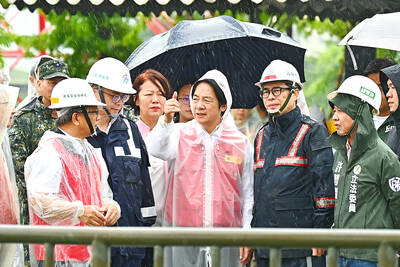
The flooding in Kaohsiung after the recent torrential rains has become an issue for mayoral candidates of both major parties. Chinese Nationalist Party (KMT) Kaohsiung mayoral candidate Ko Chih-en (柯志恩) brought in hydraulic-engineering professor Lee Hong-yuan (李鴻源), who called for comprehensive flood control measures on the Dianbao Creek (典寶溪), according to local media. Ko attacked the Democratic Progressive Party (DPP) for being behind on flood control measures, but as the city administration observed, there are many weaknesses in how the government can mitigate extreme rainfall. Nor is the river entirely under the management of the city. The low-lying Dianbao River
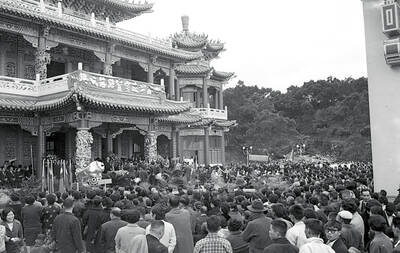
Aug. 31 to Sept. 6 More than 3 million people visited Taipei’s Zhinan Temple (指南宮) in 1973, making it Taiwan’s second-most visited scenic area that year. Built in 1891, the temple had been a tourist destination since the Japanese colonial period, when visitors had to initially take a ferry across the Jingmei River before climbing a winding trail up Houshan (猴山). Its popularity was reflected in popular media. The 1932 tune New Song of the Black Cat and Black Dog (新烏貓烏狗歌) depicted two lovers who prayed at the temple for their marriage. The man

Taiwan Power Co (Taipower, 台電) chairman Tseng Wen-sheng (曾文生) uses a sports metaphor to describe the density of electricity demand. A household is a ping-pong ball, ordinary industry a baseball and a science park a bowling ball. A data center is a shot put. Taiwan is preparing for the shot puts. Four new combined-cycle units at Hsinta (興達) and Taichung (台中), with combined capacity of about 5.2GW, are scheduled to begin supplying or testing on the grid by the end of this year. The Energy Administration’s (能源署) plan adds about 25.98GW of gas-fired capacity between this year and 2035, predominantly fueled
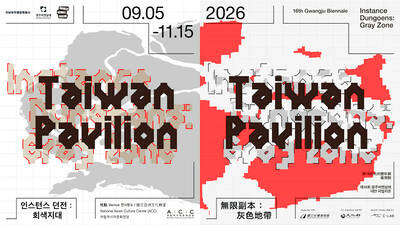
The name “Taiwan” is to appear at South Korea’s Gwangju Biennale when it opens on Saturday, after months of objections from Taiwanese artists and government agencies over an attempted name change. China Pavilion personnel halted installation and left the venue on Friday, after China’s Ambassador to South Korea Dai Bing (戴兵) objected to the restoration of the “Taiwan Pavilion” name. As of Monday, the Chinese side was reportedly preparing to withdraw, although its formal withdrawal had not been completed. The pavilion dispute began on June 10, when the ministry and participating artists said organizers had changed “Taiwan Pavilion” to “NTMoFA Pavilion,” referring


 RSS
RSS