


It was almost impossible to fault the marvelous operatic double bill from the Taipei Symphony Orchestra (TSO) on Friday evening. Gianni Schicchi in particular shone out as the masterpiece it is, but even the slighter Il Segreto di Susanna was delightful throughout. In particular, Wu Bai Yu-Hsi (巫白玉璽) excelled himself in both the leading male roles. Vocally he has always been unimpeachable, but this time his acting attained new heights as well. As the crafty Gianni he was ideal, and when he broke into a dance of elation with the relatives he was about to trick you felt he was genuinely happy even so, just as he had been genuinely moved by his daughter’s famous appeal. His hasty and emphatic dictating of all the final bequests to himself was unforgettable. This was a richly complex interpretation from every angle.
Yang Lei (楊磊), singing out with real vigor and conviction as the young lover Rinuccio, also deserves the highest praise. His voice had never sounded better, and this seemed a high point of his singing career. Chen Pei-Chi (陳珮琪) as Zita and Liao Chong-boon (廖聰文) as Simone had fewer opportunities to display their powers in this compact work, but both were very strong nonetheless, and ideally cast. Julian Lo (羅俊穎) as Betto added his strong bass voice in stalwart support throughout. And if Lo Ming-fang (羅明芳) as Lauretta slightly lacked power in O Mio Babbino Caro, she missed nothing of the famous aria’s expressiveness and tenderness.
Marti Fischer-Dieskau deserves the highest praise for his commitment and discretion as conductor. The TSO has never sounded better, and every detail of the subtle and innovative score could be heard clearly in the fine acoustic of Taipei’s Metropolitan Hall. Everything was ideal, from the tempi — never eccentric — to the gorgeously rich fortes and crystal-clear pianissimos.
All in all, this production by Tseng Dau-hsiong (曾道雄) was a stunning occasion. The set by Chang Yi-cheng (張一成) for Gianni Schicchi proved as effective as her one for Il Sigreto, with the dawn over Florence seen through a high window a fitting background for the lovers’ final mini-duet. The costumes of Kao Yu-po (高育伯), both historically authentic and sumptuously made, were indicative of a major talent.
This glorious double-bill was an occasion to treasure. The more operas TSO can stage in the future the better.
At the National Concert Hall last Friday, Taipei got a taste of living jazz history as pianist McCoy Tyner and his ensemble played a 90-minute set that came across as both a show of technical mastery and onstage musical journey.
The audience erupted with cheers and applause when Tyner appeared on stage and took a gracious bow. The room was silent as he walked gingerly to the Steinway grand piano. The 69-year-old Tyner looked gaunt and thin in contrast to his press photos. But any appearance of frailness faded immediately as Tyner and his ensemble launched into Walk Spirit, Talk Spirit. Right away the audience could see Tyner’s left hand bouncing as high as his head, as he pounded out his signature rhythmic flourishes on the piano.
Christian Scott, a 25-year-old rising star trumpeter from New Orleans, laid out the tune’s melodic theme with smooth, understated riffs. Stationed at the side of the stage, he ambled over to the microphone in the center for solos, with a gait full of bravado and a hint of youthful insecurity.
After the first number, Tyner picked up a microphone to greet the audience. In a quiet baritone voice, he said it was an honor to have played with John Coltrane, and led the band through the legendary saxophonist’s composition A Moment’s Notice. Scott again featured as the lead voice, and by then his cool exterior had melted: he beamed and shook his head slightly, as if in humble awe at Tyner’s lush, inspired soloing.
The show only grew in intensity, with energetic, masterful performances from bassist Gerald Cannon and drummer Eric Gravatt. The veteran musicians created exquisitely textured rhythms, to which Tyner added dramatic splashes of dissonant chords and lines of notes that ranged from sparse to overflowing. The result was a cerebral, elegant sound. Tyner and the group developed abstracted melodies and challenging harmonies, but housed them in tight, crisp structures — even the silences that sometimes marked solos were perfectly timed.
The remaining songs were unfamiliar to this reviewer, but the music was unmistakably familiar: it was driven and had the excitement that marked Tyner’s tenure with the John Coltrane Quartet. The tunes ran a gamut of emotions: one piece grew into a sonic frenzy, which was then tempered by a ballad; there was also a straightforward, be-bop blues number. But throughout, there was always a sense of musical exploration, as well as joy on stage, evident as the musicians frequently broke into smiles.

In late October of 1873 the government of Japan decided against sending a military expedition to Korea to force that nation to open trade relations. Across the government supporters of the expedition resigned immediately. The spectacle of revolt by disaffected samurai began to loom over Japanese politics. In January of 1874 disaffected samurai attacked a senior minister in Tokyo. A month later, a group of pro-Korea expedition and anti-foreign elements from Saga prefecture in Kyushu revolted, driven in part by high food prices stemming from poor harvests. Their leader, according to Edward Drea’s classic Japan’s Imperial Army, was a samurai

The following three paragraphs are just some of what the local Chinese-language press is reporting on breathlessly and following every twist and turn with the eagerness of a soap opera fan. For many English-language readers, it probably comes across as incomprehensibly opaque, so bear with me briefly dear reader: To the surprise of many, former pop singer and Democratic Progressive Party (DPP) ex-lawmaker Yu Tien (余天) of the Taiwan Normal Country Promotion Association (TNCPA) at the last minute dropped out of the running for committee chair of the DPP’s New Taipei City chapter, paving the way for DPP legislator Su
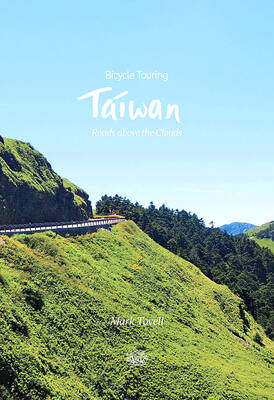
It’s hard to know where to begin with Mark Tovell’s Taiwan: Roads Above the Clouds. Having published a travelogue myself, as well as having contributed to several guidebooks, at first glance Tovell’s book appears to inhabit a middle ground — the kind of hard-to-sell nowheresville publishers detest. Leaf through the pages and you’ll find them suffuse with the purple prose best associated with travel literature: “When the sun is low on a warm, clear morning, and with the heat already rising, we stand at the riverside bike path leading south from Sanxia’s old cobble streets.” Hardly the stuff of your
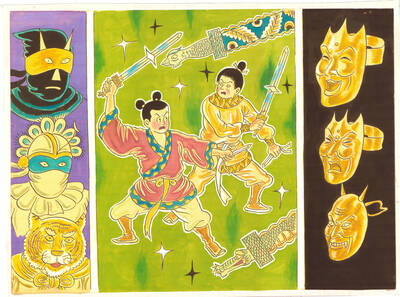
April 22 to April 28 The true identity of the mastermind behind the Demon Gang (魔鬼黨) was undoubtedly on the minds of countless schoolchildren in late 1958. In the days leading up to the big reveal, more than 10,000 guesses were sent to Ta Hwa Publishing Co (大華文化社) for a chance to win prizes. The smash success of the comic series Great Battle Against the Demon Gang (大戰魔鬼黨) came as a surprise to author Yeh Hung-chia (葉宏甲), who had long given up on his dream after being jailed for 10 months in 1947 over political cartoons. Protagonist


 RSS
RSS