


Some people march to protest their government. Gorki Luis Aguila Carrasco, the lead singer of a Cuban punk rock group called Porno para Ricardo (“Porn for Ricardo”), vents his discontent by gyrating at a microphone, clutching an electric guitar and spewing out some of the most off-color, ear-splitting lyrics around.
Amid the string of expletives that he bellows in his underground concerts in and around Havana are bold criticisms of Fidel and Raul Castro, the past and present leaders of the island. So outspoken has he become that the authorities recently charged him with “social dangerousness” and hauled him off to jail.
Turns out, though, he will sing again. After his detention drew international outrage, including a condemnation from US President George W. Bush’s administration, the Cuban authorities dropped the charge, which could have led to four years in prison. Instead they convicted him of public disorder and fined him 600 pesos, or US$28 — more than a month’s salary in Cuba.
“I feel even more hate for this tyranny,” Gorki, as he is universally known, said to reporters after he was freed. He then likened his release to walking from a small jail cell into a larger one.
With a mane of curly black hair that is as wild as his persona, Gorki is by no means the only outspoken artist in Cuba. Other rebellious singers and painters, though, are more discreet when it comes to the upper crust of the Cuban leadership. They criticize the system in a way that does not get too personal.
Not so Gorki, who rails against Cuban communism, scoffs at the revolution and lambastes in no uncertain terms Fidel Castro, who turned 82 last month, and his younger brother, Raul, 77, the longtime defense minister who took over the presidency in February after Fidel fell ill. And Gorki does all of it in a near scream.
“The Comandante holds elections, which he’s invented to keep power,” he says of Fidel Castro in El Comandante, one of his signature songs. “The Comandante wants me to go vote so he can keep (expletive) my life.”
In a shout, he sings: “The Comandante wants me to work and he pays me a miserable salary. The Comandante wants me to applaud after he’s spoken his delirious (expletive). Don’t eat (expletive), Comandante, for you are a tyrant and no one can stand you.”
Gorki has received backing from more traditional critics of the government, such as Elizardo Sanchez, who leads an unauthorized human rights group that Havana tolerates, and Yoani Sanchez, an outspoken blogger who wrote recently of Gorki, “he sings, sways and shouts in his bloody rock lyrics what others mutter with fear.”
The Cuban government has remained quiet about Gorki’s recent legal troubles. Some supporters have spoken up, though. Walter Lippmann, an American who runs an e-mail news service that collects material critical of Washington’s embargo on Cuba, recently wrote, “He helps clarify the precise meaning of the word ‘punk’ in the term ‘punk rock.’”
Gorki’s recent jail stint was not his first. In 2003 he was convicted on a drug charge and spent nearly two years in custody. He condemns that arrest as a setup by a young woman who pretended to be a fan but really worked for state security. In that case, he emerged from custody even angrier than before.
A self-taught musician and the father of a preteen girl, Gorki, 39, once told an interviewer that he grew up listening to American and British rock, particularly Deep Purple, Led Zeppelin and the Clash. “My dad never liked rock ’n’ roll,” he said, “and since he knew that this type of music brought me problems, he used to advise me to listen to other bands.”
His mother, an outspoken critic of the government, and his older sister left Cuba years ago for Mexico. Gorki married while he was in jail in 2003 so that he and his wife could have conjugal visits. They are separated now but share time with their 12-year-old daughter, Gabriella. “I try to tell her who I am, why I say the things I say,” he said.
A decade ago, he organized Porno para Ricardo — named for a friend who loved pornography but could not get enough of it because of a government ban.
At a recent concert Ricardo himself, a 50-ish man who dresses like a transient, arrived pushing a bicycle and carrying a half-empty bottle of rum. He quickly became the life of the party.
Gorki’s words are not the only rebellious thing about him. He had his nose pierced and often wears a T-shirt that calls 1959, the year of the Cuban revolution, a “year of error.” He was named after Maxim Gorky, the Russian author and founder of literary Socialist Realism.
The band’s raucous rehearsals take place in the small apartment in the Playa neighborhood of Havana that Gorki shares with his 75-year-old father, Luis. The place is devoid of furniture, and the room in the back where the band gathers has egg boxes on the walls to help reduce the noise.
Concerts are held on the sly. Word of the next performance is spread through text messages or whispers. A few months back, it was in a remote location on the outskirts of the capital.
The group arrived at 5pm to warm up. A few hours later nearly 100 people had gathered, most of them young counterculture types who knew the words to song after song.
One of the teenagers in the crowd, who wore a Nirvana T-shirt, identified himself only as Daniel and said he was an aspiring punk rocker himself. Porno para Ricardo is one of the few bands in Cuba that has the guts to tell the truth, he said.
The group played for about two hours, taking one short break to allow a band member, Herbert Dominguez, to vomit off to the side — the result, it appeared, of too much rum.
“I am against everything that limits my personal liberty,” Gorki declared in an interview this year. “The level of unpopularity of the Castro tyranny is so great. It’s obvious. You breathe it. It’s dense. But the people are afraid.”
Gorki does not appear afraid. His recent songs include one called Dinosaurs, which refers to the Cuban leadership. Another, El General, lambastes Raul Castro as a farce. After his release from prison, he told a reporter that he was at work on a follow-up to El Comandante, the song about Fidel Castro, which will be called El Comandante II.
Although Gorki is the front man, his fellow band members — Ciro Diaz Penedo on guitar, Renay Kayrus on drums and Dominguez on bass — are similarly rebellious. As a logo for their group, they use a Soviet hammer and sickle transformed into a pornographic image.
While Gorki was in jail, Diaz attended a concert of Pablo Milanes, a noted and far more conventional singer-songwriter, to press for his bandmate’s release. He and some friends unveiled a banner that said “GORKI” and began shouting the singer’s name. A dozen or more men in plain clothes moved in quickly, according to witnesses, pummeled Diaz and another man and whisked them away to a police station for questioning.
That episode prompted a response from the Bush administration, which has made no secret of its disdain for the Castro brothers.
“We condemn the regime’s violent attack on peaceful concert-goers and arrest of Mr Aguila,” Commerce Secretary Carlos Gutierrez, who left Cuba as a boy with his family in 1960, said of Gorki. Gutierrez said the authorities’ actions violated the UN International Covenant on Civil and Political Rights, which Raul Castro signed just days after replacing Fidel in February.
Left unsaid by Gutierrez was whether he had ever listened to Gorki’s music.
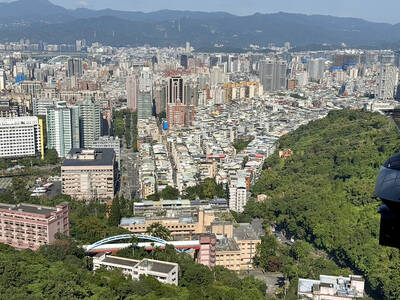
A recent report from the Environmental Management Administration of the Ministry of Environment highlights a perennial problem: illegal dumping of construction waste. In Taoyuan’s Yangmei District (楊梅) and Hsinchu’s Longtan District (龍潭) criminals leased 10,000 square meters of farmland, saying they were going to engage in horticulture. They then accepted between 40,000 and 50,000 cubic meters of construction waste from sites in northern Taiwan, charging less than the going rate for disposal, and dumped the waste concrete, tile, metal and glass onto the leased land. Taoyuan District prosecutors charged 33 individuals from seven companies with numerous violations of the law. This

As mega K-pop group BTS returns to the stage after a hiatus of more than three years, one major market is conspicuously missing from its 12-month world tour: China. The omission of one of the group’s biggest fan bases comes as no surprise. In fact, just the opposite would have been huge news. China has blocked most South Korean entertainment since 2016 under an unofficial ban that also restricts movies and the country’s popular TV dramas. For some Chinese, that means flying to Seoul to see their favorite groups perform — as many were expected to do for three shows opening
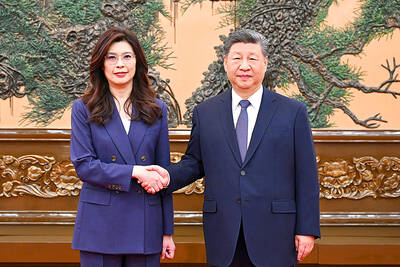
What is the importance within the Chinese Nationalist Party (KMT) of the meeting between Xi Jinping (習近平), the leader Chinese Communist Party (CCP), and Cheng Li-wun (鄭麗文), the leader of the KMT? Local media is an excellent guide to determine how important — or unimportant — a news event is to the public. Taiwan has a vast online media ecosystem, and if a news item is gaining traction among readers, editors shift resources in near real time to boost coverage to meet the demand and drive up traffic. Cheng’s China trip is among the top headlines, but by no means
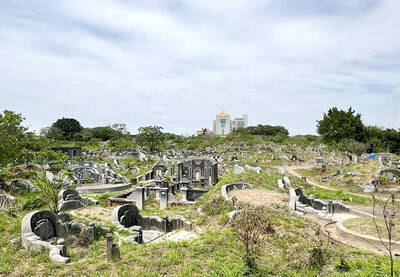
Apr. 13 to Apr. 19 From 17th-century royalty and Presbyterian missionaries to White Terror victims, cultural figures and industrialists, Nanshan Public Cemetery (南山公墓) sprawls across 95 hectares, guarding four centuries of Taiwan’s history. Current estimates show more than 60,000 graves, the earliest dating to 1642. Besides individual tombs, there are also hundreds of family plots, one of which is said to contain around 1,000 remains. As the cemetery occupies valuable land in the heart of Tainan, the government in 2018 began asking families to relocate the graves to make way for development. That


 RSS
RSS