


On a recent Monday afternoon, as the ballyhooed new designs of Gap’s fall collection by Patrick Robinson began appearing at its store on Fifth Avenue and 54th Street, a line of customers stretched well around the corner — at Abercrombie & Fitch, that is, two blocks away.
Fashion magazines have heralded the recent arrival of Robinson at Gap in reverential tones (he is actually called a “megabrand messiah” in the September issue of Elle), and the windows announce in big block letters that a “New Shape” is in store. But there has not yet been a seismic return of shoppers to a retail chain that stopped being cool around the time Abercrombie opened its doors with a reinvented brand.
Inside the Gap store, a few dozen customers were trying on US$58 waffle-knit cardigans and blazers made of fleece. But for a better picture, one could stand outside on the street corner for 15 minutes and count shopping bags: six from Gap, 27 from Abercrombie. The following day: eight from Gap, 38 from Abercrombie.
Reinventing Gap, the US’ largest specialty apparel chain, has been fashion’s equivalent of Merlin’s stone for much of the last decade, as sales and profits have dipped, along with its image among young consumers. Robinson, 41, is the third designer to attempt to pull the sword since Gap began to publicly acknowledge its creative personnel in 2003, and the most closely watched because of his popularity with industry insiders and his finesse with casual American sportswear. His fall designs have generated promising reviews, but also concern about whether a single designer — one with a mixed track record — can revive a brand with 1,155 stores in the US in the midst of an economic crisis.
On the one hand, the company has continued to report weak sales, including an 11 percent drop last month in stores open at least a year, and last week, Brand Keys, a research consultancy, announced that Gap ranked last in customer loyalty. On the other, some retail analysts long critical of Gap’s merchandising efforts and management choices have joined the chorus that is singing Robinson’s praises.
“I just about died when I went in the store,” said Jennifer Black, the president of Jennifer Black & Associates, a research company focused on the apparel industry. “I don’t know how traffic’s been, but from an aesthetic perspective, I think it looks great. For me to be taken aback is kind of a big thing.”
The clothes are indeed compelling. The trench coat and shirtdress styles and the muted colors — a variety of grays, browns and purple plaid — are at once basic and fashionable, a duality that could be either girly and pretty or androgynous in an Oliver Twist goes to a Nirvana concert sort of way. But will customers, especially those who look to Gap for jeans and T-shirts, get it?
In an interview in the Gap showroom in Chelsea last week, Robinson said he could best describe his vision for Gap as one of “optimism,” keying into an emotion conveyed by the company’s past advertising campaigns that spotlighted bright colors and made wearing khaki seem like a swingy choice. Having grown up in California, he recalled shopping at Gap stores and thinking how cool the white gallerylike spaces were. While he wanted to recapture that feeling, he said, the styles, fits and colors — even the weight of the T-shirt fabrics — all had to be changed. “We can’t go back and put women in big old heavy sweatshirts,” he said. “That was Gap in the 80s.”
Throughout his career, Robinson has demonstrated a single-mindedness about image control, including his own.
But at Gap, Robinson said, he is comfortable working within a large corporate environment. That said, he has continued to assert the need for creative control: last week the company dismissed its European design staff, adding the duties for creating lines for international markets to Robinson’s purview. The move raised eyebrows among those who have wondered whether ego had caused his problems at Perry Ellis and Paco Rabanne. But Robinson said the hoopla had not made any difference to the success of his collections.
Gary Muto, the president of Gap’s adult and body divisions, said Robinson’s arrival at the company had revitalized its design staff, describing the difference as “night and day.” Part of the reason is that the designs are selling, he said, citing a deep V-neck shirt and pull-on skirt introduced this summer as an illustration of how classic clothes could be fashionably updated.
“Where we’re going to win is with those items that are truly versatile, that a person can dress up or dress down and still be able to express their own personal style,” he said.
Robinson has demonstrated that he is a versatile designer, and one who has learned when to let the product speak louder than the personality.
“Speaking honestly, when I was younger, I really wanted the fame thing,” he said. “It was part of the game of being a fashion designer. But that doesn’t turn me on anymore. What turns me on — my soul — is making cool clothes and being part of a company where I can actually see the difference I’m making. I’m not just spinning my wheels and getting the clothes into five stores in America.”
One thing that stands out about Robinson’s collection for Gap is how similar it looks to his work for Perry Ellis, with loose popover plaid dresses, sleeveless wool jackets and cropped cargo pants in mushroomy grays, layered up with artsy knits — clothes that fashion editors had clamored about back then but customers never had a chance to buy. Now anyone can at Gap, even those who have never heard of Robinson.
“It’s definitely a major improvement,” said Rie Cochran, a 21-year-old secretary from Marshall, Michigan, as she left the Fifth Avenue store. “It’s chic, but still subdued.”
Nevertheless, she walked out empty-handed.

In late October of 1873 the government of Japan decided against sending a military expedition to Korea to force that nation to open trade relations. Across the government supporters of the expedition resigned immediately. The spectacle of revolt by disaffected samurai began to loom over Japanese politics. In January of 1874 disaffected samurai attacked a senior minister in Tokyo. A month later, a group of pro-Korea expedition and anti-foreign elements from Saga prefecture in Kyushu revolted, driven in part by high food prices stemming from poor harvests. Their leader, according to Edward Drea’s classic Japan’s Imperial Army, was a samurai

The following three paragraphs are just some of what the local Chinese-language press is reporting on breathlessly and following every twist and turn with the eagerness of a soap opera fan. For many English-language readers, it probably comes across as incomprehensibly opaque, so bear with me briefly dear reader: To the surprise of many, former pop singer and Democratic Progressive Party (DPP) ex-lawmaker Yu Tien (余天) of the Taiwan Normal Country Promotion Association (TNCPA) at the last minute dropped out of the running for committee chair of the DPP’s New Taipei City chapter, paving the way for DPP legislator Su

It’s hard to know where to begin with Mark Tovell’s Taiwan: Roads Above the Clouds. Having published a travelogue myself, as well as having contributed to several guidebooks, at first glance Tovell’s book appears to inhabit a middle ground — the kind of hard-to-sell nowheresville publishers detest. Leaf through the pages and you’ll find them suffuse with the purple prose best associated with travel literature: “When the sun is low on a warm, clear morning, and with the heat already rising, we stand at the riverside bike path leading south from Sanxia’s old cobble streets.” Hardly the stuff of your
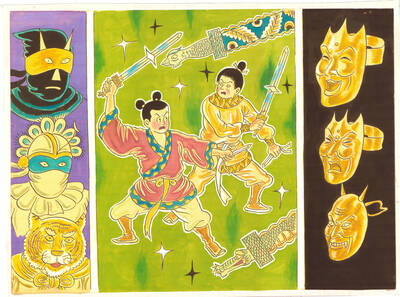
April 22 to April 28 The true identity of the mastermind behind the Demon Gang (魔鬼黨) was undoubtedly on the minds of countless schoolchildren in late 1958. In the days leading up to the big reveal, more than 10,000 guesses were sent to Ta Hwa Publishing Co (大華文化社) for a chance to win prizes. The smash success of the comic series Great Battle Against the Demon Gang (大戰魔鬼黨) came as a surprise to author Yeh Hung-chia (葉宏甲), who had long given up on his dream after being jailed for 10 months in 1947 over political cartoons. Protagonist


 RSS
RSS