


Fed up with teaching English, South African expat Frank Thiart quit his job late last year but wasn’t sure what to do next. Within three days he had found the answer — selling pies — and a suitable location for a shop-cum-restaurant in Yunghe City.
His reason: decent pies could only be found in upscale supermarkets, and they are factory-produced and over-priced.
Thiart started off with homemade quiche (NT$60 per slice) and four flavors of pie and has, since opening on March 13, expanded the menu to include hamburgers (NT$80), sausage rolls (NT$70), Hawaiian curry chicken rice (NT$130), which is baked in half of a hollowed-out pineapple and is notable for its sweet aroma and sour flavor, French fries (NT$35), which are coated in a piquant seasoning mix, salad (small NT$40, large NT$60) and more than eight flavors of pie.
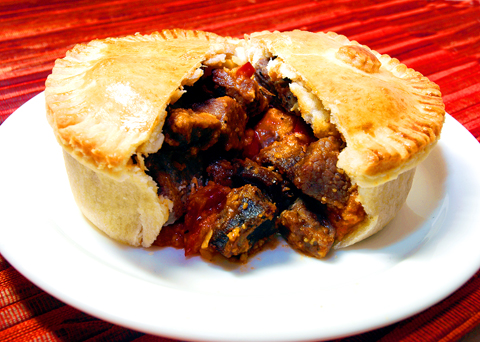
PHOTO COURTESY OF FRANKIE'S PIES N' MORE
Generously proportioned — 11cm in diameter and 5.5cm deep — and served in a foil jacket along with a miniscule portion of salad, which prevents them appearing bare, the pies cost between NT$80 for cheese and vegetable to NT$95 for Italian steak. They can be ordered in set meals with a juice (red grape) and fries. The price varies according to which pie is ordered. A second set comprises a slice of quiche, small salad and juice (NT$100).
Pie flavors range from the traditional chicken and cheese, cheese and vegetable, and pepper steak, to the more innovative adobo, inspired by the vinegary Philippine dish of the same name, three-cup chicken (三杯雞), and hamburger variety, the filling of which is made from patty meat, gherkin and barbecue sauce.
A two-floor operation with a spotless kitchen and bathroom on the second, a storefront sporting a glass display case on the first, and three tables and 11 chairs outside on the sidewalk, Frankie’s main trade is in takeouts, which can be taken home, refrigerated and reheated later. A chicken and cheese pie, after one day in the fridge, had retained the crispiness of its golden short-crust pastry top and base, although the sides had turned a tad soggy. Thiart recommends reheating the pies in the oven to crisp up the pastry. Precooked frozen pies are also available.
Three potted plants, a rope light shade, two ceiling fans, cheerful corn yellow and burnt orange walls and a red awning make the seating area a pleasant little spot in what is otherwise a noisy, densely populated suburb. At 10pm on a recent evening there was little traffic on the tree-lined street.
Frankie’s doesn’t serve alcohol, but Thiart said patrons are welcome to bring along their own refreshments.
By MRT, take the blue (Nanshijiao) line to Dingxi Station. From Exit No. 2, Frankie’s is a four-minute walk. Turn left from the station and take a left onto Wenhua Road at the first traffic lights. The pie shop is on the same side of the road, a few blocks up. From Taipei City, take Chungcheng Bridge (中正橋) to Yunghe City. Turn right onto Wenhua Road at the first traffic lights after the bridge. Frankie’s is on the left a few blocks after the lights.
To place an order or obtain a quote for party platters, which Thiart said would be included on the menu in the near future, send an e-mail to frankiespie@gmail.com.

Taiwan’s English education system is being pulled apart by three opposing forces. Bilingual Nation 2030 pulls students toward English and global communication. Artificial Intelligence (AI) readiness pulls them toward digital judgment, verification and AI-mediated work. But Taiwan’s old exam culture pulls them back toward memorization, grammar drills, timed reading and correct answers. If the education system keeps using old exams to define success, it risks producing graduates who are neither genuinely bilingual nor genuinely AI-ready, but trained for tasks machines can already perform. The first force is Bilingual Nation 2030. Launched in 2018, the policy aimed to “help Taiwan’s workforce connect
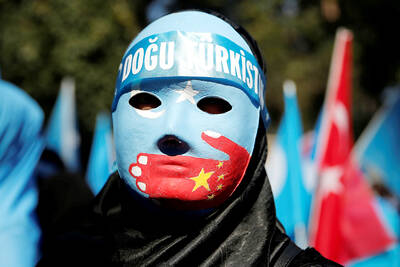
It seems every few days one bumps into one of those “real man” comments in which Taiwan is urged to “face reality” or similar, and “make a deal,” with the speaker implying that soon it will be too late. “Deal” advocates always present themselves as having a superior grip on reality, and the manly ability to make the “hard choice.” Their testosterone-laden language often echoes that of Taiwan sellout advocates. Note that such commentary always specifies a process (“make a deal, work with, make progress”), never the end state of what occupation by a violent authoritarian colonialist state will entail. In
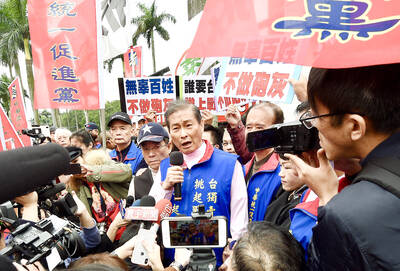
There are shadowy cabals plotting to sell out Taiwan to be annexed by China, by invasion if necessary. Fortunately, they are buffoons. In 2019, former Bamboo Union gangster and founder of the China Unification Promotion Party (CUPP), Chang An-le (張安樂, colorfully known as “White Wolf”), led a protest at the Legislative Yuan against comments made by then-premier Su Tseng-chang (蘇貞昌) that in the event of an attack by China, he would never surrender, but would protect the nation by fighting to the end, even if he only had a broom. Chang had party members bring a wooden casket that they
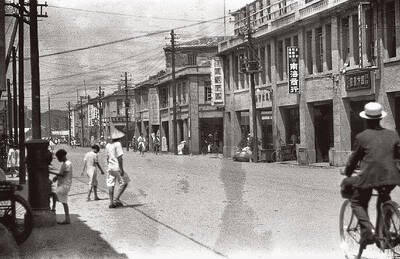
June 1 to June 7 "If all Taiwanese were as afraid of dying as you, then what would happen?” Physician Shih Chiang-nan (施江南) reportedly said this to his wife Chen Chiao-tung (陳焦桐) after she urged him to stop intervening on behalf of Taiwanese soldiers stranded overseas after serving in the Japanese Army during World War II. Shih had clashed with high-ranking officials over the issue, engaged in several heated arguments with Taiwan governor-general Chen Yi (陳儀) and allegedly shouted at general Ko Yuan-fen (柯遠芬), chief of staff of the Taiwan Garrison Command, over


 RSS
RSS