


20 Fragments of a Ravenous Youth is Xiaolu Guo’s (郭小櫓) latest publication in English, issued to coincide with the appearance in paperback of her A Concise Chinese-English Dictionary for Lovers. When I reviewed the same author’s Village of Stone [Taipei Times, May 4, 2004] I said she was lucky to have been taken up by a publishing giant like Random House, and that if her novel had been set in Cleveland, Ohio, rather than China it may well not have found a publisher at all. This book, however, feels quite a lot better.
It has the same terseness and episodic nature, though. It’s easy to read and in no way intellectually challenging. Each of its 20 chapters offers a glimpse into the life of a country girl, Fenfang, newly arrived in Beijing and looking for a job, not to mention a direction in life. She beds down with someone called Xiaolin who she meets when working as a film extra, then with a young American from Boston called Ben. She dreams of getting a speaking part in a movie — any movie — but is persuaded by a serious-minded friend called Huizi to try her hand at scriptwriting. The novel ends with her getting a film synopsis, The Seven Reincarnations of Hao An, (printed here in full) accepted by an underground film director.
The originality of her script, she says, was that it was about someone totally unexceptional, an ordinary Chinese man baffled and finally defeated by the modern world. This is very much what this novel is about — ordinary people, the “extras” of a big city. The difference is that its narrator is canny and persistent enough to come up trumps in the end.
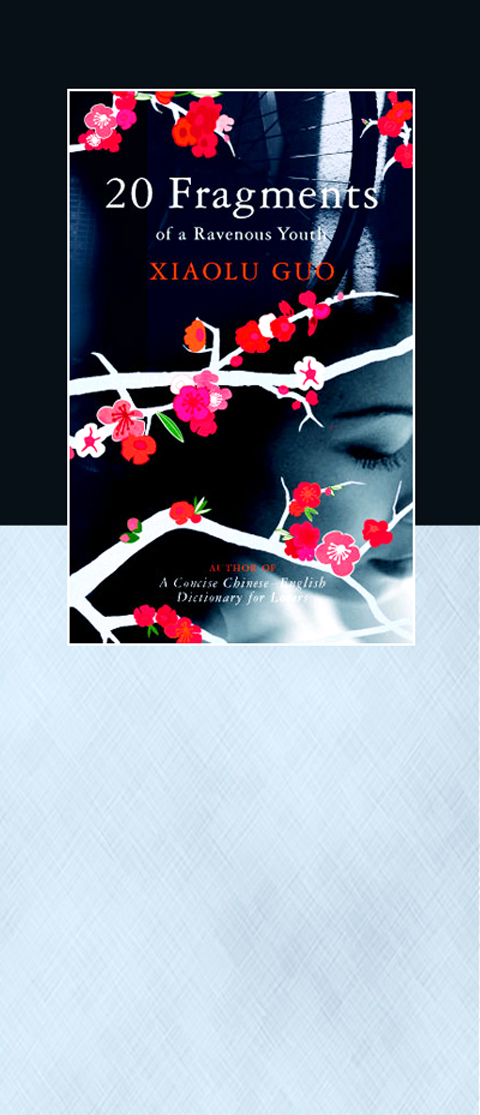
However you look at it, this is a “youth” novel. It’s about the narrator’s youth. It was the first novel the then very young Guo published in China 10 years ago. And here, in its new English-language incarnation, it still bears all the hallmarks of a work aimed predominantly at a young readership.
It’s also clearly very much an autobiographical novel. After being born in a fishing village on the south China coast (the “village of stone” of her 2004 novel), Guo studied at the Beijing Film Academy, and then went to live in London, and after that Paris. But she managed, nonetheless, to publish six books in China before she left.
In a note, Guo comments that it’s hard to return to a book written 10 years ago in order to oversee its translation into English, and that she no longer views things quite the way she did. But by working closely with her “youthful translators” (note the youth touch again) she has managed, she says, to create a language appropriate to “the elusive Fenfang.”
And the book is indeed full of nicely turned phrases and incisive short sentences. It isn’t Tolstoy, but it’s fresh, clean and, as far as it’s possible to tell, truthful. It avoids the pitfalls of pornographic passages (there are no sex scenes as such) and, though Fenfang frequently appeals to a “Heavenly Bastard in the Sky,” the tone is generally and good-natured and lightweight.
Here are some instances of her, or her translators’, easy and natural way with words: Cockroaches “sat in my rice-cooker pondering the meaning of life”; Fenfang’s unruly hair was like the weeds in the sweet-potato fields back home — vigorous, stubborn and “strong to no purpose”; When the narrator returns home she finds it both strange and over-familiar; “The damp night breeze was the same that had blown across my pillow as a child”; “As I was dragging my suitcase off the train, I saw an old woman with a decayed body and awful clothes. It was my mother.”
Guo displays an inclination to make general statements, too. “Family members always hurt each other.” “We repeat ourselves in life — the same habits, over and over again.” “Humans need cages round their bodies — wombs, houses, coffins.” The book’s Hello Kitty aspect, in other words, is quite frequently seasoned with more thoughtful material.
Guo is, needless to say, a rebel, as must be expected of someone who’s emigrated to Europe and is writing for the young. She loves China’s pirated books and films, for instance — piracy, her narrator says, was her university and only path to the foreign world. The police get short shrift — one officer is made to tell another not to worry about Fenfang after she’s been wrongfully arrested. She deserved everything she got because she was “much too individualistic.”
The narrator also belittles the Neighborhood Committees that she feels are spying on her comings and goings. “In my village we used to call them old cocks and old hens. They would sit for hours in the dust, red armbands on their sleeves, serving their everlasting socialism. Heavenly Bastard in the Sky, how I hated them.”
At one point Huizi remarks, “Fenfang, yours is the face of a post-modern woman.” And in a sense this book is an attempt at a post-modern novel — chirpy, observant, clever here and there, and everywhere instantly accessible. The narrator mentions in passing such mentors as Walt Whitman, Tennessee Williams and Marguerite Duras, but this is good post-modern practice — seriousness hinted at, but not investigated. Again, the text is interspersed with black-and-white photos of China — probably taken by the author, as Fenfang remarks on how much she enjoys taking pictures of Chinese daily life.
There are many pert obser-vations in this novel — about pet dogs, strange drinks and weird minor characters. And it’s true that the book as a whole is novelistic fast food. But like so much fast food, it’s not altogether unattractive.

In late October of 1873 the government of Japan decided against sending a military expedition to Korea to force that nation to open trade relations. Across the government supporters of the expedition resigned immediately. The spectacle of revolt by disaffected samurai began to loom over Japanese politics. In January of 1874 disaffected samurai attacked a senior minister in Tokyo. A month later, a group of pro-Korea expedition and anti-foreign elements from Saga prefecture in Kyushu revolted, driven in part by high food prices stemming from poor harvests. Their leader, according to Edward Drea’s classic Japan’s Imperial Army, was a samurai

The following three paragraphs are just some of what the local Chinese-language press is reporting on breathlessly and following every twist and turn with the eagerness of a soap opera fan. For many English-language readers, it probably comes across as incomprehensibly opaque, so bear with me briefly dear reader: To the surprise of many, former pop singer and Democratic Progressive Party (DPP) ex-lawmaker Yu Tien (余天) of the Taiwan Normal Country Promotion Association (TNCPA) at the last minute dropped out of the running for committee chair of the DPP’s New Taipei City chapter, paving the way for DPP legislator Su

It’s hard to know where to begin with Mark Tovell’s Taiwan: Roads Above the Clouds. Having published a travelogue myself, as well as having contributed to several guidebooks, at first glance Tovell’s book appears to inhabit a middle ground — the kind of hard-to-sell nowheresville publishers detest. Leaf through the pages and you’ll find them suffuse with the purple prose best associated with travel literature: “When the sun is low on a warm, clear morning, and with the heat already rising, we stand at the riverside bike path leading south from Sanxia’s old cobble streets.” Hardly the stuff of your
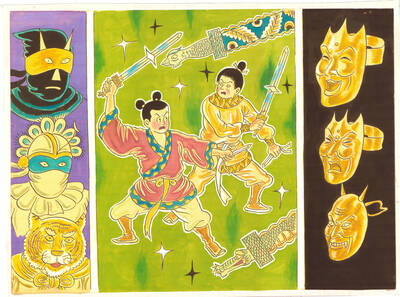
April 22 to April 28 The true identity of the mastermind behind the Demon Gang (魔鬼黨) was undoubtedly on the minds of countless schoolchildren in late 1958. In the days leading up to the big reveal, more than 10,000 guesses were sent to Ta Hwa Publishing Co (大華文化社) for a chance to win prizes. The smash success of the comic series Great Battle Against the Demon Gang (大戰魔鬼黨) came as a surprise to author Yeh Hung-chia (葉宏甲), who had long given up on his dream after being jailed for 10 months in 1947 over political cartoons. Protagonist


 RSS
RSS