


I recently asked Nick Cave what it was like to be Nick Cave, and he told me this: "I kind of know that as soon as I enter a room things are going to change for everybody." He wasn't being immodest - just honest. And then the Aussie rocker put his celebrity effect into some sort of perspective. "For some, it's more intense than others," he said. "Take Michael Jackson: When he walks into a room, everything - the entire trajectory of people's lives - changes. Now, I ain't Michael Jackson. But there is an element of that."
Cave may not be Michael Jackson, but the only postwar entertainers who could legitimately claim to equal Jackson's celebrity effect - Sinatra, Presley - are dead. Of pop's living deities, probably only a handful come close, among them Michael's younger sister, Janet.
Imagine, then, what it must be like to be Janet Jackson, the ninth-biggest selling pop act of all time, the second most successful female artist ever and the most searched-for person in Internet history, to see the effect you have on the people, the atmosphere, the temperature, as you enter a room.

PHOTO: AP
"You can feel it," says the woman herself, looking smaller than you'd expect in a black Adidas tracksuit, sitting on a sofa in the office of the Alley Cat studio complex in downtown Los Angeles where she is rehearsing a dance routine for her latest video. "You can sense it. You can see it."
Is it freaky, or a buzz, to have that kind of effect?
"It's not a buzz, and it's not freaky," she considers, her voice veering between a high-pitched murmur and a barely audible whisper. "I've been around it almost all my life. I saw it with my brothers, so it's just ... . It is what it is. But I do see it. I don't really pay that much attention to it, but I see it."

PHOTO: AP
It is she who mentions her brothers, not me: I'm under strict instructions from her PR team not to ask questions about Michael, which is a shame because the T-shirt that she wore during her brother's trial on 10 counts of child molestation in 2005, bearing the words I'm a Pervert Too, was crying out to be discussed. Other subjects that can't be addressed in this interview: Her yo-yoing weight and Nipplegate - the notorious "wardrobe malfunction" during the 2004 Super Bowl half-time show, when Justin Timberlake whipped off part of her Mad Maxine black leather ensemble to reveal her right breast with a silver star covering the offending areola ("offend" is the word: more than half a million Americans complained to the TV network).
But I haven't been told that sex per se is off-limits, so I ask Jackson about the title of her 10th and latest record, Discipline, and how it relates to her 1986 breakthrough album, Control. On one of the record's many between-song interludes, she talks about self-control and chastisement, connoting will to power as well as S&M. She seems to have a thing about discipline and control.
"It's actually about aspects of love," she says of her new output. "It is on the sensual side, but I titled the album Discipline because it has different meanings, the most important being discipline in work. To have done it for as long as I have and to have had the success I've had - I mean, obviously, it's God, but it takes discipline and a great deal of focus for that. And I've had that since I was a kid."

PHOTO: AP
Her long career has been all about asserting control - wresting it either from record companies eager to sell her as a pop puppet, or from her domineering father Joe - and sex has been her method of achieving this. On Nasty (from Control), she made explicit her refusal to be portrayed as demure; on If (from 1993's Janet), the phallic imagery left little to the imagination; Would You Mind (from 2001's All for You) should have had a parental advisory sticker with its lyrics about how she was going to kiss you, suck you, taste you, ride you/Feel you deep inside me ooh.
Jackson is shocked that people are still, well, shocked by her forthright approach.
"Discipline is no different than the previous albums," she suggests, "but I notice that people are paying more attention to this one in the way it's being rated as more sexual than the other. But the Janet album was very much like that. Or even Rope Burn [from 1997's Velvet Rope] where I talked about blindfolds and being tied up. Or Would You Mind: there were no metaphors whatsoever used in that song. I remember Jimmy [Jam, producer] read the lyrics and went, 'Whoa, okay!' I'm just being honest and telling you how I feel. Discipline is nothing new. I'm surprised [at people's reactions]. It's, like, what's the big deal? On If, when I say, 'Your smooth and shiny feels good against my lips' - it's like, what else could it possibly be talking about?"
The American press, she decides, is far more prudish than its British counterpart - "We need to catch up with you guys because we're just butthole backwards," she says - and is taken aback by recent reports in the US that she's been promoting group sex without even realizing.
"Isn't that something?" she almost giggles. "A journalist brought up a threesome, and I said, 'I mention threesomes on this album?' - which I don't think I do. And then I said - and I honestly meant it - if a person is into that, that's their business. There are people who swing, couples who swing. So why are people hounding me about a threesome?"
Perhaps they think you're leading the innocent astray. Kind of: "If Janet Jackson's doing it, maybe we should?"
"Because I'm doing it? They need to get their own mind and figure out their own life," she says, more gently than it appears. "What about your own life? What about the things that you want to do? Granted, there are people that look up to you, but what about people within your own life? What about your parents? You understand what I'm saying?"
But we're always told that people look at celebrities as their role models and leaders. …
"I understand what you're saying, I totally understand, but at the same time, you still have to be true to yourself. I'm not saying I've had one, I'm not saying I haven't had one, but if a threesome is something that I was into, that would be me, not you. And if that's something you want to try, then that's up to you."
Then there's the new album's The 1, during which reference is made to penis size. But it's guest rapper Missy Elliott being her usual playful self, not Jackson.
"I keep saying, 'That's Missy,'" she says, as exasperated as she can sound with that breathy, high voice. "I say, 'That's not me. I've never said anything about being seven inches. Missy says that.' But once again, they put it back on me."
Jackson's rigorous self-discipline is what has pushed her to achieve 100 million album sales, win acclaim for her groundbreaking videos and dance routines, and recognition for her acting (the recent Why Did I Get Married? was her third consecutive film to open at number one at the box office). She gives her parents a lot of credit for her success - it was their discipline that drove her.
"My parents were very strict with where we went and what we did," she says. "They made us do a lot of chores. People laugh when I tell them, but we worked when we were home, and we didn't get paid for it. We got no allowance. My parents had three acres [1.2 hectares], and on a Saturday morning we'd have to get up early and rake every leaf on the yard. There were tonnes of trees and we had tonnes of animals, and we had to keep the animals clean and their cages clean and feed them on a daily basis. And when my brothers were on tour, I was doing everybody's chores."
For Jackson, discipline has always been crucial, then?
"Of course it has, and I think that's what helped us to stay grounded," she says, though the extent to which Michael is grounded is open to debate. "My parents knew what they were doing. You see all these people screaming for you and giving you anything you want ... . My mother and father were quick to say that this is all because of God, and as quickly as you acquired it, he could take it away, so respect it."
Apart from her parents, Jackson says she has few, if any, role models. "I hope that doesn't sound bad. Some of the artists that I've looked up to, they're no longer here, maybe due to drugs or things like that, but musically looking up to them, um, not really. Does that sound weird? I feel like I'm supposed to have someone because everybody has someone, but I don't have anyone. But yeah, it does feel kind of strange."
Despite almost rivaling him in terms of statistics, Janet doesn't quite match her brother for sheer outrageous hubris. No giant statues of her sailing down the Thames nor displays of messianic self-glory. There are eccentric moments - when I ask her who she'd most like to meet, she says the Dalai Lama and Jesus - but the essential difference between Janet and Michael is that Janet can enjoy some semblance of normality. Fame is something she can switch on and off.
"Someone said to me, 'Oh my God, you seem so quiet, and when I listen to your album it's so sensual,' and I'm, like, 'Well, am I supposed to be walking around with my butt hanging out and my boobs up to my ears, with voluptuous lips and high heels all the time?' That person still lives within me, but it doesn't necessarily mean it's there every ... moment of the day."

Recently the Chinese Nationalist Party (KMT) and its Mini-Me partner in the legislature, the Taiwan People’s Party (TPP), have been arguing that construction of chip fabs in the US by Taiwan Semiconductor Manufacturing Co (TSMC, 台積電) is little more than stripping Taiwan of its assets. For example, KMT Legislative Caucus First Deputy Secretary-General Lin Pei-hsiang (林沛祥) in January said that “This is not ‘reciprocal cooperation’ ... but a substantial hollowing out of our country.” Similarly, former TPP Chair Ko Wen-je (柯文哲) contended it constitutes “selling Taiwan out to the United States.” The two pro-China parties are proposing a bill that
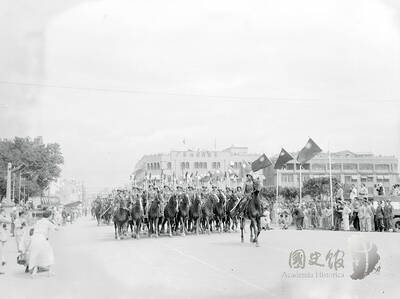
March 9 to March 15 “This land produced no horses,” Qing Dynasty envoy Yu Yung-ho (郁永河) observed when he visited Taiwan in 1697. He didn’t mean that there were no horses at all; it was just difficult to transport them across the sea and raise them in the hot and humid climate. “Although 10,000 soldiers were stationed here, the camps had fewer than 1,000 horses,” Yu added. Starting from the Dutch in the 1600s, each foreign regime brought horses to Taiwan. But they remained rare animals, typically only owned by the government or
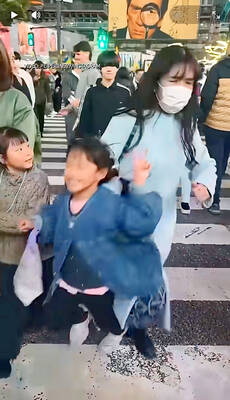
It starts out as a heartwarming clip. A young girl, clearly delighted to be in Tokyo, beams as she makes a peace sign to the camera. Seconds later, she is shoved to the ground from behind by a woman wearing a surgical mask. The assailant doesn’t skip a beat, striding out of shot of the clip filmed by the girl’s mother. This was no accidental clash of shoulders in a crowded place, but one of the most visible examples of a spate of butsukari otoko — “bumping man” — shoving incidents in Japan that experts attribute to a combination of gender

Last month, media outlets including the BBC World Service and Bloomberg reported that China’s greenhouse gas emissions are currently flat or falling, and that the economic giant appears to be on course to comfortably meet Beijing’s stated goal that total emissions will peak no later than 2030. China is by far and away the world’s biggest emitter of greenhouse gases, generating more carbon dioxide than the US and the EU combined. As the BBC pointed out in their Feb. 12 report, “what happens in China literally could change the world’s weather.” Any drop in total emissions is good news, of course. By


 RSS
RSS