


Julian Schnabel has made three feature films: Basquiat, Before Night Falls and now The Diving Bell and the Butterfly. All are biographical, examining the lives of real people, and in each case the protagonist struggles with a condition of literal or metaphorical imprisonment.
Jean-Dominique Bauby, a French fashion magazine editor and the author of the international best seller on which The Diving Bell and the Butterfly is based, suffered a stroke in his 40s that left him in a rare affliction called "locked-in syndrome." He retained vision and hearing, and his mind continued to function perfectly, but his body was almost completely paralyzed. He could not move or speak. In the film a friend, visiting him in the hospital in Berck reports the latest gossip from the cafes of Paris: "Have you heard? Jean-Dominique is a vegetable."
"What kind of vegetable?" Jean-Dominique wonders. Like his condition, the metaphor is cruel, but not altogether unredeemable. As we come to understand in the course of this fierce and lovely film, his existence is not that of a vegetable but rather of a garden, a hothouse of consciousness, memory and ecstatic imagination.
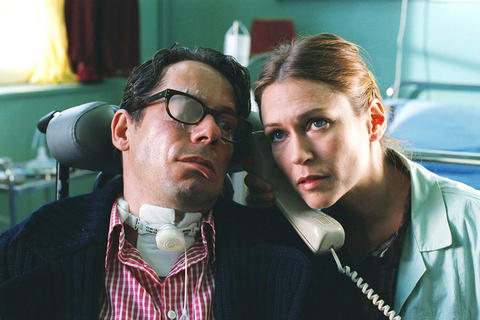
PHOTO: COURTESY OF CMC
Jean-Dominique is played by Mathieu Amalric, a French actor whose twitching, antic physicality makes the character's immobility all the more painful. But The Diving Bell, true to its hero and its literary source, is neither morbid nor mawkish. Propped up in a wheelchair, able to communicate only by blinking his left eye, he remains a sensualist, a bon vivant and a keen literary wit.
But never a saint. Before his stroke Jean-Dominique led a life of glamour, pleasure and self-indulgence, for which he never apologizes.
The phrase "triumph of the human spirit" hovers over The Diving Bell and the Butterfly, along with a swarm of other empty, uplifting cliches. But Schnabel and the screenwriter, Ronald Harwood, have other themes in mind: limitation, constraint, incarceration. But Schnabel is not content simply to state or to dramatize this idea. Rather, he demonstrates his own imaginative freedom in every frame and sequence, dispensing with narrative and expository conventions in favor of a wild, intuitive honesty.
And yet he also shows astonishing formal control. The movie begins claustrophobically, as we see the blurry bustle of the hospital room from Jean-Dominique's hazy, panicked perspective. Faces loom suddenly and awkwardly into view, while his captive consciousness writhes in its cage, trying to make contact with the world outside.
After a while it does, with the help of a speech therapist who patiently teaches Jean-Dominique to turn his left eyelid into a means of communication. She sits beside him, reciting the alphabet and stopping when he blinks, piecing together words and sentences from his signals.
Later an amanuensis (Anne Consigny) takes her place, and together she and Jean-Dominique compose the compact, lyrical book that will become Schnabel's expansive, passionate film. Their attention also introduces both the patient and the audience to an intense, nonsexual intimacy that is itself a form of love.
And so, curiously enough, a movie about deprivation becomes a celebration of the richness of experience, and a remarkably rich experience in its own right. In his memoir Bauby performed a heroic feat of alchemy, turning horror into wisdom, and Schnabel, following his example and paying tribute to his accomplishment, has turned pity into joy.

In late October of 1873 the government of Japan decided against sending a military expedition to Korea to force that nation to open trade relations. Across the government supporters of the expedition resigned immediately. The spectacle of revolt by disaffected samurai began to loom over Japanese politics. In January of 1874 disaffected samurai attacked a senior minister in Tokyo. A month later, a group of pro-Korea expedition and anti-foreign elements from Saga prefecture in Kyushu revolted, driven in part by high food prices stemming from poor harvests. Their leader, according to Edward Drea’s classic Japan’s Imperial Army, was a samurai

The following three paragraphs are just some of what the local Chinese-language press is reporting on breathlessly and following every twist and turn with the eagerness of a soap opera fan. For many English-language readers, it probably comes across as incomprehensibly opaque, so bear with me briefly dear reader: To the surprise of many, former pop singer and Democratic Progressive Party (DPP) ex-lawmaker Yu Tien (余天) of the Taiwan Normal Country Promotion Association (TNCPA) at the last minute dropped out of the running for committee chair of the DPP’s New Taipei City chapter, paving the way for DPP legislator Su

It’s hard to know where to begin with Mark Tovell’s Taiwan: Roads Above the Clouds. Having published a travelogue myself, as well as having contributed to several guidebooks, at first glance Tovell’s book appears to inhabit a middle ground — the kind of hard-to-sell nowheresville publishers detest. Leaf through the pages and you’ll find them suffuse with the purple prose best associated with travel literature: “When the sun is low on a warm, clear morning, and with the heat already rising, we stand at the riverside bike path leading south from Sanxia’s old cobble streets.” Hardly the stuff of your
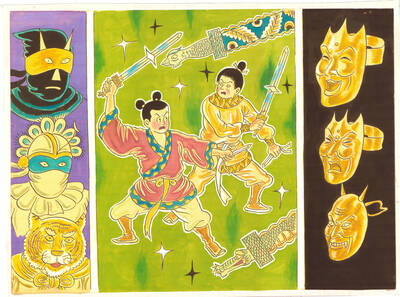
April 22 to April 28 The true identity of the mastermind behind the Demon Gang (魔鬼黨) was undoubtedly on the minds of countless schoolchildren in late 1958. In the days leading up to the big reveal, more than 10,000 guesses were sent to Ta Hwa Publishing Co (大華文化社) for a chance to win prizes. The smash success of the comic series Great Battle Against the Demon Gang (大戰魔鬼黨) came as a surprise to author Yeh Hung-chia (葉宏甲), who had long given up on his dream after being jailed for 10 months in 1947 over political cartoons. Protagonist


 RSS
RSS