


The Peter Doig retrospective now filling several galleries at London's Tate Britain is easily the most enthralling show in town. Its achievement is to mystify even as it compels. Doig's paintings have always been singular - narcotic, yet intensely stimulating, beautiful yet way out on a limb - and they seem to grow more original and mesmerizing by the year.
A perpetual outsider, born in Scotland in 1959 but raised in Canada, then an expatriate in London and now Trinidad, Doig didn't show much until he was 30. But if he was a late starter, a few years older than the YBA [Young British Artists] generation with whom he studied, he survived the manic star-making of the 1990s by constantly deepening his art, and the early paintings set the scene for the future. Frequently snowbound - ski-slopes, icy forests, deep drifts settling on the canvas or arriving like hale in twinkling spatters - they often included the lone figures that have come to symbolize his work.
A boy on a frozen pond studies his reflection in the mauve-rippled surface, the paint - flecked, scribbled, stained, perilously thin - as unstable as the ice. A hooded figure in a mountain landscape turns his back to us, apparently sketching something we can't see but ominous as the dwarf in Don't Look Now. A man by the river's edge at twilight, the car headlights on behind him as if he might yet return to reality, is either mesmerized by the weird phosphorescence on the water or about to do away with himself.
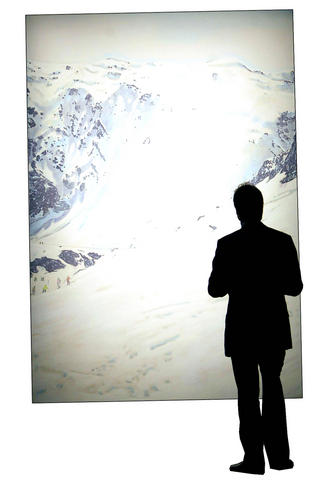
PHOTO: EPA
At another bend in the river drifts the canoe Doig has painted over and again like some deathless Raft of Medusa. A very early craft, unmanned, appears on an inky expanse that holds the reflection of the Milky Way with the eerie brightness of a basalt mirror. Another, becalmed on a stretch of burning blue, carries a bearded man who could as easily be Charles Manson or the Ancient Mariner, time having stopped like this vessel without oars; the picture is called 100 Years Ago. And out in the beating heat of the West Indian bay, palm trees all around, five spectral figures float away into the future. Or is it the past? One of them looks strangely like the young Paul McCartney.
Every scene suggests an idee fixe, some sight or experience perpetually trapped in the mind that can never be exorcised. Doig's gift is for making these memories seem not just his own, but the viewer's as well, as if we, too, could not forget these peculiar moments in films, novels or scenes skimmed from life with a camera that keep flashing back on the mind's eye.
The slow and distanced trance that characterizes Doig's art comes in part from his use of the camera. Stills and snapshots and even album covers (the bearded man started out as a member of the Allman Brothers) form an aide-memoire, a departure point.
But the memories - not necessarily his own in the first place, and chosen with exceptional instinct for the universal - are obscured, overlaid, blended, corroded, lost and found again, quite altered, in the paint. You can see that happening, both literally and metaphorically, as figures on a shoreline darken into shadows behind flurries of snow accumulating on the canvas like aerosol graffiti, or in a vast diptych showing hundreds of skiers on the slopes. The people are melting into the snow, itself deliquescing into a pink twilight as if the sky had overwhelmed the earth below.
Doig holds back the oblivion, every time, with a strong depictive touch. A painting that looks on the verge of abstraction will be held together with precise description - the puckering of water, the piebald dappling of sunshine, a striation of reeds along a riverbank that looks like a drawing catching fire: just enough to keep the scene plausibly real, before releasing it into the dreamy wilds. And they are quite wild, his paintings, veering between enchantment and fear. Who is this man who turns to meet your gaze with a dying pelican in his hand? Where is this wall apparently studded with jewels at which two costumed figures stand sentry beneath a performance of the Northern Lights? How did the little girl in the white pajamas climb so high in that midnight tree? Doig seeks to fix in your mind whatever haunted his from the wondrous strangeness of the visible world.
But he never lets you forget the strangeness of picturing itself - that a painting, unlike a photograph, is never really still and, in his case, quite the reverse. The whole surface of a Doig is a micro-life of incidents - focus pulls, jumps in scale, skittering-scattering brushmarks, encrusted impasto, veiled blurs and cross-fades, the leaching and streaking of paint, abrupt discontinuities between psychedelic colors and severe monochromes that seem to belong only to the world of painting.
Lately, it's been suggested, the paint is taking over altogether and it might seem so when you consider the apparently empty expanse of an enormous canvas like Untitled 2006. But look closer into the wash of paint, thin as watercolor, and you'll see a figure high up a palm tree, a bird soaring across the pulsating lilac light and, as your eyes adjust, the spectral trace of an interloper: a stranger in paradise.
If his art was always a bit trippy, reamed out with visions, it now approaches the hallucinatory: winged figures, hot shores, the canoe vanishing into the pale horizon. But Doig's style, by contrast, gets more disciplined by the year. His art is becoming grander and more formal with the decades, his latest paintings composed as distinctively as anything by Bonnard or Matisse.
There are no false notes, the great scale is perfectly judged to hold all the perceptual incidents and maintain the balance between narrative and image. For in the end, no matter how much they invite interpretation, propose a backstory or riddle with the viewer's sense of mystery, Doig's paintings are about mood and atmosphere above all else. His great gift is for altering our state of mind through the mind's eye, for getting out of this world by inventing another through painting.

By global standards, the traffic congestion that afflicts Taiwan’s urban areas isn’t horrific. But nor is it something the country can be proud of. According to TomTom, a Dutch developer of location and navigation technologies, last year Taiwan was the sixth most congested country in Asia. Of the 492 towns and cities included in its rankings last year, Taipei was the 74th most congested. Taoyuan ranked 105th, while Hsinchu County (121st), Taichung (142nd), Tainan (173rd), New Taipei City (227th), Kaohsiung (241st) and Keelung (302nd) also featured on the list. Four Japanese cities have slower traffic than Taipei. (Seoul, which has some

Michael slides a sequin glove over the pop star’s tarnished legacy, shrouding Michael Jackson’s complications with a conventional biopic that, if you cover your ears, sounds great. Antoine Fuqua’s movie is sanctioned by Jackson’s estate and its producers include the estate’s executors. So it is, by its nature, a narrow, authorized perspective on Jackson. The film ends before the flood of allegations of sexual abuse of children, or Jackson’s own acknowledgment of sleeping alongside kids. Jackson and his estate have long maintained his innocence. In his only criminal trial, in 2005, Jackson was acquitted. Michael doesn’t even subtly nod to these facts.
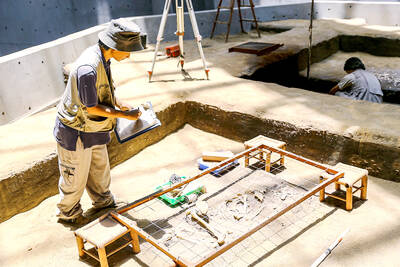
Writing of the finds at the ancient iron-working site of Shihsanhang (十 三行) in New Taipei City’s Bali District (八里), archaeologist Tsang Cheng-hwa (臧振華) of the Academia Sinica’s Institute of History and Philology observes: “One bronze bowl gilded with gold, together with copper coins and fragments of Tang and Song ceramics, were also found. These provide evidence for early contact between Taiwan aborigines and Chinese.” The Shihsanhang Web site from the Ministry of Culture says of the finds: “They were evidence that the residents of the area had a close trading relation with Chinese civilians, as the coins can be
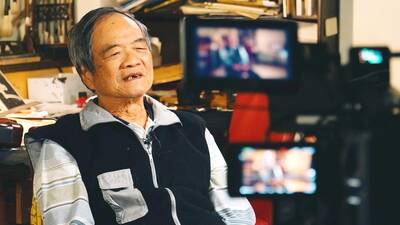
During her 2015 trip to Taiwan, Sophia J. Chang (張詠慧) got fewer answers than she’d hoped for, but more revelations than she could have imagined. “That was the year I last saw my grandmother. She was in hospice care in Tainan, and it was painful to see her in bed, barely able to open her eyes,” says Los Angeles-born Chang. “The grandma I’d known, a fantastic cook and incredibly kind, was already gone.” After their visit, Chang and her grandfather went back to his apartment. There she asked him how he’d met her grandmother. “He hesitated, then started talking a bit.


 RSS
RSS