


Pattern and Decoration: An Ideal Vision in American Art, 1975-1985, at the Hudson River Museum, documents the last genuine art movement of the 20th century, which was also the first and only art movement of the postmodern era and may well prove to be the last art movement ever.
We don't do art movements anymore. We do brand names (Neo-Geo); we do promotional drives ("Painting is back!"); we do industry trends (art fairs, master's of fine arts students at Chelsea galleries, etc.). But now the market is too large, its mechanism too corporate, its dependence on instant stars and products too strong to support the kind of collective thinking and sustained application of thought that have defined movements as such.
Pattern and Decoration, known as P&D, was the real thing. The artists were friends, friends of friends or students of friends. Most were painters, with distinctive styles but similar interests and experiences. All had had exposure to, if not immersion in, the liberation politics of the 1960s and early 1970s, notably feminism. All were alienated by dominant movements like Minimalism.
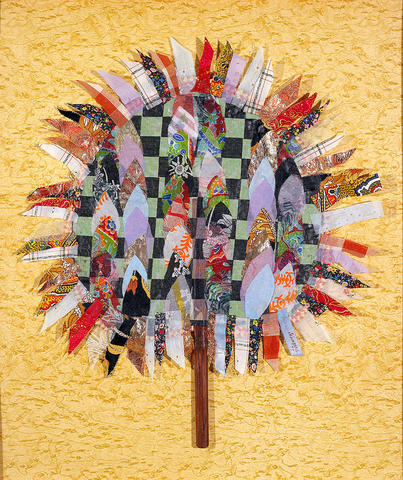
PHOTO: NY TIMES NEWS SERVICE
They were also acutely aware of the universe of cultures that lay beyond or beneath Euro-American horizons, and of the alternative models they offered for art. Varieties of art from Asia, Africa and the Middle East, as well as folk traditions in the West, blurred distinctions between art and design, high and low, object and idea. They used abstract design as a primary form and ornament as an end in itself. They took beauty, whatever that meant, as a given.
P&D artists were scattered geographically. Some - Robert Kushner, Kim MacConnel, Miriam Schapiro - were in California. Others - Cynthia Carlson, Brad Davis, Valerie Jaudon, Jane Kaufman, Joyce Kozloff, Tony Robbin, Ned Smyth, Robert Zakanitch - were in New York. As a group they found an eloquent advocate in the critic and historian Amy Goldin, who was immersed in the study of Islamic art. And they had an early commercial outlet in the Holly Solomon Gallery in SoHo.
They all asked the same basic question: When faced with a big, blank, obstructing Minimalist wall, too tall, wide and firmly in place to get over or around, what do you do? And they answered: You paint it in bright patterns, or hang pretty pictures on it, or drape it with spangled light-catching fabrics. The wall may eventually collapse under the accumulated decorative weight. But at least it will look great.
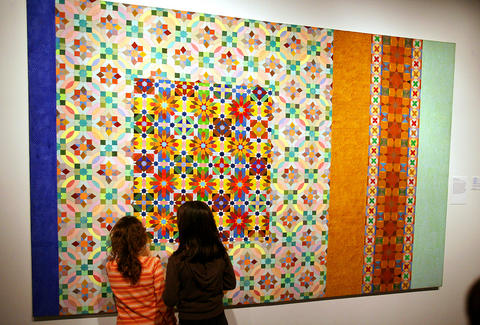
PHOTO: NY TIMES NEWS SERVICE
And where do you find your patterns and pictures and fabrics? In places where Modernism had rarely looked before: in quilts and wallpapers and printed fabrics; in Art Deco glassware and Victorian valentines. You might take the search far afield, as most of these artists did.
They looked at Roman and Byzantine mosaics in Italy and Islamic tiles in Spain and North Africa. They went to Turkey for flower-covered embroideries, to Iran and India for carpets and miniatures and to Manhattan's Lower East Side for knockoffs of these. Then they took everything back to their studios and made a new art from it.
Kaufman turned 19th-century American quilt designs into abstract nocturnes glinting with sewn-on beads. Zakanitch went for flowers in monumental paintings based on fabrics remembered from his childhood home in New Jersey. Schapiro also drew on floral images in a type of feminist-inspired collage she called "femmage." And in her Gates of Paradise she applied domestic craft materials - lace, ribbons, fabric trim and so on - to a theme associated with Lorenzo Ghiberti.
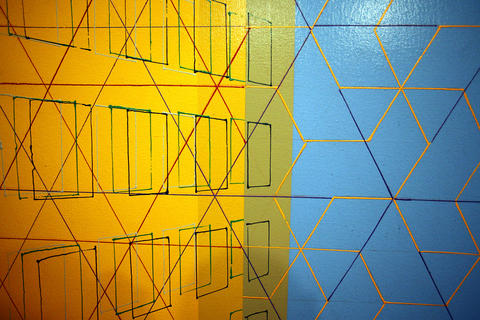
PHOTO: NY TIMES NEWS SERVICE
Carlson's all-over tweedlike patterns, done with repeated strokes of thick paint, are less specific in their references. And even if Jaudon doesn't insist on Islamic art as a source for her crisp interlace designs, it surely had some effect. Kozloff is forthright about the debt she owes to Moroccan and Mexican tile work. Her melding of brilliant colors with a basic Minimalist grid has yielded generous results in public architectural projects, and in her poetic and intensely political recent art.
Davis and Smyth lie a little outside the general P&D loop, one doing figurative work and the other mosaics. Robbin, who lived in Iran as a child, conflates geometric Persian motifs with others from Japanese silk kimonos. For MacConnel and Kushner, textiles themselves are a primary medium.
MacConnel glues pieces of Near Eastern and Southeast Asian fabric together into suspended open-work hangings. Kushner, who studied with MacConnel and traveled with Goldin to the Middle East, originally draped his painted fabric pieces over his own body in performances. One festive piece in the show, Visions Beyond the Pearly Curtain, is shaped like a chador, cape or kimono, although with its gathered swags and melon-orange curlicues it has the theatrical punch of a rococo opera curtain about to rise.
When Kushner finished this piece in 1975, P&D was taking off. It had avid collectors in the US; in Europe it was a hit. Then interest dried up. Worse than that, in the US, the movement became an object of disdain and dismissal.
There were reasons. Art associated with feminism has always had a hostile press. And there was the beauty thing. In the neo-Expressionist, neo-Conceptualist late 1980s, no one knew what to make of hearts, Turkish flowers, wallpaper and arabesques.
Thanks to multiculturalism and identity politics, we know better what to make of them now; the art world's horizons are immeasurably wider than they were two decades ago (without being all that wide). Besides, to my eye, most P&D art isn't beautiful and never was, not in any classical way. It's funky, funny, fussy, perverse, obsessive, riotous, accumulative, awkward, hypnotic, all evident even in the fairly tame selections by Anne Swartz, the curator for this show.
And not-quite-beauty is exactly what saved it, what gave it weight, weight enough to bring down the great Western Minimalist wall for a while and bring the rest of the world in. Let the art historical record show, in the post-movement future, the continuing debt we owe it for that.

In late October of 1873 the government of Japan decided against sending a military expedition to Korea to force that nation to open trade relations. Across the government supporters of the expedition resigned immediately. The spectacle of revolt by disaffected samurai began to loom over Japanese politics. In January of 1874 disaffected samurai attacked a senior minister in Tokyo. A month later, a group of pro-Korea expedition and anti-foreign elements from Saga prefecture in Kyushu revolted, driven in part by high food prices stemming from poor harvests. Their leader, according to Edward Drea’s classic Japan’s Imperial Army, was a samurai

The following three paragraphs are just some of what the local Chinese-language press is reporting on breathlessly and following every twist and turn with the eagerness of a soap opera fan. For many English-language readers, it probably comes across as incomprehensibly opaque, so bear with me briefly dear reader: To the surprise of many, former pop singer and Democratic Progressive Party (DPP) ex-lawmaker Yu Tien (余天) of the Taiwan Normal Country Promotion Association (TNCPA) at the last minute dropped out of the running for committee chair of the DPP’s New Taipei City chapter, paving the way for DPP legislator Su

It’s hard to know where to begin with Mark Tovell’s Taiwan: Roads Above the Clouds. Having published a travelogue myself, as well as having contributed to several guidebooks, at first glance Tovell’s book appears to inhabit a middle ground — the kind of hard-to-sell nowheresville publishers detest. Leaf through the pages and you’ll find them suffuse with the purple prose best associated with travel literature: “When the sun is low on a warm, clear morning, and with the heat already rising, we stand at the riverside bike path leading south from Sanxia’s old cobble streets.” Hardly the stuff of your
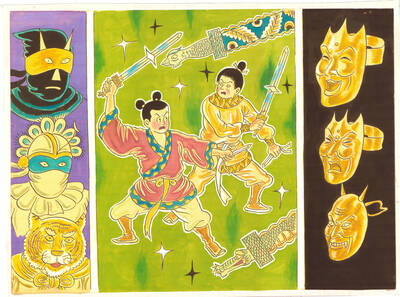
April 22 to April 28 The true identity of the mastermind behind the Demon Gang (魔鬼黨) was undoubtedly on the minds of countless schoolchildren in late 1958. In the days leading up to the big reveal, more than 10,000 guesses were sent to Ta Hwa Publishing Co (大華文化社) for a chance to win prizes. The smash success of the comic series Great Battle Against the Demon Gang (大戰魔鬼黨) came as a surprise to author Yeh Hung-chia (葉宏甲), who had long given up on his dream after being jailed for 10 months in 1947 over political cartoons. Protagonist


 RSS
RSS