


All the stories in this lively collection are portraits, mainly of human beings, though a monster with an identity crisis, a giant in search of love and a puppy in need of a home put in appearances as well. While the stories vary widely in quality - a few are dazzling, many are simply well crafted, a handful are embarrassingly slight or contrived - they come together to provide a kind of lesson in fiction writing.
Whether they are old-fashioned narratives, playful improvisations or comic-strip-like tales told in pictures, these stories force us to re-evaluate that old chestnut "Character is destiny." They remind us that an individual's life is itself a narrative with a beginning, a middle and at least the intimations of an end. And they showcase the many time-honored techniques that writers use to limn their characters' predicaments, from straight-up ventriloquism to the use of unreliable narrators to a Rashomon-like splitting of perspectives.
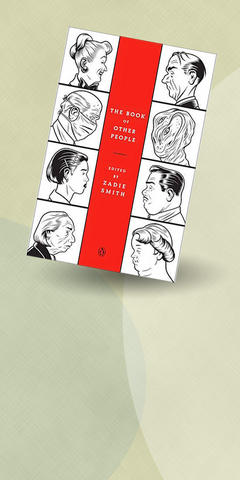
The Book of Other People was edited by the gifted young British novelist Zadie Smith, and its contributors include well-known writers like Jonathan Safran Foer, Jonathan Lethem, Dave Eggers and Nick Hornby. The two most haunting stories in the volume - Lele by Edwidge Danticat and Donal Webster by Colm Toibin - unfold, like elaborate origami flowers, into complex portraits with the emotional density and historical depth of field of a novel.
Each of these stories takes a pivotal moment in the lives of its protagonists and uses that moment to illuminate an entire life. They depict middle-aged people, damaged by misfortune and eager to protect themselves from further emotional hurt.
In Donal Webster, the anniversary of a death goads an Irish emigre teacher into a contemplation of abandonment suffered as a child and the rupture of a longtime romance. In Lele, a small-town Haitian woman, who knows that the child she is carrying has a serious birth defect, leaves the baby's father, convinced that had she never ventured into the adult world of relationships, she might have remained exempt from the worst losses and woes of life.
In this story, Danticat - the author of the powerful novel The Dew Breaker - does a magical job of conjuring up the town of Leogane, a humid river town, where flood waters are threatening people's homes, and the frogs have been mysteriously dying, a town where the light is bright and dazzling, and where the narrator, Lele's brother, tends his vetiver and almond trees.
A similarly visceral sense of place can be found in Lethem's Perkus Tooth: "To live in Manhattan," he writes, "is to be persistently amazed at the worlds squirreled inside one another, like those lines of television cable and fresh water and steam heat and outgoing sewage and telephone wire and whatever else which cohabit in the same intestinal holes that pavement-demolishing workmen periodically wrench open to the daylight and to our passing, disturbed glances. We only pretend to live on something as orderly as a grid."
The title character of Lethem's story is a true eccentric, an autodidact and sometime writer who lives in a "bohemian grotto" on the Upper East Side, and who passes his time smoking pot, wolfing down Jackson Hole burgers and prattling away about obscure Werner Herzog films and reruns of the old television show Columbo.
Perkus reminds the narrator of a self-portrait of Edvard Munch, showing "the painter wide-eyed and whiskered, shrunken within his clothes," and he takes charge of the narrator's aesthetic education, loading him up with essential tapes and DVDs, and lecturing him about everyone from Chet Baker to Myrna Loy to John Cassavetes. Although Perkus could easily have degenerated, in the hands of a less skillful writer, into a collection of odd traits pasted haphazardly together, Lethem manages in these pages to make him a palpable and oddly moving figure.
Miranda July's sad-funny tale Roy Spivey also pivots around an oddball character: A Hollywood heartthrob who flirts with his seatmate on a long plane flight, sprays her down with Febreze, (yes, Febreze fabric spray: read the story, it's too complicated to explain) and makes her, for an instant, envision a different life for herself. He gives her a phone number minus one digit, which he makes her memorize. That missing number is four, and for years four will be a talisman to her, a lucky number to be whispered at times of passion or stress.
Only years later, after she has married and settled into a humdrum life, does she realize that Roy Spivey might have actually wanted her to call him, that giving her the number wasn't just the playful gesture of a movie star, but an attempt at genuine connection. But when she tries the number, it doesn't work: "I looked down at the number and felt a tidal swell of loss. It was too late. I had waited too long."
In Hanwell Snr, Smith maps her hero's relationship with his irresponsible and frequently absent father, who he keeps imagining will one day confess his regrets. In Nigora, Adam Thirlwell uses a discontented wife's musings about the men in her life, past and present and future, to chart this woman's disappointments and hopes, and to delineate her own sense of self.
And in Gordon Andrew O'Hagan sketches out the life of a writer in eight staccato takes, which give the reader both a real sense of Gordon's life (from a boyhood football injury to his bookish adolescence in Scotland to the publication of his first book) and a sense of how brief and inconsequential many people's lives can be.
Other tales in this volume feel overly pat or mechanically perfunctory, as if they'd been tossed off to complete an annoying assignment. J. Johnson by Hornby (with illustrations by Posy Simmonds) is a silly and unilluminating send-up of the blurbs about authors that appear on book jackets. The Liar by Aleksandar Hemon is a predictable parable that plays with the biography of Jesus. And Judge Gladys Parks-Schultz by Heidi Julavits devolves from a promising portrait of a difficult old woman into an overly ironic tale with a cheap, O. Henry-esque conclusion.
In the end, the reader of this volume will most likely hopscotch through this collection, skipping over the less satisfying entries to focus on its few gems. Indeed, the strongest stories in The Book of Other People should serve as introductions to their authors' oeuvres, enticing the reader to investigate further the work of writers like Edwidge Danticat, Jonathan Lethem and Colm Toibin.

Michael slides a sequin glove over the pop star’s tarnished legacy, shrouding Michael Jackson’s complications with a conventional biopic that, if you cover your ears, sounds great. Antoine Fuqua’s movie is sanctioned by Jackson’s estate and its producers include the estate’s executors. So it is, by its nature, a narrow, authorized perspective on Jackson. The film ends before the flood of allegations of sexual abuse of children, or Jackson’s own acknowledgment of sleeping alongside kids. Jackson and his estate have long maintained his innocence. In his only criminal trial, in 2005, Jackson was acquitted. Michael doesn’t even subtly nod to these facts.

Writing of the finds at the ancient iron-working site of Shihsanhang (十 三行) in New Taipei City’s Bali District (八里), archaeologist Tsang Cheng-hwa (臧振華) of the Academia Sinica’s Institute of History and Philology observes: “One bronze bowl gilded with gold, together with copper coins and fragments of Tang and Song ceramics, were also found. These provide evidence for early contact between Taiwan aborigines and Chinese.” The Shihsanhang Web site from the Ministry of Culture says of the finds: “They were evidence that the residents of the area had a close trading relation with Chinese civilians, as the coins can be

The March/April volume of Foreign Affairs, long a purveyor of pro-China pablum, offered up another irksome Beijing-speak on the issues and solutions for the problems vexing the People’s Republic of China (PRC) and the US: “America and China at the Edge of Ruin: A Last Chance to Step Back From the Brink” rang the provocative title, by David M. Lampton and Wang Jisi (王緝思). If one ever wants to describe what went wrong with US-PRC relations, the career of Wang Jisi is a good place to start. Wang has extensive experience in the US and the West. He was a visiting

The January 2028 presidential election is already stirring to life. In seven or eight months, the primary season will kick into high gear following this November’s local elections. By this point next year, we will likely know the Democratic Progressive Party (DPP) candidate and whether the Taiwan People’s Party (TPP) will be fielding a candidate. Also around this time, the Chinese Nationalist Party (KMT) will either have already completed their primary, or it will be heading into the final stretch. By next summer, the presidential race will be in high gear. The big question is who will be the KMT’s


 RSS
RSS