


If there was ever a tourist destination that seemed out of reach to someone in a wheelchair, it must be Venice, where going a couple of blocks often means crossing steep, stepped bridges.
Just getting there can be a challenge that requires negotiating docks, stairs and, of course, boats.
Even for Pat, who has wheeled through Egypt, South America and Nepal, the watery island city of Venice had long remained an unfulfilled life goal.
NY TIMES NEWS SERVICE
But the intrepid traveler refused to give up on her dream. So the two of us took off on a quest to conquer Venice and its aura of inaccessibility.
We had moments of doubt, starting with the water taxi that was to take us from the mainland to the city. The boat was equipped with a flimsy looking platform lift so tiny that Pat and her quite compact chair were perched precariously in the air before being lowered into the cramped vessel, with bystanders along the busy dock gaping at the sight.
It was hardly the most dignified entrance.
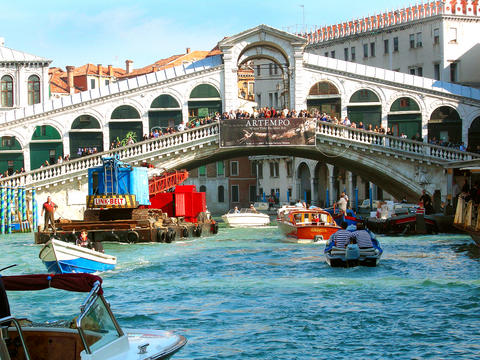
However, the ordeal was all but forgotten by the time the speedboat was plying through the Grand Canal, lined with venerable buildings and churning with activity of motorized boats, working barges and, of course, gondolas.
"It was magic," Pat said of that first ride through Venice's main thoroughfare. "You could see all the life, the energy, the beauty."
"The whole trip was worth it, just for that," she allowed.
For the rest of the stay, Venice continued to present more challenges, followed by delightful rewards.
Sure, it's not easy to strike out on the streets when steps and bridges are all around. But we discovered freedom of movement aboard the crowded vaporettos - the water buses that continuously chug through the canals, taking tourists and Venetians to almost any spot they would want to go.
So, when our specially ordered private water taxi with its dubious lift system failed to show up to take us to Murano, the glass factory center, we simply boarded a vaporetto and went on our own, with greater flexibility, not to mention a huge savings.
The Venetian transit system allows a person in a wheelchair plus one companion to travel for free. A round trip private water taxi fare for two to Murano could easily cost US$230.
Faced with a steep bridge on the way
to the famed heart of the city at San Marco Square, we boarded a vaporetto at the nearest stop. It meant going the long way instead of taking a three-minute walk, but the long way in Venice is always a feast for the eyes and the camera lens.
Later we toured the Basilica di San Marco, with a guide arranged by an Italian travel agency that caters to the disabled. She took us in the back entrance, where a kindly church worker led us to the altar, while others waited in a long line that often snakes through the pigeon-filled piazza.
Even the bridges that lace together the streets of Venice were not insurmountable, as we discovered one night when our vaporetto dropped us off just a few meters away from our usual Rialto Bridge stop. As we disembarked, we saw that returning to our hotel would require somehow climbing the many steps of a bridge.
In the dark, Pat wheeled toward the span as we both focused on the steps looming ahead. I knew I could easily push her chair up two or even three steps, but not this many.
It was the kind of obstacle for which she has a saying-one that she heard years ago and has used frequently in the more than three decades since she lost the use of her legs in an automobile accident: "Inconvenience is adventure wrongly considered, and adventure is inconvenience rightly considered."
Reaching the stairs, she felt the concerned gaze of a white-haired man who saw her predicament, but she hesitated to ask him for help until she saw a younger man walking down the bridge steps.
"Are you strong?" Pat asked with a big grin as she flexed her arm muscles. The man smiled back and swung into action, along with another man nearby and the white-haired gentleman. Within a few seconds the threesome, all fellow tourists, had swept her up and over the bridge.
"People really like to help out," she said as she wheeled through the narrow, dark passageways toward our hotel.
"I get to see the human heart when I travel," said Pat, who in her other life is Patricia Broderick, a judge on the Superior Court of the District of Columbia.
On the road, it's the kindness of people that she usually encounters, she said. "You get to see that all the time."

In late October of 1873 the government of Japan decided against sending a military expedition to Korea to force that nation to open trade relations. Across the government supporters of the expedition resigned immediately. The spectacle of revolt by disaffected samurai began to loom over Japanese politics. In January of 1874 disaffected samurai attacked a senior minister in Tokyo. A month later, a group of pro-Korea expedition and anti-foreign elements from Saga prefecture in Kyushu revolted, driven in part by high food prices stemming from poor harvests. Their leader, according to Edward Drea’s classic Japan’s Imperial Army, was a samurai

The following three paragraphs are just some of what the local Chinese-language press is reporting on breathlessly and following every twist and turn with the eagerness of a soap opera fan. For many English-language readers, it probably comes across as incomprehensibly opaque, so bear with me briefly dear reader: To the surprise of many, former pop singer and Democratic Progressive Party (DPP) ex-lawmaker Yu Tien (余天) of the Taiwan Normal Country Promotion Association (TNCPA) at the last minute dropped out of the running for committee chair of the DPP’s New Taipei City chapter, paving the way for DPP legislator Su
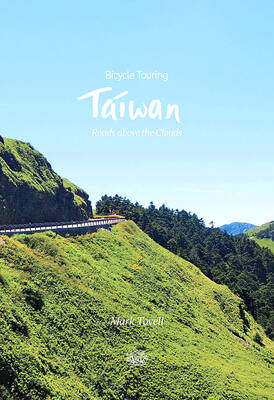
It’s hard to know where to begin with Mark Tovell’s Taiwan: Roads Above the Clouds. Having published a travelogue myself, as well as having contributed to several guidebooks, at first glance Tovell’s book appears to inhabit a middle ground — the kind of hard-to-sell nowheresville publishers detest. Leaf through the pages and you’ll find them suffuse with the purple prose best associated with travel literature: “When the sun is low on a warm, clear morning, and with the heat already rising, we stand at the riverside bike path leading south from Sanxia’s old cobble streets.” Hardly the stuff of your
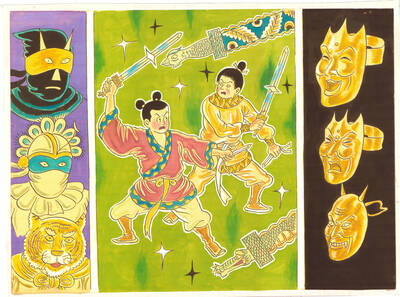
April 22 to April 28 The true identity of the mastermind behind the Demon Gang (魔鬼黨) was undoubtedly on the minds of countless schoolchildren in late 1958. In the days leading up to the big reveal, more than 10,000 guesses were sent to Ta Hwa Publishing Co (大華文化社) for a chance to win prizes. The smash success of the comic series Great Battle Against the Demon Gang (大戰魔鬼黨) came as a surprise to author Yeh Hung-chia (葉宏甲), who had long given up on his dream after being jailed for 10 months in 1947 over political cartoons. Protagonist


 RSS
RSS