


The production designer Jack Fisk has made a specialty of bringing lost worlds to life. In a more literal sense than cinematographers, production designers are responsible for the look of a film - they create its physical reality - and Fisk's projects tend to be more physically demanding and more rooted in reality than most.
He works on a large, even heroic scale, combining elements of architecture and anthropology. For The Thin Red Line, Terrence Malick's meditative depiction of the Battle of Guadalcanal, he built World War II fighter jets and a Melanesian village.
For The New World, Malick's retelling of the Pocahontas legend, Fisk replicated the log fort and mud buildings of 17th-century Jamestown, not far from the actual site. Most recently, for Paul Thomas Anderson's There Will Be Blood, an obsessive epic about a California oil prospector (Daniel Day-Lewis), he conjured from scratch a turn-of-the-century desert settlement studded with derricks and drills, a starkly poetic vision of the Old West suffering its first industrial scars.
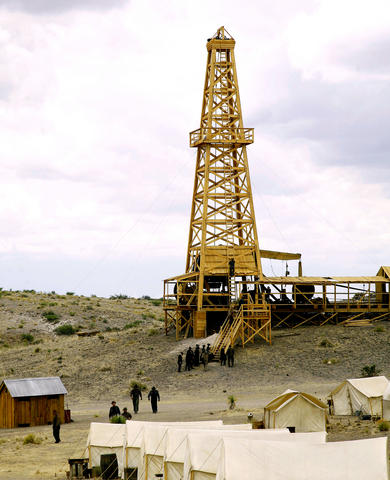
PHOTO: NY TIMES NEWS SERVICE
Fisk, 62, may not be the most prolific designer - he has worked on fewer than 20 features and even gave up the trade in the 1980s to focus on directing - but he is one of the most fascinating unsung figures in American movies. It is impossible to trace a line through the major filmmakers of the last few decades, from Malick to Brian De Palma to David Lynch to Anderson, without running into Fisk. (He has yet to be nominated for an Oscar, an oversight that his work on There Will Be Blood seems likely to redress.)
Fisk has been the production designer (or art director, as the job used to be called) on all four of Malick's films; he met his wife, Sissy Spacek, on Malick's first feature, Badlands (1973). He goes even further back with Lynch (for whom he has worked twice as production designer, on The Straight Story and Mulholland Drive). They met in the ninth grade, shared a painting studio while in high school in Alexandria, Virginia, and then attended the Pennsylvania Academy of the Fine Arts in Philadelphia. Fisk provided sculptures for Lynch's first short, an expulsive animation called Six Men Getting Sick (1966), and has a memorable cameo as the Man in the Planet in Lynch's first feature, Eraserhead (1977).
There Will Be Blood is his first collaboration with Anderson, whom he was quick to put in the company of Lynch and Malick. "Like a lot of films I work on, it doesn't seem commercial," Fisk said in a recent interview in Manhattan. "But I think 20 years from now people will still be talking about it, the way they talk about Badlands and Eraserhead."
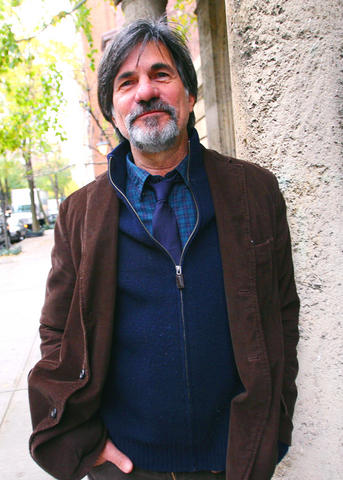
PHOTO: NY TIMES NEWS SERVICE
While writing the screenplay, Anderson was acutely aware that some scenes would be logistically daunting, but "I didn't want to not write something because I didn't know how to do it," he said. "I kind of had to say, 'Well, there's going to have to be a scene down a 15m mine shaft.'" He added: "The first time I talked to Jack, he said, 'I have no idea how to do this, but I really want to do it.' Which was exciting. That's exactly what you want to hear from someone you're going to work with."
The first big decision was where to shoot. "I was searching for years in California because it was a California story," Anderson said, "but you could barely get a place with 360-degree views."
They scouted in New Mexico, but the locations, Fisk said, "didn't have that hard look Paul was looking for." On the outskirts of Marfa, Texas, where part of No Country for Old Men was also shot, they found expansive vistas and suitably inhospitable conditions. "We had heat and dust and mountain lions and snakes that'll kill you," Fisk said.
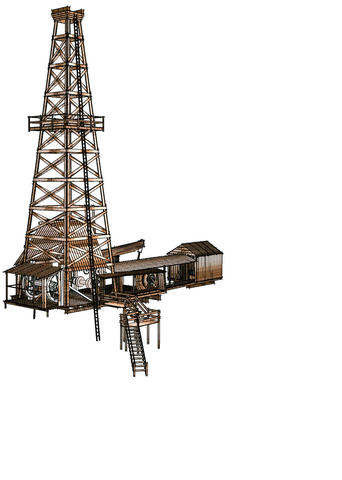
PHOTO: NY TIMES NEWS SERVICE
The oil-rich town of Little Boston was created on a 24,281-hectare ranch that was selected partly for the train tracks running through it. Fisk said that he and Anderson "spent two days just walking" to take in the lay of the land. He then used Google Earth to get an aerial view of the area and to determine the placement of the main structures: a 24m derrick, a family ranch, the church and a row of buildings, parallel to the tracks, that make up the commercial strip.
Fisk cited Edward Hopper's famous painting of light-streaked storefronts, Early Sunday Morning, as an inspiration for the main street. The mansion he built in Malick's Days of Heaven was modeled on House by the Railroad, another Hopper painting.
"Hopper would have been a great production designer," Fisk said. "In art school I used to say, 'Oh, Hopper, he's just an illustrator,' but he grows on you. He simplifies images, and that's what production design is. If you understand the image immediately, it doesn't take you away from the action."
Beyond Marfa, the other locations included an abandoned mine (where they had to fend off killer bees); an oil refinery in Signal Hill, California; and the Doheny Mansion in Beverly Hills, built by the oil tycoon Edward Doheny, a partial inspiration for Day-Lewis' character. The grand finale takes place in the mansion's bowling alley, which Fisk rebuilt to the specifications of a 1920s bowling equipment catalog.
Anderson did most of his research at the oil museums in Bakersfield and Taft, California. "That was our Library of Congress," he said. Anderson unearthed copious photographs of oil fields in early-20th-century California. No less useful were technical manuals. Fisk used the blueprint of a wooden derrick from 1916, with minor modifications, for the one in the film. It had to be sturdy enough to support carpenters and actors and to stand up to high winds, but in the end, Fisk said, "the rig that we built was strong enough, we could have actually drilled."
In the movie's most visually dramatic sequence the derrick burns to the ground. The plan was to shoot in stages, shutting off the gas to allow the crew to regroup. But once the derrick was lighted, "it just kept burning," Fisk said. "We had to shoot in real time until it collapsed."
Besides building and dressing sets - to help the actors stay in character, every room of every building was fully outfitted - it also fell to the film's art department to devise a credible stand-in for oil. Fisk combined food coloring with methylcellulose, a thickener sometimes used as a food additive. It is an ingredient in a McDonald's McFlurry dessert, he said. "You can buy it by the trainload."
Not surprising for someone with a background in sculpture, Fisk gets more involved in the work of set building than most production designers. "That's sort of my trademark," he said.
On There Will Be Blood, in an intriguing corollary to Day-Lewis' method acting, Fisk and his team often practiced a kind of method building. These modest structures were built as they might have been in a small frontier town, starting with the use of salvage lumber. To build the ranch house, "I got together about five carpenters," he said. "I didn't have any plans, and I told them not to bring levels. We just marked the space and started laying the foundation. I figured that's the way they would have done it then."
Fisk said his do-it-all approach might be a holdover from youthful diffidence. He landed his first art-directing gig (on the 1971 bikersploitation film Angels Hard as They Come) without a clear sense of the job description. "I was so scared of not doing what I was supposed to do that I did everything," he said.
It was Lynch who got Fisk his first job on a movie. Lynch, by then enrolled at the American Film Institute, had a job casting gold bricks from plaster on a western that was shooting in Utah. The work was so tedious that after a while he asked if his friend Jack could take over.
Recalling his first impression of Fisk at 14, Lynch said, "I thought he was a loser." But they soon struck up a friendship. "In the whole high school we were basically the only artists," Lynch recalled. "In this conservative world all we wanted to do was paint and live the art life."
The two men have remained close through the years. They were even brothers-in-law. (Lynch was once married to Fisk's sister, Mary.) But it was Malick, a film institute classmate of Lynch's, who sparked Fisk's love of movies. Badlands, Fisk said, was "the film that changed my life," and not just because he married its lead actress. "That's the first time I realized film could be a fine art, equal to painting or sculpture," he said.
Fisk's career is still about the continuing relationships with directors he admires. He and Anderson have talked about teaming up again.
"I'm the luckiest designer I know," Fisk said. "I have an association with these great artists where I don't really question them, and they give me a lot of freedom. I get to hang out with friends and I get to build stuff."
Anderson put it even more succinctly. "Jack likes to hit nails into wood," he said. "And he likes a good adventure."

Last week, Viola Zhou published a marvelous deep dive into the culture clash between Taiwanese boss mentality and American labor practices at the Taiwan Semiconductor (TSMC) plant in Arizona in Rest of World. “The American engineers complained of rigid, counterproductive hierarchies at the company,” while the Taiwanese said American workers aren’t dedicated. The article is a delight, but what it is depicting is the clash between a work culture that offers employee autonomy and at least nods at work-life balance, and one that runs on hierarchical discipline enforced by chickenshit. And it runs on chickenshit because chickenshit is a cultural

My previous column Donovan’s Deep Dives: The powerful political force that vanished from the English press on April 23 began with three paragraphs of what would be to most English-language readers today incomprehensible gibberish, but are very typical descriptions of Democratic Progressive Party (DPP) internal politics in the local Chinese-language press. After a quiet period in the early 2010s, the English press stopped writing about the DPP factions, the factions changed and eventually local English-language journalists could not reintroduce the subject without a long explanation on the context that would not fit easily in a typical news article. That previous
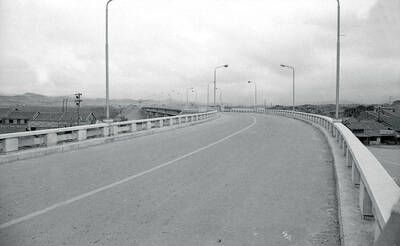
April 29 to May 5 One month before the Taipei-Keelung New Road (北基新路) was set to open, the news that US general Douglas MacArthur had died, reached Taiwan. The military leader saw Taiwan as an “unsinkable aircraft carrier” that was of huge strategic value to the US. He’d been a proponent of keeping it out of Chinese Communist Party (CCP) hands. Coupled with the fact that the US had funded more than 50 percent of the road’s construction costs, the authorities at the last minute renamed it the MacArthur Thruway (麥帥公路) for his “great contributions to the free world and deep
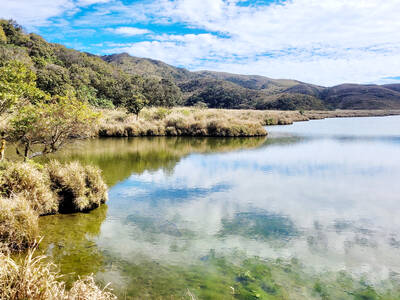
Years ago, I was thrilled when I came across a map online showing a fun weekend excursion: a long motorcycle ride into the mountains of Pingtung County (屏東) going almost up to the border with Taitung County (台東), followed by a short hike up to a mountain lake with the mysterious name of “Small Ghost Lake” (小鬼湖). I shared it with a more experienced hiking friend who then proceeded to laugh. Apparently, this road had been taken out by landslides long before and was never going to be fixed. Reaching the lake this way — or any way that would


 RSS
RSS