


The morning was just starting to heat up when a biologist, Ricardo Costa, set out to look for jaguars on Fazenda San Francisco, a 12,140-hectare cattle ranch, rice farm and wildlife reserve in the region of southwest Brazil known as the Pantanal.
Soon, along a fringe of scrubby woodland, Costa spotted a young male jaguar lazing in sun-flecked shade. "It's Orelha," he whispered, pointing out the tear in the animal's right orelha, or ear.
As Costa watched from the driver's seat of a Toyota truck, the animal stretched and yawned, exposing teeth strong enough to crunch through the skull of almost anything. "Wonderful!" he said.
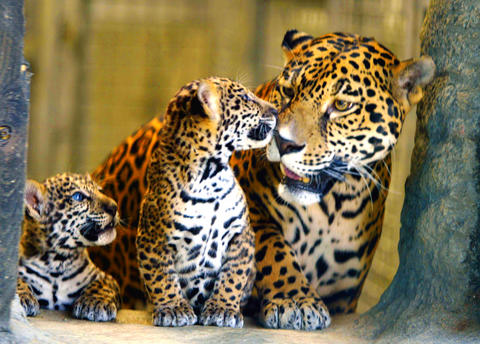
PHOTO: NY TIMES NEWS SERVICE
The jaguar, Panthera onca - the largest cat in the Americas and the third largest in the world - still prowls the rangelands of the Pantanal, a 191,600km2 mosaic of rivers, forests and seasonally flooded savannas that spill from Brazil into neighboring Bolivia and Paraguay.
From the jaguar's perspective, this vast, wildlife-rich area probably seems close to a slice of heaven - or at least it would if the big cats were not routinely hunted down in retaliation for cattle losses.
Costa, for example, said that he worried about Orelha and his more skittish brother, Grandao. Two years ago, he said, an older, larger male who patrolled the same territory was killed when it ventured onto a neighboring ranch.
And now Fernando Azevedo, the senior scientist with whom Costa has been working, says he has lost four of the 14 jaguars he was starting to study at Fazenda Sao Bento, about 97km from San Francisco.
Once again, it appears, the animals were picked off when they wandered away from a ranch where they were protected, onto adjoining properties. Among the casualties, Azevedo suspects, were an adult female and her two nearly full-grown cubs. Convincing ranchers and ranch hands to end such killing has become a priority for conservationists in the region.
The importance of the Pantanal was underscored last October when Thomas Kaplan, executive chairman of the foundation Panthera, an emerging force in big cat conservation, finalized the purchase of two large ranches and signed an agreement to buy a third, creating a property that will soon total more than 161,874 hectares.
The ranches, which will be run by Panthera, are particularly important because they connect previously isolated wildlife preserves. Now, jaguars will be able to travel safely from one sanctuary to the other.
"With jaguars we have the opportunity to play offense," said Kaplan, an entrepreneur and financier who in 2006 founded Panthera. "There are certain areas, like the Pantanal, where the wind is at your back."
Kaplan said that Panthera's plan was to continue running cattle on the ranches while testing a broad range of techniques for reducing livestock-jaguar interactions. The results, he hopes, will encourage others to adopt range management practices that encourage co-existence over conflict.
At stake in the Pantanal, conservationists say, is a significant fraction - perhaps 15 percent - of the world's remaining population of jaguars.
Cattle ranching and jaguar conservation do not need to be mutually exclusive, said Alan Rabinowitz, executive director of the science and exploration program at the Wildlife Conservation Society, based in the Bronx.
"Cattle open up the landscape," Rabinowitz said, and enhance habitat for the jaguar's wild prey. "If you were to take out the cattle and let large areas revert to scrubby vegetation, you'd have far fewer jaguars in the Pantanal than you do today."
Jaguars can also provide ranchers with an additional source of income. For example, several ranches in the Pantanal, San Francisco among them, run ecotourism operations that have turned a liability into a valuable asset.
Conservationists say that the next decade will be pivotal for jaguars, in the Pantanal and throughout its range, which runs from northern Argentina to the borderlands shared by Mexico and the US.
No one knows the precise rate at which the number of jaguars is declining or just how many jaguars there are. But the World Conservation Union pegs the total free-ranging population at fewer than 50,000 adults and classifies the animal as near threatened.
Jaguars may not yet be in such desperate shape as Asian tigers, whose noncaptive breeding population has plummeted below 2,500, or African lions, of which there are perhaps only 20,000 to 30,000 left in the wild. But if conflicts with people and their livestock are not soon resolved, conservationists warn, jaguars could quickly trace a similar trajectory.
At first pass, the conflict between jaguars and ranchers would seem to be intractable. "The cats are where the cows are, and the cows belong to people," said Almira Hoogesteijn, a research veterinarian at the Center for Research and Advanced Studies of the National Polytechnic Institute in Mexico.
But even though jaguars kill and eat cattle, they do so less often than one might imagine.
A quantitative picture of the dietary habits of jaguars emerged from a study conducted by Azevedo at San Francisco in 2003 and 2004.
Over the course of nearly two years, Azevedo and his field assistants collared 11 adult jaguars and tracked their movements. They also methodically collected their scats and examined the carcasses of their prey.
The contents of the scats revealed that the giant rodents known as capybaras were the jaguars' most common prey, followed by caimans and marsh deer. Of 113 carcasses confirmed as jaguar kills, capybaras made up 35; caimans, 23; and cattle, 32.
Azevedo, a postdoctoral fellow at the University of Sao Paulo, then measured the cattle that were killed against a larger background.
In all, 169 cattle deaths occurred at San Francisco during the study period, he and his former thesis adviser, Dennis Murray of Trent University in Canada, reported in the September issue of The Journal of Wildlife Management. Nineteen percent were lost to jaguars. Out of a 5,000-head cattle herd, the jaguar's take faded even more in significance: It amounted to less than 1 percent.
Jaguars in the Pantanal seem to be on a teeter-totter that could tilt strongly in one direction or the other. Given the stakes, Sandra Cavalcanti, a jaguar expert who will soon receive her PhD from Utah State University, said researchers no longer have the luxury to just study these elegantly patterned beasts. To save them, she said, "we have to act."

In late October of 1873 the government of Japan decided against sending a military expedition to Korea to force that nation to open trade relations. Across the government supporters of the expedition resigned immediately. The spectacle of revolt by disaffected samurai began to loom over Japanese politics. In January of 1874 disaffected samurai attacked a senior minister in Tokyo. A month later, a group of pro-Korea expedition and anti-foreign elements from Saga prefecture in Kyushu revolted, driven in part by high food prices stemming from poor harvests. Their leader, according to Edward Drea’s classic Japan’s Imperial Army, was a samurai

The following three paragraphs are just some of what the local Chinese-language press is reporting on breathlessly and following every twist and turn with the eagerness of a soap opera fan. For many English-language readers, it probably comes across as incomprehensibly opaque, so bear with me briefly dear reader: To the surprise of many, former pop singer and Democratic Progressive Party (DPP) ex-lawmaker Yu Tien (余天) of the Taiwan Normal Country Promotion Association (TNCPA) at the last minute dropped out of the running for committee chair of the DPP’s New Taipei City chapter, paving the way for DPP legislator Su

It’s hard to know where to begin with Mark Tovell’s Taiwan: Roads Above the Clouds. Having published a travelogue myself, as well as having contributed to several guidebooks, at first glance Tovell’s book appears to inhabit a middle ground — the kind of hard-to-sell nowheresville publishers detest. Leaf through the pages and you’ll find them suffuse with the purple prose best associated with travel literature: “When the sun is low on a warm, clear morning, and with the heat already rising, we stand at the riverside bike path leading south from Sanxia’s old cobble streets.” Hardly the stuff of your

April 22 to April 28 The true identity of the mastermind behind the Demon Gang (魔鬼黨) was undoubtedly on the minds of countless schoolchildren in late 1958. In the days leading up to the big reveal, more than 10,000 guesses were sent to Ta Hwa Publishing Co (大華文化社) for a chance to win prizes. The smash success of the comic series Great Battle Against the Demon Gang (大戰魔鬼黨) came as a surprise to author Yeh Hung-chia (葉宏甲), who had long given up on his dream after being jailed for 10 months in 1947 over political cartoons. Protagonist


 RSS
RSS