


An exhibition of William Kentridge's tapestries now at the Philadelphia Museum of Art may be uneven, but that's not totally surprising.
Kentridge, born in Johannesburg, South Africa, in 1955, has always tackled an immense and urgent subject: his country's anguish and inequity in the wake of apartheid. Yet he seems to lack some requisite sense of touch or engagement with the materials of art. Perhaps because he began as an actor, writer and set designer, he doesn't exhibit great feeling for the immediacy of the art object.
As a result, his work is almost always best when presented at a remove, in translation or in motion. His charcoal drawings are never as effective on the wall as they are when mutating in his powerful animated films and videos. In moving images the charcoal becomes a tool that almost literally burrows through South African history and human consciousness. Similarly, his drawings, objects, films and shadow figures can work brilliantly for the illusory magic of set design, as his imaginative staging of Mozart's Magic Flute proved recently at the Brooklyn Academy of Music.
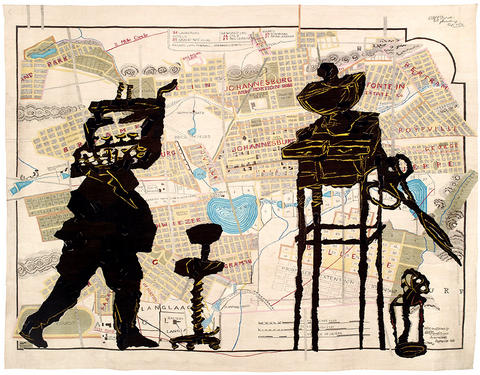
PHOTO: NY TIMES NEWS SERVICE
William Kentridge: Tapestries clarifies this discrepancy, and even benefits from it. The collages on which these tapestries are based, along with related prints and bronze sculptures - all looking fairly inert - are in one gallery. In the other, much larger gallery are the 11 tapestries, completed since 2001, looking a lot livelier, even rather gorgeous, if not as completely alive as his films and video.
The tapestries show large, dark silhouettes - the latest incarnation of the shadow figures Kentridge has deployed for years - against the patterns of old maps. That the tapestries improve greatly upon the collages is one of the show's revelations.
The tapestries were made by the Stephens Tapestry Studio in Johannesburg, in close consultation with Kentridge. Marguerite Stephens established the studio in 1963 in Swaziland as a carpet and curtain weaving business. She moved it two years later to Johannesburg to focus on her craft's artistic potential. According to the exhibition catalog, the weavers use the French Gobelin high-warp technique, working from the bottom up on a vertical loom with the cartoon of the weaving behind it.
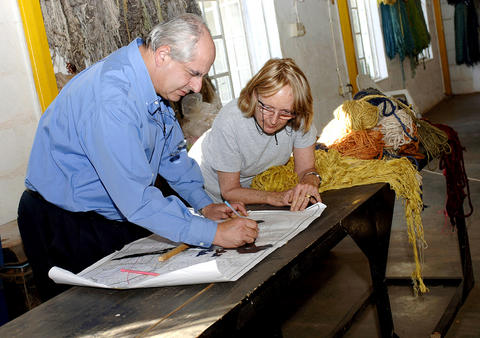
PHOTO: NY TIMES NEWS SERVICE
You don't need to know all this to be impressed by these works, which tap into a long, glorious history and take full advantage of tapestry's capacities for intricacy, color and scale.
Ten are from Kentridge's Porter Series. Measuring as much as 3.6m high or wide, they show one or two figures carrying, or oddly fused with, objects. Of indefinite race, age and often gender, the porters have a Michelangelesque grandeur, even as their black-brown tonality suggests tar or earth. Contributing to their imposing stature are their backgrounds: maps from a world atlas published in 19th-century Europe, when its empires were the most expansive.
In the Puppet Drawings collages on which these tapestries are based, the porters are made from pieces of thick, seemingly torn dark paper hinged together with small, circular pins. As with puppets, their limbs appear moveable.
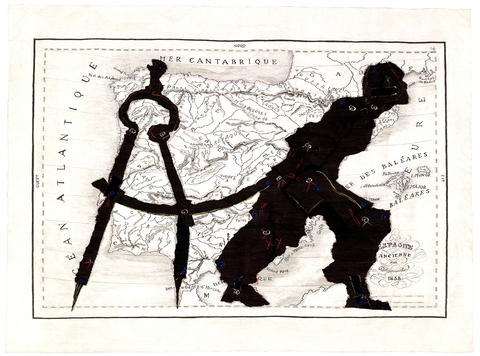
PHOTO: NY TIMES NEWS SERVICE
True to their name, the porters are moving stuff. They are nomads, refugees, asylum seekers or maybe even adventurers. They seem more industrious than driven, but mostly they are on the move, set in motion by forces beyond their control. They are universal, but you could locate them at any point on the maps, and they would become specific, displaced by this or that invasion, liberation, revolution, colonialism or economic crisis.
As characters they range from the symbolic to the real and back again. Rushing across Germany, the Pylon Lady has legs that suggest a draftsman's compass. The figure marching across Central America is piled with ladders and tools that might belong to a gardener or carpenter. Asia Minor is being traversed by a man who has sprouted tree limbs.
The 11th tapestry, Office Love, is the largest - around 3.6m by 4.6m - and easily the most beautiful. Its protagonists include a heavyset businessman with a typewriter for a head, who purposefully approaches three more or less feminine pieces of office furniture, the largest of which is a scribe's table that seems to hold a pair of scissors. Something is in the air. Maybe it is sexual tension; maybe it is simply progress. The writing machine is invading the scriptorium. Interestingly, typewriters started to become standardized in the 1890s, as modern Johannesburg was first being built.
Translating the collages into tapestries is a process of amplification, expansion and refinement. They are redrawn and further detailed in thread. Lines of red, yellow and blue, muted in the collages, become brighter. New lines are added, too, giving the works a greater sense of flux, as if Kentridge were rethinking them. The maps become more legible, the edges of the torn paper more assertive. In awakening and giving life to Kentridge's images, the weaving process could almost be said to animate the collages, to give them a visual energy bordering on motion.
In his catalog essay, Carlos Basualdo, the Philadelphia Museum's curator of contemporary art and the organizer of this exhibition, uses the term "generic creativity." To my mind, generic is a pejorative that implies something is routine, general and impersonal. It is exactly the term I would use to describe what's wrong with many of Kentridge's art objects. I would also suggest that as Kentridge's work moves further away from the specific travails of South Africa, as it does here, it becomes more generic.
But Basualdo translates generic differently, more positively, and arrives at a fresh and helpful point of view. He uses the phrase to describe how weaving transforms Kentridge's ideas by reinterpreting them through a human activity that is not attached to an individual creator, but is instead a "generic creativity" that can be expressed by anyone, in this case, trained in and attentive to the craft.
That's a big idea. It makes sense, given Kentridge's roots in the collaborative art of theater. And it underscores why the work from his own hand gains immeasurably when filtered through a second process, whether provided by a weaver or a video camera. In keeping with the themes of his best efforts, his art is subjected to a form of liberation.

In late October of 1873 the government of Japan decided against sending a military expedition to Korea to force that nation to open trade relations. Across the government supporters of the expedition resigned immediately. The spectacle of revolt by disaffected samurai began to loom over Japanese politics. In January of 1874 disaffected samurai attacked a senior minister in Tokyo. A month later, a group of pro-Korea expedition and anti-foreign elements from Saga prefecture in Kyushu revolted, driven in part by high food prices stemming from poor harvests. Their leader, according to Edward Drea’s classic Japan’s Imperial Army, was a samurai

The following three paragraphs are just some of what the local Chinese-language press is reporting on breathlessly and following every twist and turn with the eagerness of a soap opera fan. For many English-language readers, it probably comes across as incomprehensibly opaque, so bear with me briefly dear reader: To the surprise of many, former pop singer and Democratic Progressive Party (DPP) ex-lawmaker Yu Tien (余天) of the Taiwan Normal Country Promotion Association (TNCPA) at the last minute dropped out of the running for committee chair of the DPP’s New Taipei City chapter, paving the way for DPP legislator Su
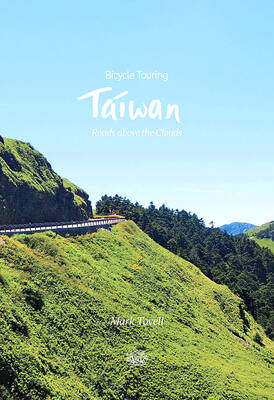
It’s hard to know where to begin with Mark Tovell’s Taiwan: Roads Above the Clouds. Having published a travelogue myself, as well as having contributed to several guidebooks, at first glance Tovell’s book appears to inhabit a middle ground — the kind of hard-to-sell nowheresville publishers detest. Leaf through the pages and you’ll find them suffuse with the purple prose best associated with travel literature: “When the sun is low on a warm, clear morning, and with the heat already rising, we stand at the riverside bike path leading south from Sanxia’s old cobble streets.” Hardly the stuff of your
April 22 to April 28 The true identity of the mastermind behind the Demon Gang (魔鬼黨) was undoubtedly on the minds of countless schoolchildren in late 1958. In the days leading up to the big reveal, more than 10,000 guesses were sent to Ta Hwa Publishing Co (大華文化社) for a chance to win prizes. The smash success of the comic series Great Battle Against the Demon Gang (大戰魔鬼黨) came as a surprise to author Yeh Hung-chia (葉宏甲), who had long given up on his dream after being jailed for 10 months in 1947 over political cartoons. Protagonist


 RSS
RSS