


Fisk University, an historically black school in financial trouble, is sitting on a lottery ticket it cannot cash: a remarkable collection of 19th- and 20th-century art donated by the painter Georgia O'Keeffe.
Two years of legal battles have prevented Fisk from turning some of the valuable art - with works by Picasso, Renoir, Cezanne and others - into money.
The latest battle - over Fisk's proposed deal to share the 101-piece art collection with an Arkansas museum for US$30 million - is scheduled for trial in February.
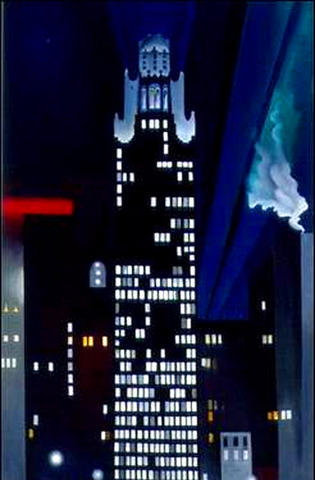
PHOTO: AP
University officials acknowledge it could be years before any money changes hands, if ever. In the meantime, Fisk is struggling.
The 900-student school has mortgaged all its buildings and tapped all of its endowment not restricted to specific programs. As recently as October, a Fisk lawyer told a judge that the school would probably run out of cash before the end of the year.
The crisis eased somewhat earlier this month when the Mellon Foundation announced it would give the university up to US$3 million in grants, with US$1 million of that up front.
But getting others to donate to Fisk to put it on a firm permanent footing could be difficult, because it has had to be rescued several times before.
"Foundations who give serious money don't give it to poorly managed institutions,'' said Davis Carr, a former member of the school's board of trustees. "I'm not saying Fisk is currently poorly managed, but if they've not been able to make it work over some long period of time, that sends a signal." At issue is a collection of art that belonged to O'Keeffe's husband, the photographer Alfred Stieglitz. It includes what is considered one of O'Keeffe's masterpieces, the 1927 oil painting Radiator Building - Night, New York, as well as works by Picasso, Renoir, Cezanne, Marsden Hartley, Alfred Maurer and Charles Demuth.
O'Keeffe donated the art in 1949, choosing Fisk because the school, founded in 1866, educated blacks at a time when the South was segregated. She died in 1986.
To art historians, the collection has an appealing unity, because many of the American artists were part of O'Keeffe and Stieglitz's circle of friends.
In 2005, Fisk's trustees voted to sell off two signature pieces of the collection to help keep the school afloat. Those efforts became bogged down in court battles over whether the sale would violate the terms of O'Keeffe's bequest, and no deal ever went through.
Then Fisk came up with a plan to sell a 50 percent stake in the collection to the Crystal Bridges Museum of American Art for US$30 million. Under the arrangement, the collection would travel back and forth between Nashville and the Bentonville, Arkansas, museum founded by Wal-Mart heiress Alice Walton.
SELLING THE FAMILY SILVER
But the Georgia O'Keeffe Museum in Santa Fe, New Mexico, the legal representative of the artist's estate, has asked a judge to disallow the deal, saying it was O'Keeffe's wish that the collection not be sold. Also, the museum argues that Fisk is violating a condition of gift that the collection be displayed.
Fisk put the art into storage in 2005 because the gallery where it was exhibited was falling apart, and there were fears the works could get damaged.
Experts estimate the two paintings that the university wanted to sell two years ago - Radiator Building and Hartley's Painting No. 3 - could fetch more than US$45 million, and the entire collection could be worth well more than US$100 million.
Art historians and others object strongly to attempts by cultural institutions to sell art just to pay the bills. Moreover, Fisk has gotten little sympathy from those who say the school waited too long to focus on fundraising because it was preoccupied with selling the art.
"Why opt for the strategy of selling your art rather than developing a capital campaign?'' said Lucius Outlaw Jr, a Vanderbilt University professor and Fisk alumnus. "The normal way of managing an institution is to have developed and implemented a plan for substantial fundraising to build an endowment."
The university had to borrow money in the late in 1970s and averted a shutdown in the early 1980s, thanks in large part to donations from Nashvillians and alumni. Fisk reported operating losses totaling more than US$7 million in 2005 and 2006, according to GuideStar.org.
Fisk President Hazel O'Leary set a goal earlier this month of raising US$6.2 million by June 30 but has said that selling the artwork remains a key component of the school's efforts.
While court filings have emphasized Fisk's worsening finances, O'Leary and school officials have publicly downplayed the seriousness of the situation.
Fisk officials have not returned repeated calls from the Associated Press. But O'Leary acknowledged in an opinion piece in the Tennessean last month that the school "has not done a stellar job" of raising money.
She blamed the bleak fundraising performance on frequent turnover of university leadership and an understaffed fundraising team.
Saul Cohen, president of the O'Keeffe Museum, has said the museum's overriding concern is the art, not Fisk's financial condition.
But others have their doubts as to whether the museum is truly interested in protecting O'Keeffe's wishes, noting that it tried to make a deal under which it would buy Radiator Building for US$7.5 million and allow Fisk to sell the Hartley on the open market.
Jock Reynolds, director of the Yale University Art Gallery, has called the O'Keeffe Museum officials "the most hypocritical bunch of looters I've ever run across."

In late October of 1873 the government of Japan decided against sending a military expedition to Korea to force that nation to open trade relations. Across the government supporters of the expedition resigned immediately. The spectacle of revolt by disaffected samurai began to loom over Japanese politics. In January of 1874 disaffected samurai attacked a senior minister in Tokyo. A month later, a group of pro-Korea expedition and anti-foreign elements from Saga prefecture in Kyushu revolted, driven in part by high food prices stemming from poor harvests. Their leader, according to Edward Drea’s classic Japan’s Imperial Army, was a samurai

The following three paragraphs are just some of what the local Chinese-language press is reporting on breathlessly and following every twist and turn with the eagerness of a soap opera fan. For many English-language readers, it probably comes across as incomprehensibly opaque, so bear with me briefly dear reader: To the surprise of many, former pop singer and Democratic Progressive Party (DPP) ex-lawmaker Yu Tien (余天) of the Taiwan Normal Country Promotion Association (TNCPA) at the last minute dropped out of the running for committee chair of the DPP’s New Taipei City chapter, paving the way for DPP legislator Su

It’s hard to know where to begin with Mark Tovell’s Taiwan: Roads Above the Clouds. Having published a travelogue myself, as well as having contributed to several guidebooks, at first glance Tovell’s book appears to inhabit a middle ground — the kind of hard-to-sell nowheresville publishers detest. Leaf through the pages and you’ll find them suffuse with the purple prose best associated with travel literature: “When the sun is low on a warm, clear morning, and with the heat already rising, we stand at the riverside bike path leading south from Sanxia’s old cobble streets.” Hardly the stuff of your
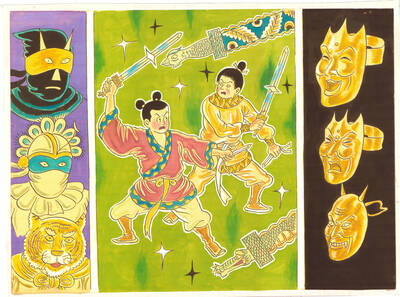
April 22 to April 28 The true identity of the mastermind behind the Demon Gang (魔鬼黨) was undoubtedly on the minds of countless schoolchildren in late 1958. In the days leading up to the big reveal, more than 10,000 guesses were sent to Ta Hwa Publishing Co (大華文化社) for a chance to win prizes. The smash success of the comic series Great Battle Against the Demon Gang (大戰魔鬼黨) came as a surprise to author Yeh Hung-chia (葉宏甲), who had long given up on his dream after being jailed for 10 months in 1947 over political cartoons. Protagonist


 RSS
RSS