


In the tradition of Lord of the Rings (LOTR) and Harry Potter, The Golden Compass gives us yet another visually stunning fantasy universe to deal with. As with LOTR, the source material for the film is taken from a book, in this case Philip Pullman's His Dark Materials series. Though intended for young adults, it is philosophically complex and involves a vast array of characters. Its transition to film posed the same problems of composition and technology as LOTR, and it has received the same intelligent and loving treatment from the production team behind the venture.
Abridging the story to less than two hours is a miracle of compression by director Chris Weitz, but this shorter screening time, along with the news that New Line Cinema waited to gauge reception before going ahead with the subsequent books, suggests hesitancy about throwing big money at this lesser-known series. This and the cutting may explain some of the film's flaws - especially the ending, which is glibly upbeat and a truncation of the book.
Fortunately, Compass' virtues overcome its flaws. The cast is splendid; Nicole Kidman is in a role for which she could have been made - the coldly calculating, ambitious, emotionally predatory Marisa Coulter. This complex creation will be a major selling point for the second part of the series, The Subtle Knife, which she has already signed on for. Daniel Craig, who plays the enigmatic Lord Asriel, Coulter's antagonist through most of the series, will also be back.
PHOTOS: COURTESY OF LONG SHONG
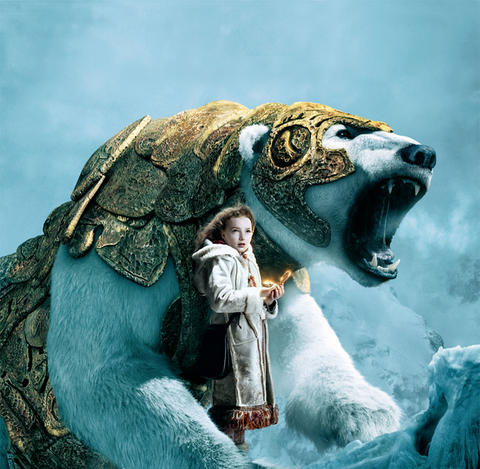
The Golden Compass tells the story of Lyra Belacqua (Dakota Blue Richards), who lives in a world similar yet different from ours and her efforts to save her friends who have been taken away for vile experiments in the frozen wastes of the north through a process of "intercision." The experiments are carried out by the Magisterium, an organization that bears some resemblance to the Catholic Church. On the way she meets and befriends a bear, Iorek Byrnison, voiced in a rumbling baritone by Ian McKellen, who becomes her champion and an itinerant aviator Lee Scoresby, played by Sam Elliott. Needless to say, her efforts are successful.
The interaction between actors and CGI figures is flawless, an essential element in making The Golden Compass watchable, for in Lyra's world, every human has an animal daemon - an attendant spirit - who accompanies them at all times. This clutter of CGI characters could have fatally undermined the story had the director given in to the temptation of using them in a cute or cartoonish manner. As it is, they serve usefully as a sounding board for the thoughts and emotions of the characters to whom they belong. A scene in which Kidman comes to blows with her golden monkey daemon as she is torn by contradictory emotions regarding Lyra is as good a piece of psychological drama as you are likely to find in a big budget movie.
The process of "intercision" is an operation that separates the daemon from the person, with a consequent loss of free volition on the part of the person - it is the loss of that person's soul. In contrast to Pullman's books which have a serious philosophical theme and have been viewed by some as an attack on aspects of the Catholic Church and the Christian faith, the film's hints at theology are never fully brought to the surface.
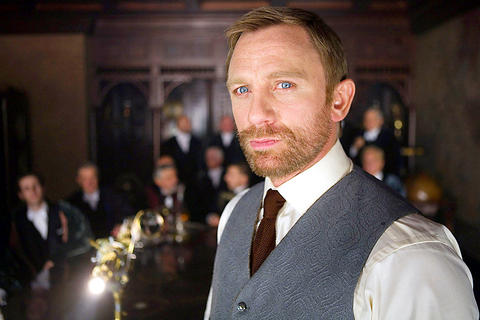
PHOTO: COURTESY OF LONG SHONG
Pullman was influenced in the writing of this series by the poems of William Blake and Milton's Paradise Lost, from which the title of the series His Dark Materials, is taken. In an interview with Pullman on fan Web site bridgetothestars.net, Weitz said, "They [New Line Cinema] have expressed worry about the possibility of HDMs' [His Dark Materials] perceived anti-religiosity making it an unviable project financially ... . All my best efforts will be directed towards keeping HDM as liberating and iconoclastic an experience as I can. But there may be some modification of terms. You will probably not hear of the 'Church,' but you will hear of the Magisterium."
This cowardliness in the face of pressure from organizations such as the Catholic League in the US, which has accused Pullman of being the "new face of atheism," is sad. Nevertheless, it must be said that the philosophical thinness of the film probably owes more to the demands of the medium than to Weitz's and New Lines' desire to avoid confrontation with the kind of militant and intolerant religious organization that is criticized in Pullman's books.
Inevitably, the book is boiled down to its simplest components, but even then, there is so much story to tell that the film has a galloping pace in which the philosophical underpinnings of the book get lost or hopelessly confused. This is hardly surprising, as cinema is increasingly something akin to illustrated companions of much-loved books.
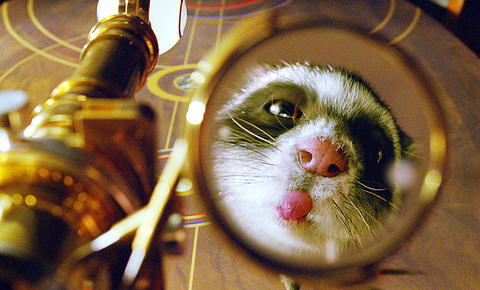
PHOTO: COURTESY OF LONG SHONG
In The Golden Compass the author tries to represent philosophical world views. The pictures themselves, while very splendid, are less effective in giving the audience a true sense of what the book is about. Reliance is placed instead on iconic visuals. For example, the polar bear character Iorek Byrnison, a CGI creation, is the center of a set-piece battle sequence which is alone worth the price of admission. It is rather unfortunate that only people who have read the book will understand just exactly how he comes to win it.
For all that, Weitz must be congratulated on fitting so much into so little space, even if this roller-coaster ride might have benefited from a few slower moments. For the most part, plot point follows plot point in such tight succession that there is hardly time to draw breath, and little time for surprise or delight to register. Still we must hope that the film will act as "bait," in the words of Bill Donohue, president of the Catholic League, and bring more readers to a series of books that deserves to be more widely known.

In late October of 1873 the government of Japan decided against sending a military expedition to Korea to force that nation to open trade relations. Across the government supporters of the expedition resigned immediately. The spectacle of revolt by disaffected samurai began to loom over Japanese politics. In January of 1874 disaffected samurai attacked a senior minister in Tokyo. A month later, a group of pro-Korea expedition and anti-foreign elements from Saga prefecture in Kyushu revolted, driven in part by high food prices stemming from poor harvests. Their leader, according to Edward Drea’s classic Japan’s Imperial Army, was a samurai

The following three paragraphs are just some of what the local Chinese-language press is reporting on breathlessly and following every twist and turn with the eagerness of a soap opera fan. For many English-language readers, it probably comes across as incomprehensibly opaque, so bear with me briefly dear reader: To the surprise of many, former pop singer and Democratic Progressive Party (DPP) ex-lawmaker Yu Tien (余天) of the Taiwan Normal Country Promotion Association (TNCPA) at the last minute dropped out of the running for committee chair of the DPP’s New Taipei City chapter, paving the way for DPP legislator Su

It’s hard to know where to begin with Mark Tovell’s Taiwan: Roads Above the Clouds. Having published a travelogue myself, as well as having contributed to several guidebooks, at first glance Tovell’s book appears to inhabit a middle ground — the kind of hard-to-sell nowheresville publishers detest. Leaf through the pages and you’ll find them suffuse with the purple prose best associated with travel literature: “When the sun is low on a warm, clear morning, and with the heat already rising, we stand at the riverside bike path leading south from Sanxia’s old cobble streets.” Hardly the stuff of your
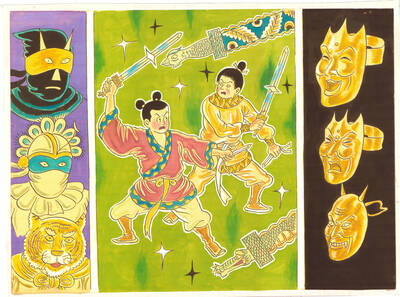
April 22 to April 28 The true identity of the mastermind behind the Demon Gang (魔鬼黨) was undoubtedly on the minds of countless schoolchildren in late 1958. In the days leading up to the big reveal, more than 10,000 guesses were sent to Ta Hwa Publishing Co (大華文化社) for a chance to win prizes. The smash success of the comic series Great Battle Against the Demon Gang (大戰魔鬼黨) came as a surprise to author Yeh Hung-chia (葉宏甲), who had long given up on his dream after being jailed for 10 months in 1947 over political cartoons. Protagonist


 RSS
RSS