


For nearly two decades, a serial killer has terrorized one of Hong Kong's most affluent residential areas. Motive and identity remaining a mystery.
The infamous "Bowen Road Poisoner" has claimed dozens of lives, his - or her - most recent victim dying just last month after eating meat laced with a lethal dose of insecticide.
Lethal, that is, to the pet dogs who are the target of this elusive killer.
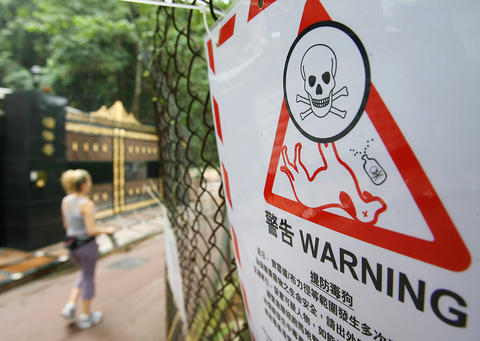
PHOTO: AFP
The poisoner's name derives from a tree-lined street popular with dog-walkers where many of the victims have died.
And the killer's modus operandi - laying down poisoned meat at the side of the road where dogs are likely to find it - has allowed whoever it is to go undetected since 1989.
The latest victim, a chocolate-brown mongrel adopted from Hong Kong's dog rescuers, died last month within 30 minutes of eating poisoned meat as her owners took her for an early morning walk on Bowen Road.

PHOTO: AFP
Police figures show there have been 72 reported poisonings in the area since 1989, 44 of them fatal, although vets here believe many more such incidents might have gone unreported.
Earlier this year, one Hong Kong dog lover decided enough was enough.
Local resident and dog owner Barry Lea pledged US$6,500 of his own money to allow Hong Kong's Society for the Prevention of Cruelty to Animals (SPCA) to double its long-standing reward for information leading to the poisoner's arrest.
Lea, a former police officer, said he was inspired to act after the deaths of two Labrador-poodle crosses being trained to work as care dogs.
"I'm a dog lover and I have a Labrador retriever who's a trained search and rescue dog. Why anyone would want to see her dying an agonizing death is beyond me," he says.
"(The case) is in the hands of regional crime units, who usually deal with serious crime. But so far, they've not been able to track the culprit down, and it will be money well spent if they do."
The pledge has injected new life into the SPCA's campaign to raise awareness of the poisonings among dog owners.
The organization says it has switched the focus of its campaign to public education as the poisoner continues to evade police.
SPCA Chief Superintendent Tony Ho, a retired police officer, leads a team of people who regularly patrol Bowen Road, and nearby Black's Link, handing out leaflets and talking to walkers.
"We are trying to educate the dog owners to control their dogs and by telling them what they should do if they suspect the dog may have consumed poison," he says.
"But we also talk to the other road users. We try to explain to them that if they're not happy about the animals they shouldn't put the blame on the animals, it's the owners' fault."
Ho says the patrols have uncovered high levels of anti-dog sentiment in this traditionally pet-loving city.
He believes there may be some ill-feeling, particularly among older people, about dogs fouling the street near sacred spots such as Lover's Rock, where unmarried women go to pray for a husband, in this deeply superstitious city.
"You do get copycat crimes and it's very difficult to say whether it's one person doing this, or more.
"All we can do is do our very best and continue to send our men up more than once a day, and the police are doing almost the same. Trouble is we can't do it for 24 hours, it's a very long stretch of road," Ho says.
Lea believes the poisoner has been "either very clever or very lucky, or a combination of both" to be able to evade detection for so long, while continuing to lay down bait on the popular street.
"The area spreads over several kilometers and while it's a well trod path there are lots of twists and turns and there are times when it's pretty quiet," he says.
There have been frequent complaints that Hong Kong police do not take the killings seriously enough, although the force has devoted considerable resources to the case, at one point drafting in a Swedish pet specialist to profile the serial killer.
Lea, a long-term Hong Kong resident, fears the poisonings are now beginning to harm the city's image.
"It's been going on for a very long time now, far too long, and a lot of animals have been killed or injured," he says.
"But it goes further than the killing of innocent creatures. The Australian Chamber of Commerce recently published an article on living in Hong Kong that included a warning about the dog poisoner.
"When you get that kind of thing it starts to reflect quite badly on the place as a whole."

By global standards, the traffic congestion that afflicts Taiwan’s urban areas isn’t horrific. But nor is it something the country can be proud of. According to TomTom, a Dutch developer of location and navigation technologies, last year Taiwan was the sixth most congested country in Asia. Of the 492 towns and cities included in its rankings last year, Taipei was the 74th most congested. Taoyuan ranked 105th, while Hsinchu County (121st), Taichung (142nd), Tainan (173rd), New Taipei City (227th), Kaohsiung (241st) and Keelung (302nd) also featured on the list. Four Japanese cities have slower traffic than Taipei. (Seoul, which has some

Taiwan’s semiconductor industry consumes electricity at rates that would strain most national grids. Taiwan Semiconductor Manufacturing Co (TSMC) alone accounted for more than 9 percent, or 2,590 megawatts (MW), of the nation’s power demand last year. The factories that produce chips for the world’s phones and servers run around the clock. They cannot tolerate blackouts. Yet Taiwan imports 97 percent of its energy, with liquefied natural gas reserves measured in days. Underground, Taiwan has options. Studies from National Taiwan University estimate recoverable geothermal resources at more than 33,000 MW. Current installed capacity stands below 10 MW. OBSTACLES Despite Taiwan’s significant geothermal potential, the

In our discussions of tourism in Taiwan we often criticize the government’s addiction to promoting food and shopping, while ignoring Taiwan’s underdeveloped trekking and adventure travel opportunities. This discussion, however, is decidedly land-focused. When was the last time a port entered into it? Last week I encountered journalist and travel writer Cameron Dueck, who had sailed to Taiwan in 2023-24, and was full of tales. Like everyone who visits, he and his partner Fiona Ching loved our island nation and had nothing but wonderful experiences on land. But he had little positive to say about the way Taiwan has organized its

The entire Li Zhenxiu (李貞秀) saga has been an ugly, complicated mess. Born in China’s Hunan Province, she moved to work in Shenzhen, where she met her future Taiwanese husband. Most accounts have her arriving in Taiwan and marrying somewhere between 1993 and 1999. She built a successful career in Taiwan in the tech industry before founding her own company. She also served in high-ranking positions on various environmentally-focused tech associations. She says she was inspired by the founding of the Taiwan People’s Party (TPP) in 2019 by Ko Wen-je (柯文哲), and began volunteering for the party soon after. Ko


 RSS
RSS