


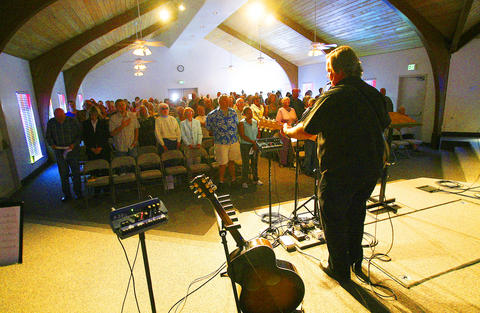
Mike Day, singer and guitarist, gathered his rock band around him.
Dressed in a faded black T-shirt, jeans and skateboard sneakers, he bent his shaved head. "God," he said, "I hope these songs we sing will be much more than the music. I know it's so difficult at times when we're thinking about chords and lyrics and when to hit the right effect patch, but would you just help that to become second nature, so that we can truly worship you from our hearts?"
A few minutes later the band broke into three songs of slightly funky, distorted rock with heaving choruses, and the room sang along: 1,500 or so congregants of High Desert Church here, where Day, 33, is a worship director. This was Sunday night worship for the young-adult subset of the church's congregation, but it was also very much a rock show, one that has helped create a vibrant social world in this otherwise quiet desert town.
PHOTOS: NY TIMES NEWS SERVICE
There has been enormous growth in the evangelical Protestant movement in the US over the last 25 years, and bands in large, modern, nondenominational churches - some would say megachurches - like this one, 140km northeast of Los Angeles, now provide one of the major ways that Americans hear live music.
The house bands that play every weekend in High Desert Church - there are a dozen or so - scavenge some of their musical style from the radio and television. They reflect popular taste, though with lyrics about the power of God, not teenage turmoil.
They are not aiming for commercial success. Church-based Christian rock - often referred to as CCM, for contemporary Christian music - does not exist primarily to compete in mainstream culture; it exists first to bring together a community.
PHOTOS: NY TIMES NEWS SERVICE
"When you start a church," said Tom Mercer, 52, the senior pastor, "you don't decide who you're going to reach and then pick a music style. You pick a music style, and that determines who's going to come."
High Desert Church has a sprawling concrete campus that includes a lavish auditorium, a gym, classrooms and office space for its 70 employees. Once a traditional Baptist church, it moved toward nondenominational and evangelical Christianity in the mid-1990s and experienced steep growth. Now more than 8,000 people attend services here at least twice a month.
A number of factors encouraged the church's expansion, Mercer and others say. For one thing, there are more people in Victorville to receive the gospel: Since the early 1990s the region has been experiencing a population surge, as city dwellers have moved north from Los Angeles County, seeking lower real estate costs.
For another, in 1993 the church hired Jeff Crandall, the drummer for a Christian punk band called the Altar Boys, as its music director.
Crandall, 46, spent more than a decade crossing the country in vans, playing in churches, nightclubs and high school gyms, fighting the battle for a more progressive and aggressive worship music. "I knew that the future, even in the early '80s, was with bands in churches," he said. "I liked hymns as a kid, but I just didn't see myself waving my arms and directing them. I've always been one of those guys who tries to figure his own way."
Bands for all ages
What he did was to pack the church with rock 'n' roll. He organized a rotation of bands, so the volunteering musicians - drawn from the largely commuter population of Victorville and its surrounding towns - would not exhaust themselves by playing to multiple services. And then he let them play, loudly.
High Desert Church holds three different large services over the weekend for three different age groups, with music tailored to each audience: Seven (so named for the number's positive associations in the Bible), the 18-to-30-year-old set that made up Day's audience; Harbor, the 30-to-55 group; and Classic, for people 55 and over. The church also maintains even more bands for services at the junior high, high school and elementary school levels. Each band carefully calibrates its sound toward the pop culture disposition of the target age group.
Young people and future generations are in fact the fixation of High Desert Church, which has already broken ground on building a children's ministry complex called Pointe Discovery, a US$20 million project financed entirely by worshiper donations. "If I ask God's people to give me US$20 million," Mercer said during an interview in his corner office, "when I stand before God someday, I don't want to hear him say, 'Dude, you wasted a ton of my money.' I want him to say, 'You did a good job.' My definition of a good job is that it will impact people until Christ comes back."
JESUS is a punk
Praise-rock is at the heart of that impact. The teenagers and young adults at High Desert - those who haven't been attending services since birth - tend to say they joined the church for the teaching and the community, and stayed because of the bands. But some are clearly more enthusiastic about the music itself.
"I started out in Harbor, but I moved to Seven because I liked the music more," said Tony Cherco, 32, a recent arrival to the church who would not have been out of place in the East Village of Manhattan: He wore a long beard and large rings in his earlobes. "Between Pastor Tom and the music of Seven, I was like, yes!"
To generalize, the music tailored to the Seven service is modern rock, with a modicum of wired aggressiveness. (In its sets before and after the pastor's sermon, the band does play some adaptations of hymns, including a power-chord version of the doxology. It was arranged by the worship minister Matt Coulombe to approximate the droning, locomotive style of the secular New York rock band Secret Machines, one of his favorite groups.)
The music for Harbor, meanwhile, resembles U2 from about 1985, while the Classic crowd gets a softer and more acoustic sound, like the West Coast folk-rock of the 1970s.
For the children, in both their Sunday school classes and youth group events, the music is pop-punk. The idea is to keep their attention with high energy, then to slide gradually toward contemplation.
On a Saturday afternoon in October a group for the junior high contingent, called Power Surge, which included four guitarists and two bassists, played in the church gym, rehearsing a version of the Jason Wallis song Hey God. Fifteen girls performed choreographed hand motions to the music, which sounded like pious Ramones:
Hey, hey, hey, God I love you
Hey, hey, hey, God I need you
I know there's not anything you can't do
I know there's nothing you won't see me through
Hey God!
These bands don't need to take all their cues from secular rock. Since the 1970s there have been Christian versions of all kinds of genres, from folk-rock to metal to punk. But the music heard at this church descends more directly from other Christian music.
The fountainheads are artists like Lincoln Brewster, a singer, guitarist and songwriter who began as a touring rock guitarist in the mid-1990s and later became music minister at several churches, before starting his own recording career. His highly melodic songs, as well as those by other Christian-rock artists like Chris Tomlin and Matt Redman, are performed here in nearly constant rotation.
Then there is Air One, a national FM radio network with 164 stations that serves as an index of the current Christian-rock movement and provides a playlist for many of the bands here. For the most part the groups at High Desert Church don't write their own songs; they are high-functioning garage bands, playing cover versions. But they operate in a large, modern auditorium with top-quality sound, lights and video operated by young volunteers; there are smoke machines and overhead screens that announce the title of each song and its lyrics.
The ultimate purpose
Still, showmanship has its limits in praise-rock music. The musicians don't want to distract themselves, or their audiences, from the higher purpose of serving God; in interviews they talked about not exuding rock-star charisma but instead remaining humble. "We're not up there to have people say, 'Wow, what an amazing band,'" Day said. His goal, he explained, was to play with excellence but to remain "transparent."
"There's a constant tension," he continued, "between the audience and the people on the stage, all thinking, 'OK, music is a great tool, but the ultimate purpose is worship.' And riding that tension is tough."
The congregants also tend to respond fairly chastely. A performance at a Seven service may look like a rock show, with the audience dressed as fashionably as the band, but in some ways it represents an inversion of one.
"It's all about the heart of worship," said Bobby Stolp, 39, a drummer in several different bands here. "God can enjoy a distorted guitar as well as a clean guitar. Especially when you're playing it for him."

In late October of 1873 the government of Japan decided against sending a military expedition to Korea to force that nation to open trade relations. Across the government supporters of the expedition resigned immediately. The spectacle of revolt by disaffected samurai began to loom over Japanese politics. In January of 1874 disaffected samurai attacked a senior minister in Tokyo. A month later, a group of pro-Korea expedition and anti-foreign elements from Saga prefecture in Kyushu revolted, driven in part by high food prices stemming from poor harvests. Their leader, according to Edward Drea’s classic Japan’s Imperial Army, was a samurai

The following three paragraphs are just some of what the local Chinese-language press is reporting on breathlessly and following every twist and turn with the eagerness of a soap opera fan. For many English-language readers, it probably comes across as incomprehensibly opaque, so bear with me briefly dear reader: To the surprise of many, former pop singer and Democratic Progressive Party (DPP) ex-lawmaker Yu Tien (余天) of the Taiwan Normal Country Promotion Association (TNCPA) at the last minute dropped out of the running for committee chair of the DPP’s New Taipei City chapter, paving the way for DPP legislator Su
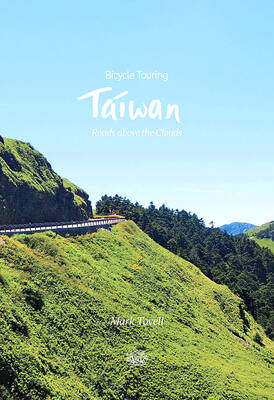
It’s hard to know where to begin with Mark Tovell’s Taiwan: Roads Above the Clouds. Having published a travelogue myself, as well as having contributed to several guidebooks, at first glance Tovell’s book appears to inhabit a middle ground — the kind of hard-to-sell nowheresville publishers detest. Leaf through the pages and you’ll find them suffuse with the purple prose best associated with travel literature: “When the sun is low on a warm, clear morning, and with the heat already rising, we stand at the riverside bike path leading south from Sanxia’s old cobble streets.” Hardly the stuff of your
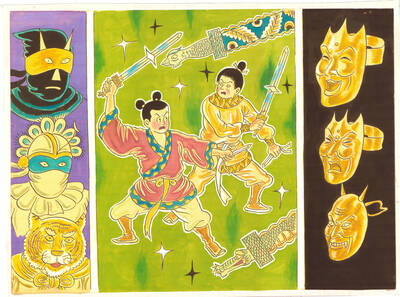
April 22 to April 28 The true identity of the mastermind behind the Demon Gang (魔鬼黨) was undoubtedly on the minds of countless schoolchildren in late 1958. In the days leading up to the big reveal, more than 10,000 guesses were sent to Ta Hwa Publishing Co (大華文化社) for a chance to win prizes. The smash success of the comic series Great Battle Against the Demon Gang (大戰魔鬼黨) came as a surprise to author Yeh Hung-chia (葉宏甲), who had long given up on his dream after being jailed for 10 months in 1947 over political cartoons. Protagonist


 RSS
RSS