


Passers-by in Changliao (長寮), a town in Kinmen not big enough to be found on most maps of the island, might be surprised to see a series of sculptures and installation art sitting in the middle of a sorghum field. The sculptures are part of an exhibition being held until Oct. 31 titled Kinmen Bunker Art Festival (金門碉堡藝術節).
"Kinmen has three or four thousand bunkers. Our goal was to use local characteristics to create an art exhibition," said Zhou Xiang-ming (周祥敏), head of the Kinmen County Cultural Affairs Bureau Art Department.
The bunkers, weather-beaten to the same brown as the surrounding fields, appear to be as much a part of Kinmen's natural environment as the island's trees. By adding objects such as Chinese style roofs and infusing them into the bunkers, the artists explore the boundaries between nature and man-made objects.
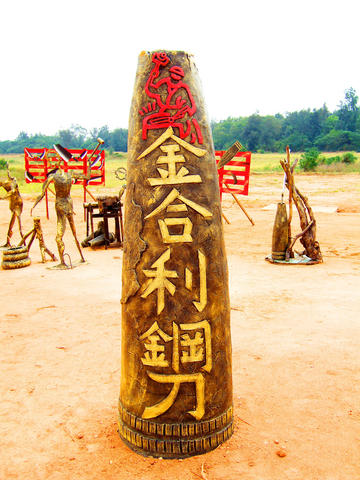
Photo: Michael Kearney, Taipei Times
Chang Yongho (張永和), head of the Architecture Center at Peking University (北京大學), cut open a bunker for his piece, One Divided by Two (一分為二). By doing so Chang exposes the inner space of the bunker, which he says transforms the defunct, stark shell into "a conceptual space that embodies the traditional Chinese [concepts of] yin (陰) and yang (陽)."
The Maestro Wu (金合利鋼刀) knife company and artist Cai Xian-rui (蔡賢瑞) used concrete, steel, wood and other materials to create a piece that shows workers making knives. From 1950 to 1970, close to a million artillery shells were dropped on Kinmen, leaving behind a large amount of metal detritus. Hong Xiu-nuan (洪秀暖), head manager of the Maestro Wu, said the main point of the exhibit "was to show that artillery shells were used to make knives and that these knives are a Kinmen specialty."
Some of the works highlight the horrors of war. Wu Hui-min's (吳惠民) Blood-Stained Demeanor (血染的風采) is a structure that looks like a line of blood-covered human forms and is surrounded by signs that read "Mine Field."
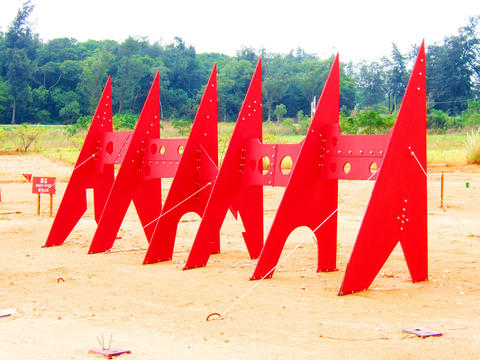
Photo: Michael Kearney, Taipei Times
Wu, who is a pottery artist, said: "My inspiration came from the anti-landing devices I've seen my whole life, which are placed in the ocean to prevent enemy rafts from landing."
Another addition to the installation is a series of poems written by four poets. Bai Ling (白靈), provides a number of clever and often lighthearted poems, with verses such as, "Which region is your body's mine push-button? Why don't you press here and there to see?" Soldiers' mottos and humorous phrases have also been included, such as: "Close your fly; keep careful watch over water and electricity," and "A cockroach struts by the wall; pay attention to suspicious people."
Apart from the robot-like knife craftsmen and the abstract structure of Blood-Stained Demeanor, the installation is devoid of images of people. The effect conveys a message about the impact cross-strait conflict would have on the island.
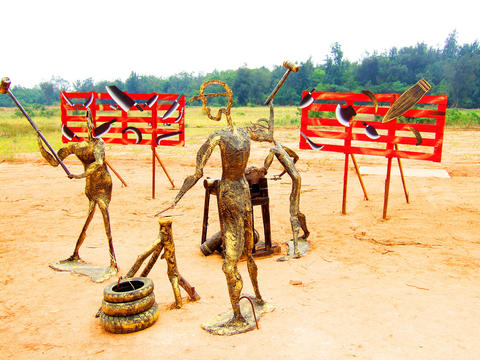
Photo: Michael Kearney, Taipei Times

In late October of 1873 the government of Japan decided against sending a military expedition to Korea to force that nation to open trade relations. Across the government supporters of the expedition resigned immediately. The spectacle of revolt by disaffected samurai began to loom over Japanese politics. In January of 1874 disaffected samurai attacked a senior minister in Tokyo. A month later, a group of pro-Korea expedition and anti-foreign elements from Saga prefecture in Kyushu revolted, driven in part by high food prices stemming from poor harvests. Their leader, according to Edward Drea’s classic Japan’s Imperial Army, was a samurai

The following three paragraphs are just some of what the local Chinese-language press is reporting on breathlessly and following every twist and turn with the eagerness of a soap opera fan. For many English-language readers, it probably comes across as incomprehensibly opaque, so bear with me briefly dear reader: To the surprise of many, former pop singer and Democratic Progressive Party (DPP) ex-lawmaker Yu Tien (余天) of the Taiwan Normal Country Promotion Association (TNCPA) at the last minute dropped out of the running for committee chair of the DPP’s New Taipei City chapter, paving the way for DPP legislator Su

It’s hard to know where to begin with Mark Tovell’s Taiwan: Roads Above the Clouds. Having published a travelogue myself, as well as having contributed to several guidebooks, at first glance Tovell’s book appears to inhabit a middle ground — the kind of hard-to-sell nowheresville publishers detest. Leaf through the pages and you’ll find them suffuse with the purple prose best associated with travel literature: “When the sun is low on a warm, clear morning, and with the heat already rising, we stand at the riverside bike path leading south from Sanxia’s old cobble streets.” Hardly the stuff of your
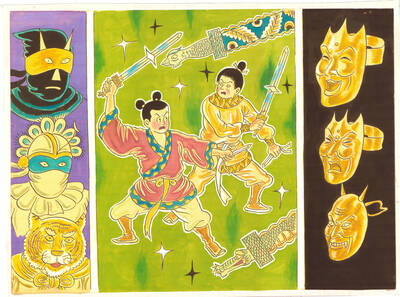
April 22 to April 28 The true identity of the mastermind behind the Demon Gang (魔鬼黨) was undoubtedly on the minds of countless schoolchildren in late 1958. In the days leading up to the big reveal, more than 10,000 guesses were sent to Ta Hwa Publishing Co (大華文化社) for a chance to win prizes. The smash success of the comic series Great Battle Against the Demon Gang (大戰魔鬼黨) came as a surprise to author Yeh Hung-chia (葉宏甲), who had long given up on his dream after being jailed for 10 months in 1947 over political cartoons. Protagonist


 RSS
RSS