


It was a life-altering event.
Lai Fou-hwan (賴復寰) was looking forward to a long career playing basketball and handball when his dreams were cut short in 1979 after a car accident left him with only one leg. But the current secretary general of the Chinese Taipei Paralympic Committee (CTPC, 中華台北殘障體育運動總會) says he looks back at the accident without anger or regret as his disability led him to become one of Taiwan's key spokespersons for athletes with disabilities.
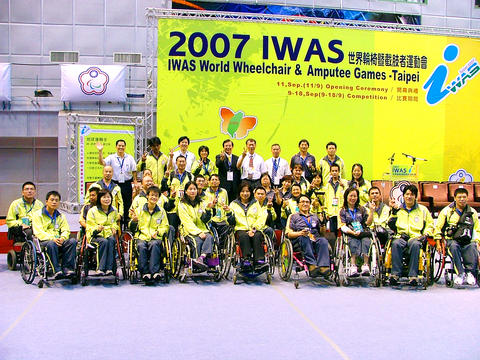
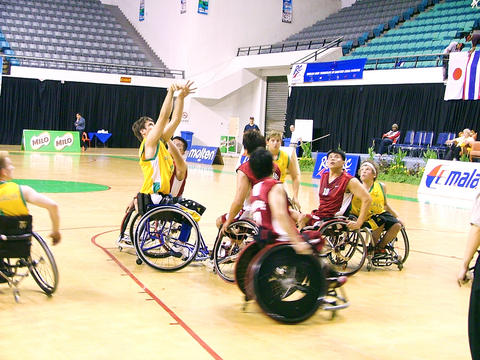
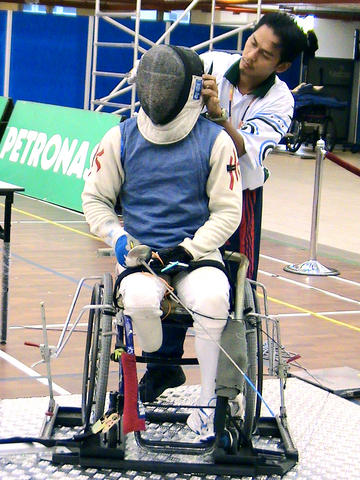
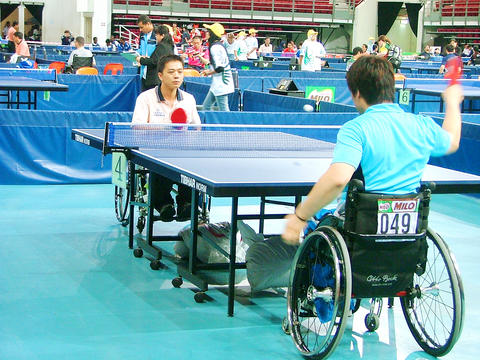
His efforts, along with those of many others, have paid off as Taiwan was chosen to host the 2007 IWAS World Wheelchair and Amputee Games, which began this week in Taipei. Over 800 athletes from 40 countries are competing in eight different categories, seven of which are regional or international qualifiers for the 2008 Paralympic Games in Beijing, at venues across the capital.
PHOTOS: COURTESY OF CTPC
Learning to live with his disability, Lai said, couldn't have happened without the support of his family - especially his wife.
"It's all because of her," he said, pointing to his wife Chen Lee-chou (陳李綢), CTPC president. "Without her, I wouldn't be here today."
Speaking of his own experience as an amputee and a previous competitor in disabled competitions - his sports are discus, javelin and shot put - Lai sees Taiwan's limited venues and resources as obstacles to drawing athletes with disabilities into the sports arena.
PHOTOS: COURTESY OF CTPC
The CTPC was established in 1984 under the name Chinese Taipei Sports Organization for the Disabled. It changed name in 1998. Today, the CTPC has nine full-time employees and 30 volunteers. Lai estimates there are roughly 1,500 disabled athletes in Taiwan - double the number three years ago - who compete in domestic games held every two years.
In the beginning, however, promoting sport for persons with a disability in Taiwan was problematic. A lack of funding for sports in general and disabled sports in particular, coupled with scant media interest, meant that few venues were available for disabled athletes to use.
Recently, however, the CTPC has fostered relations with many non-disabled sport associations, which means that training fields and facilities are placed at disabled athletes' disposal and assistance and specialist equipment are available when needed. The 2002 IPC Table Tennis World Championships held in Taipei, stimulated considerable media attention with television and print media covering the event.
PHOTOS: COURTESY OF CTPC
"Funding for disabled athletes in the form of sponsorships or grants is also an issue as the majority of athletes has to work full-time jobs between practicing for competitions," Lai said.
The CTPC has been trying to turn the situation around by providing athletes with grants.
The National Council on Physical Fitness and Sports has also stepped up to the plate by providing grants to athletes based on the number of medals an athlete wins at either the Paralympic Games or World Championships. For each gold, silver or bronze medal, the athlete receives a financial award. However, the amount pales in comparison to that given to able-bodied athletes.
PHOTOS: COURTESY OF CTPC
"Disabled athletes who win gold receive NT$2.4 million," said Andy Yao (姚韋如) of the CTPC. "But athletes without disabilities who win gold receive about NT$12 million."
"And the coaches don't get paid," said Chen.
The CTPC's goal is to raise enough money so that athletes who win medals at international events are provided with enough money to devote themselves fully to sports, even after they retire. The purpose is to take winning athletes and turn them into coaches or volunteers.
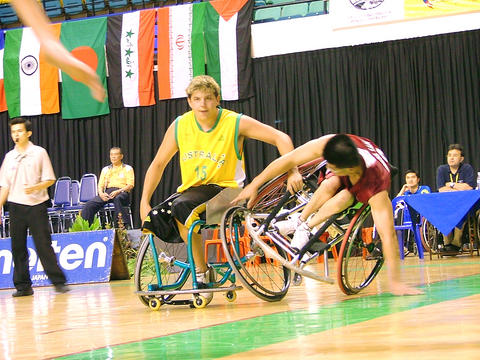
PHOTOS: COURTESY OF CTPC
It would be money well spent. In the 2005 IWAS World Games held in Rio de Janeiro, Brazil, Taiwan's disabled athletes gave impressive performances, returning home with 11 gold, 15 silver and seven bronze medals.
When asked how the athletes may fare at the 2007 IWAS games, Chen was optimistic. Lai piped in that they don't want to place pressure on the athletes but judging by the stellar performances at the most recent competitions he is looking for a good turn out of medals.
Like any sports competition, athletes that win medals serve as ambassadors for Taiwan abroad, and provide role models for athletes at home.
As more local athletes with disabilities bring home medals, the stigmas associated with disabled sport are likely to diminish. Holding the games in Taipei, Chen hopes, will compel other disabled members of the community to take a more active interest in sport.
"If we don't hold any games than people won't know about these sports," she said.
Though sports events for the disabled are now common in most parts of the world, Asia still only has one regional disabled sporting event.
Often parents are afraid to allow their disabled child to participate in sports fearing they may be injured.
However, "when they see the children ... outside and they are happy, free and exercis[ing], ... this [eliminates] their worries," Chen said.
Crucial to bringing along young disabled athletes is instilling them with confidence, Lai said, and this starts by showing parents that a disability doesn't limit a child's potential.
Greater exposure would also erode the view that disabled people cannot become professional athletes.
"These people are professional athletes," said Lai.
In addition to playing host to the 2007 IWAS World Games, Taiwan will host the 2009 Deaflympic Games in Taipei and the 2009 World Games in Kaohsiung. Further details about the 2007 IWAS event competitions, times and venues can be found at mvp140.104web.com.tw/cetacean/front/bin/home.phtml.

In late October of 1873 the government of Japan decided against sending a military expedition to Korea to force that nation to open trade relations. Across the government supporters of the expedition resigned immediately. The spectacle of revolt by disaffected samurai began to loom over Japanese politics. In January of 1874 disaffected samurai attacked a senior minister in Tokyo. A month later, a group of pro-Korea expedition and anti-foreign elements from Saga prefecture in Kyushu revolted, driven in part by high food prices stemming from poor harvests. Their leader, according to Edward Drea’s classic Japan’s Imperial Army, was a samurai

The following three paragraphs are just some of what the local Chinese-language press is reporting on breathlessly and following every twist and turn with the eagerness of a soap opera fan. For many English-language readers, it probably comes across as incomprehensibly opaque, so bear with me briefly dear reader: To the surprise of many, former pop singer and Democratic Progressive Party (DPP) ex-lawmaker Yu Tien (余天) of the Taiwan Normal Country Promotion Association (TNCPA) at the last minute dropped out of the running for committee chair of the DPP’s New Taipei City chapter, paving the way for DPP legislator Su

It’s hard to know where to begin with Mark Tovell’s Taiwan: Roads Above the Clouds. Having published a travelogue myself, as well as having contributed to several guidebooks, at first glance Tovell’s book appears to inhabit a middle ground — the kind of hard-to-sell nowheresville publishers detest. Leaf through the pages and you’ll find them suffuse with the purple prose best associated with travel literature: “When the sun is low on a warm, clear morning, and with the heat already rising, we stand at the riverside bike path leading south from Sanxia’s old cobble streets.” Hardly the stuff of your
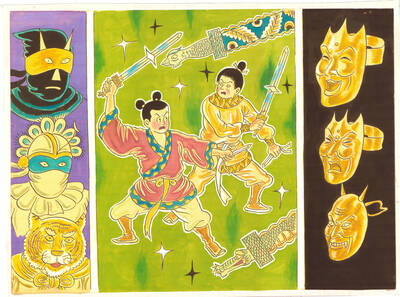
April 22 to April 28 The true identity of the mastermind behind the Demon Gang (魔鬼黨) was undoubtedly on the minds of countless schoolchildren in late 1958. In the days leading up to the big reveal, more than 10,000 guesses were sent to Ta Hwa Publishing Co (大華文化社) for a chance to win prizes. The smash success of the comic series Great Battle Against the Demon Gang (大戰魔鬼黨) came as a surprise to author Yeh Hung-chia (葉宏甲), who had long given up on his dream after being jailed for 10 months in 1947 over political cartoons. Protagonist


 RSS
RSS