


At first, second and final glance, Susan Minot's Evening, a claustrophobic 1998 novel about a woman in her 60s remembering the days and few torrid nights of her life while slowly, very slowly dying, doesn't seem as if it would translate easily to the big screen. It hasn't. Stuffed with actors of variable talent, burdened with false, labored dialogue and distinguished by a florid visual style better suited to fairy tales and greeting cards, this miscalculation underlines what can happen when certain literary works meet the bottom line of the movies. It also proves that not every book deserves its own film.
That bottom line might explain why Claire Danes was cast to play the unripened young Ann in the 1950s, the same character Vanessa Redgrave ushers from this mortal coil in the present. Danes and Redgrave bear no resemblance to each other - they're strangers in look, voice, gesture and screen presence - and neither do the ill-matched Natasha Richardson and Toni Collette, who play Ann's daughters. Among other things, Danes looks agonizingly uncomfortable, as she now often does on screen; Redgrave, by contrast, gives the impression that she'd rather eat a grand piano than surrender the spotlight. Her character may be dying, but she's dying importantly, with flattering lighting and not a pearl of drool.
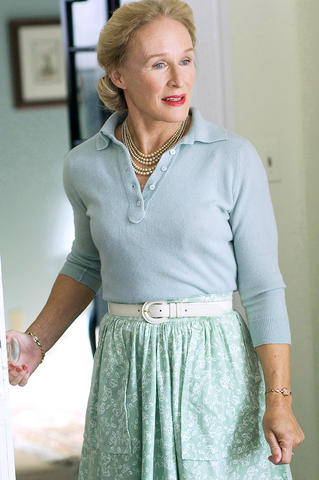
But Evening is not about sickness and dreadful death. It's about how some words that pass muster on the page can sound terribly precious coming out of a real person's mouth. It's also about how modest projects like this depend on name actors to get made, which probably explains why Glenn Close pops up in the film as one of those 1950s matriarchs. Close breathes life and a hint of camp into a cliche, as does the equally fleet and fleeting Meryl Streep.
PHOTOS:COURTESY OF CMC
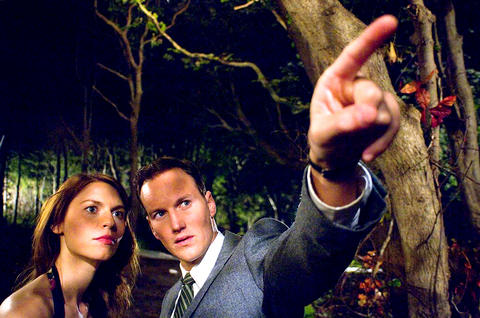
Adapted by Minot and Michael Cunningham (The Hours), the film scales back the novel's ambitious design, notably by jettisoning Ann's imaginary (or spiritual) encounters with her one great love. In the film, the dying Ann drifts between the morphine-fogged present, where her daughters pick at each other and their barely healed wounds, and the hothouse refuge of memory. First among her reminiscences are the few days in the 1950s that she spent under the stars and inside a magical shack with Harris (Patrick Wilson), a strapping young doctor with sensitive eyes and apparently even more sensitive hands whom she met at Lila's wedding. (Streep's daughter Mamie Gummer plays the young Lila.)
The film also ditches one of the novel's central female characters and invests a delicate young man named Buddy with the kind of uncertain sexual desire that Montgomery Clift would have conveyed effortlessly and which the young British actor Hugh Dancy botches. This isn't wholly his fault. Dancy has to try to animate a wheezing stereotype and deliver dialogue laden with forced allusions and a sense of doom so foreboding it might as well come accompanied by Chopin's funeral march. The added complication of Buddy's confused sexuality and the drama it provokes only makes the young Ann, an already unappealing, callow presence in the novel, seem even less attractive and more selfish on screen.
On her deathbed Ann recalls when her younger self first discovered love, or at least the sort of five-alarm sex that inspires Minot to reach for words like "ripping," "clashing," "hammering," "scaling" and "diving." In death Ann floats through the watery memories of youth that nominally sustained her in life, but it is a life strikingly and cripplingly absent any sense of true, blood-warmed experience. It's no wonder that the Hungarian director Lajos Koltai, whose last film was the very good and affecting Holocaust drama Fateless, sinks before he can swim (or dive). He has tried to instill a sense of wonderment into a kitsch romance. He fails badly, but in this he has plenty of company.
PHOTOS:COURTESY OF CMC

In late October of 1873 the government of Japan decided against sending a military expedition to Korea to force that nation to open trade relations. Across the government supporters of the expedition resigned immediately. The spectacle of revolt by disaffected samurai began to loom over Japanese politics. In January of 1874 disaffected samurai attacked a senior minister in Tokyo. A month later, a group of pro-Korea expedition and anti-foreign elements from Saga prefecture in Kyushu revolted, driven in part by high food prices stemming from poor harvests. Their leader, according to Edward Drea’s classic Japan’s Imperial Army, was a samurai

The following three paragraphs are just some of what the local Chinese-language press is reporting on breathlessly and following every twist and turn with the eagerness of a soap opera fan. For many English-language readers, it probably comes across as incomprehensibly opaque, so bear with me briefly dear reader: To the surprise of many, former pop singer and Democratic Progressive Party (DPP) ex-lawmaker Yu Tien (余天) of the Taiwan Normal Country Promotion Association (TNCPA) at the last minute dropped out of the running for committee chair of the DPP’s New Taipei City chapter, paving the way for DPP legislator Su

It’s hard to know where to begin with Mark Tovell’s Taiwan: Roads Above the Clouds. Having published a travelogue myself, as well as having contributed to several guidebooks, at first glance Tovell’s book appears to inhabit a middle ground — the kind of hard-to-sell nowheresville publishers detest. Leaf through the pages and you’ll find them suffuse with the purple prose best associated with travel literature: “When the sun is low on a warm, clear morning, and with the heat already rising, we stand at the riverside bike path leading south from Sanxia’s old cobble streets.” Hardly the stuff of your
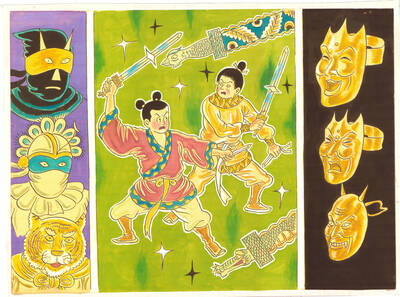
April 22 to April 28 The true identity of the mastermind behind the Demon Gang (魔鬼黨) was undoubtedly on the minds of countless schoolchildren in late 1958. In the days leading up to the big reveal, more than 10,000 guesses were sent to Ta Hwa Publishing Co (大華文化社) for a chance to win prizes. The smash success of the comic series Great Battle Against the Demon Gang (大戰魔鬼黨) came as a surprise to author Yeh Hung-chia (葉宏甲), who had long given up on his dream after being jailed for 10 months in 1947 over political cartoons. Protagonist


 RSS
RSS