


The average Manhattan midsummer day is hot, rank and long. Some of us keep to the great air-conditioned indoors; others head for the country. Both options are available at the Museum of Modern Art, and the word must be out. The ticket lines lately have been long. The lobby of 11 West 53rd Street is an ocean of flip-flops and shorts.
Not that the museum itself is in a kick-back mood. It's taken some serious critical heat since its 2004 reopening. MoMA bashing is the art world sport that Whitney bashing was in the 1990s. People say the Yoshio Taniguchi building is leaden, space hogging, art-hostile. Tongues wag about the museum's cozying up to corporations. And then there's the US$20 entrance fee.
But a lot of people don't seem to care about any of this. Day after day the visitors arrive, armies of them, ready to take their expensive plunge into one of the coolest collections of modern Western art in the world. You go to museums to see art; MoMA owns fabulous art.
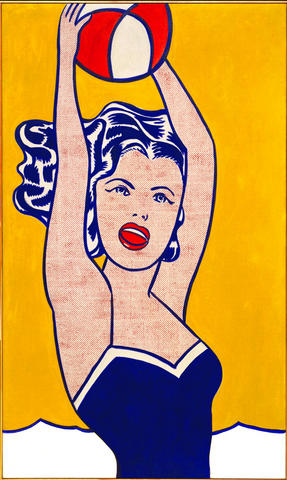
PHOTO: NY TIMES NEWS SERVICE
And a surprising amount of that art, which was once in the vanguard of culture, is about very old-fashioned things, like love and death, and landscapes and seasons, and one season in particular: summer.
In the hot months artists have traditionally fled Paris and New York, but only to take working vacations. They went to the country for refreshment - to wash the studio light from their eyes, as Georges Seurat put it - but also to capture an image of nature on the spot, and to store the memory of it for later use.
So why not follow them on their summer travels - to the Riviera and Long Island, Provence and Cape Cod - by which I mean up and down the Modern's escalators to different galleries on different floors? Let the artists give you a tour.
I took one recently. It was a workout, but it was great, and it ended with an anyone-can-join-in party: beach blanket bingo with Seurat (a real doll); Henri Matisse in a skimmer (let's have a smile, Henri); Liubov Popova, in from Russia (she designed her own bathing suit, and earrings, and shoes); and Pablo Picasso, who flexed nonstop. I worried that they'd have nothing to say to one another. They had everything to say to one another. The conversation was magical. And when it was over, they each went their separate ways.
I'd never thought of Matisse as an outdoor person, and he isn't really, despite all his early fiery Fauve landscapes, of which the museum has a slew. His is an indoor disposition. An environment of contained domestic order gives him the freedom to arrange and disarrange the world at will, take it apart, collapse its space, control its expressive temperatures, determine its confusions.
This is what he's up to in The Blue Window, painted in the bedroom of his home outside Paris in (according to the museum) the summer of 1913. Everything is blue: the walls, the window, the table holding vases and pots, the trees and garden outside. It's as if the sky had invaded the house, or interior shadows had leaked outside.
Giorgio de Chirico was most likely studio-bound the summer he finished Great Metaphysical Interior (1917), a dark, suffocated picture consisting mostly of a setup of easels coming to life in a sort of Sorcerer's Apprentice fantasy. Right in the center, though, like an open window, is a painting within the painting, a view of a lakeside house or hotel in a lush garden landscape. Picture-postcard perfect, the scene feels like a breath of fresh country air. It seems to have "Weather is beautiful - wish I were there" written all over it.
Gardens, of course, can offer some of the most exotic trips on earth in the span of a few feet. Claude Monet's half-blind summer strolls in his gardens at Giverny were interstellar. To his failing, deepening vision, the image of flowers, rippling water and reflected clouds was a trip to an alternative universe, one at once cosmic and materialistic. Is there a difference? He seemed to pose the question.
The Modern has its own garden, the Sculpture Garden. And it too is overgrown this summer, though not with plants. It is almost entirely taken up by two humongous sculptures by Richard Serra, whose work also claims the special exhibition gallery on the sixth floor and the second-floor space usually assigned to the museum's contemporary collection. The garden still has plantings and trees, but mostly you stare at towering rusted-steel Serra walls.
But haven't you had enough of nature tamed, of summer indoors, of autumnal introspection in July? If so, dash back to the design department, rev up the 1963 Jaguar convertible roadster on display there (top speed: a blistering 240kph), grab a Cady Noland license plate drawing from Rattemeyer's show and speed out of town, choosing the route as you go.
In the museum's atrium you'll pass large, grassy Joan Mitchell paintings, fragrant with heat and loam. Upstairs you'll encounter a fleet, blocky watercolor of a mill that Picasso knocked out in the Spanish town of Horta de Ebro in 1909, when he vacationed there and started getting Cubism off the ground. Nearby you'll see Georges Braque's tawny, deciduous Road Near L'Estaque, a late-summer scene of hills, dense trees and a distant view of the sea.
MoMA is thick with trees right now. Max Ernst's tiny Forest and Sun (1931) is all linear arches and loop. Agnes Martin's 1964 painting The Tree is a cage of light built from thousands of twiglike lines. For greenery, though, nothing is greener than Jasper Johns' Green Target (1955): leaf-green, hope-green, it's a traffic light set on "go."
And if you obey it, you'll soon clear the woods and find yourself on a rise, approaching the sea. You can catch its glint in Mondrian's easy-to-miss View From the Dunes With Beach and Piers, Domburg (1909). By the time Milton Avery's Sea Grasses and Blue Sea (1958) comes into sight, you can smell the salt air. You're there.
Back on the highway you slow down to take in a series of four Seurat landscape paintings, of harbor scenes at different times of day. The last one, Evening, Honfleur, is a tender portrait of the seaside resort on the Normandy coast where the young artist passed the summer of 1886. The sea is rough and the winds brisk year round in this part of the world. But you'd never know this from Seurat's scene of a beach, a wedge of sea and a stretch of cloud-banded sky, brought into being one dot of paint at a time, with the dots spreading, like sand, or pollen, or a humid haze, out of the picture and across the frame.
Drink in its tranquillity, its cool grace. Soon you'll be back in town. Mondrian's Broadway Boogie-Woogie (1942-43), that beeping, dancing geometric sizzler, automatically puts you there. But Honfleur at dusk stays in your eyes, ends your tour and carries you out to the street to the end of a perfect getaway summer day.

In late October of 1873 the government of Japan decided against sending a military expedition to Korea to force that nation to open trade relations. Across the government supporters of the expedition resigned immediately. The spectacle of revolt by disaffected samurai began to loom over Japanese politics. In January of 1874 disaffected samurai attacked a senior minister in Tokyo. A month later, a group of pro-Korea expedition and anti-foreign elements from Saga prefecture in Kyushu revolted, driven in part by high food prices stemming from poor harvests. Their leader, according to Edward Drea’s classic Japan’s Imperial Army, was a samurai

The following three paragraphs are just some of what the local Chinese-language press is reporting on breathlessly and following every twist and turn with the eagerness of a soap opera fan. For many English-language readers, it probably comes across as incomprehensibly opaque, so bear with me briefly dear reader: To the surprise of many, former pop singer and Democratic Progressive Party (DPP) ex-lawmaker Yu Tien (余天) of the Taiwan Normal Country Promotion Association (TNCPA) at the last minute dropped out of the running for committee chair of the DPP’s New Taipei City chapter, paving the way for DPP legislator Su
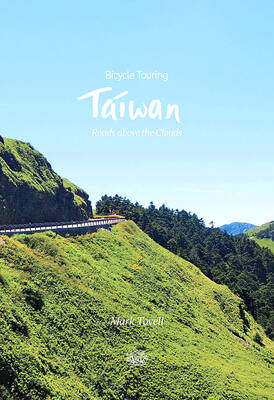
It’s hard to know where to begin with Mark Tovell’s Taiwan: Roads Above the Clouds. Having published a travelogue myself, as well as having contributed to several guidebooks, at first glance Tovell’s book appears to inhabit a middle ground — the kind of hard-to-sell nowheresville publishers detest. Leaf through the pages and you’ll find them suffuse with the purple prose best associated with travel literature: “When the sun is low on a warm, clear morning, and with the heat already rising, we stand at the riverside bike path leading south from Sanxia’s old cobble streets.” Hardly the stuff of your
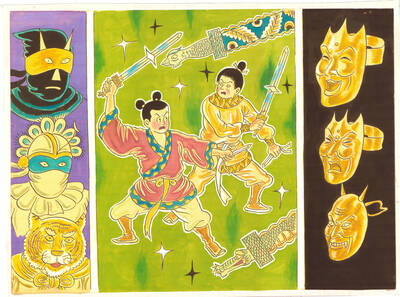
April 22 to April 28 The true identity of the mastermind behind the Demon Gang (魔鬼黨) was undoubtedly on the minds of countless schoolchildren in late 1958. In the days leading up to the big reveal, more than 10,000 guesses were sent to Ta Hwa Publishing Co (大華文化社) for a chance to win prizes. The smash success of the comic series Great Battle Against the Demon Gang (大戰魔鬼黨) came as a surprise to author Yeh Hung-chia (葉宏甲), who had long given up on his dream after being jailed for 10 months in 1947 over political cartoons. Protagonist


 RSS
RSS