


In December 2002, the British journalist Mick Brown was driven by Phil Spector's chauffeur in Phil Spector's white Rolls-Royce to Phil Spector's gloomy castle in Alhambra, California, for a spooky interview with Phil Spector, who wore black silk pajamas and made a grand entrance to the strains of Handel.
Two months later, Lana Clarkson, a tall blond actress who had starred in two Barbarian Queen movies and delivered the line "Hi" in Fast Times at Ridgemont High, died violently at the same house.

The opening chapter of Brown's Spector biography insinuates that the visiting interviewer might also have been in peril.
But it was Spector, the tiny, Napoleonic, gun-toting rock 'n' roll genius who was in jeopardy on that day. Brown was in the midst of compiling a seriously damning, though not even actively malevolent, set of stories about the Spector life and oeuvre. Grouped together in the bloodcurdling biography Tearing Down the Wall of Sound, they add up to a portrait of pure self-interest and cruelty, tempered only slightly by the great musical achievements of Spector's golden age in the early 1960s. This book would feel like a crime story even if its subject were not currently on trial for Clarkson's murder.
Brown is not a muckraker. Nor is he really discovering anything new, at least not in the first half of Spector's story. As many Spector acquaintances and scorched musical collaborators report, Spector's autocratic nature was thought to have obvious sources. There was his father's suicide (which led to the hit To Know Him Is to Love Him, with its title taken from Benjamin Spector's gravestone). There were an overbearing mother and sister, Bertha and Shirley. There was also the possibility of inbreeding, since this rock maestro had both paternal and maternal grandfathers named George Spector and Phil's parents were thought to be first cousins. There were the schoolyard bullies whose persecution supposedly explained the adult Spector's cadre of bodyguards.
This first part of Tearing Down the Wall of Sound, after sketchily defining Spector's pathology, is mostly devoted to explaining how the famous Wall of Sound was created. For those who know the musical history of this period, which has been expertly documented elsewhere, this part of the book holds little surprise beyond the elaborate skein of creative connections. Brown underscores the cause-and-effect links between certain recordings, like the Beach Boys' Don't Worry Baby with Spector's production for the Ronettes, Be My Baby, or the Four Tops' Baby, I Need Your Loving with the monster, Spector-produced Righteous Brothers hit, You've Lost That Lovin' Feeling.
He also explains the ubiquitousness of singers like Darlene Love, who might perform under different names at Spector's whim and then wind up with nothing to show for it. The consensus expressed in the book is that Spector habitually betrayed and discarded musicians after he was through with them. "Rather than develop his artists' careers," Brown quotes the Atlantic Records pioneer Jerry Wexler as saying, "Phil developed himself."
But just as the Spector mystique was being hyperbolically immortalized by Tom Wolfe's 1964 magazine article The First Tycoon of Teen (which, as Brown points out, compares Spector with Thomas Jefferson), the Spector career hit a ceiling. This book maintains that Spector, unlike some of the artists he disparages (notably the Beach Boys' Brian Wilson), began to stall as the world changed around him. "He was like a little boy who does something really cute and gets applauded for that," says Bruce Johnston, the former Beach Boy, "and so he starts figuring out how to get the applause back, but then it's not quite as cute again."
At this point, the book begins to overflow with not-quite-as-cute effluvia. Borrowing from the sad, lurid memoir of Ronnie Spector, whose career with the Ronettes took a nosedive after she married her producer and disappeared under Spector's possessive wing, it describes a lonely household that became a prison. Not for nothing was Citizen Kane Spector's favorite film at the time. The Manson murders and the disastrous adoptions of three Spector children (later virtually abandoned by their father) only worsened the atmosphere of deterioration. In court testimony, it was alleged that Ronnie Spector drank to "shut out the continuous stream of shrieking by the respondent." Said respondent would go on to pay Ronnie Spector a court-ordered interim support payment of US$1,250 in nickels.
Professionally, he grew to be "like Sherlock Holmes without a case." His magisterial Be My Baby became background music in an advertisement for Cialis, the erectile dysfunction drug. And his attempted comebacks and collaborations (the most successful of which, in Brown's opinion, being John Lennon's Imagine) grew ever crazier. He famously aimed a gun at the neck of the singer Leonard Cohen and declared "Leonard, I love you," prompting Cohen to reply drolly "I hope you do, Phil." Working with Spector, says someone who attended their collaborative sessions, "gave Leonard a chance to perfect his Shaolin priesthood stuff and become one with the universe." That was the degree of patience a Spector run-in required.
While Tearing Down the Wall of Sound, with a title that perfectly describes its subject's gift for self-destruction, does find those who appreciated Spector's brilliance, humor, and occasional wild generosity ("Phil, how can you give a thousand-dollar tip to the waiters but you won't pay over scale to the musicians?"), it mostly traces an upward trajectory of anger and paranoia, fueled by alcohol and made ever more alarming by the Spector arsenal. Whatever the circumstances surrounding the deadly firing of a gun in Clarkson's mouth in the early hours of Feb. 3, 2003, Spector's initial response is as telling as anything that may emerge from his trial. He felt annoyed. He felt put upon. He felt misunderstood. And he felt aggrieved. Clarkson, he said, had had absolutely no right to blow her head off inside his castle.

Taiwan’s overtaking of South Korea in GDP per capita is not a temporary anomaly, but the result of deeper structural problems in the South Korean economy says Chang Young-chul, the former CEO of Korea Asset Management Corp. Chang says that while it reflects Taiwan’s own gains, it also highlights weakening growth momentum in South Korea. As design and foundry capabilities become more important in the AI era, Seoul risks losing competitiveness if it relies too heavily on memory chips. IMF forecasts showing Taiwan widening its lead over South Korea have fueled debate in Seoul over memory chip dependence, industrial policy and

“China wants to unify with Taiwan at the lowest possible cost, and it currently believes that unification will become easier and less costly as time passes,” wrote Amanda Hsiao (蕭嫣然) and Bonnie Glaser in Foreign Affairs (“Why China Waits”) this month, describing how the People’s Republic of China (PRC) is playing the long game in its quest to seize Taiwan. This has been a favorite claim of many writers over the years, easy to argue because it is so trite. Very obviously, if the PRC isn’t attacking Taiwan, it is waiting. But for what? Hsiao and Glaser’s main point is trivial,
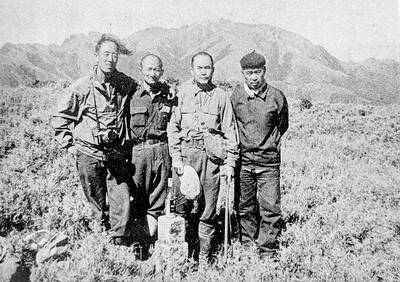
May 18 to May 24 Gathered on Yangtou Mountain (羊頭山) on Dec. 5, 1972, Taiwan’s hiking enthusiasts formally declared the formation of the “100 Peaks Club” (百岳俱樂部) and unveiled the final list of mountains. Famed mountaineer Lin Wen-an (林文安) led this effort for the Chinese Alpine Association (中華山岳協會). Working with other experienced climbers, he chose 100 peaks above 10,000 feet (3,048m) that featured triangulation points and varied in difficulty and character. The list sparked an alpine hiking craze, inspiring many to take up mountaineering and competing to “conquer” the summits. A common misconception is that the 100 Peaks represent Taiwan’s 100 tallest

In a sudden move last week, opposition lawmakers of the Chinese Nationalist Party (KMT) and Taiwan People’s Party (TPP) passed a NT$780 billion special defense budget as a preemptive measure to stop either Chinese leader Xi Jinping (習近平) or US President Donald Trump from blocking US arms sales to Taiwan at their summit in Beijing, said KMT heavyweight Jaw Shaw-kong (趙少康), speaking to the Taipei Foreign Correspondents Club on Wednesday night in Taipei. The 76-year-old Jaw, a political talk show host who ran as the KMT’s vice presidential candidate in 2024, says that he personally brokered the deal to resolve


 RSS
RSS