


The first thing that gets you is the noise. Physics, after all, is supposed to be a cerebral pursuit. But this cavern almost measureless to the eye, stuffed as it is with an Eiffel Tower's worth of metal, eight-story wheels of gold fan-shape boxes, thousands of kilometers of wire and fat duct-like coils, echoes with the shriek of power tools, the whine of pumps and cranes, beeps and clanks from wrenches, hammers, screwdrivers and the occasional falling bolt. It seems no place for the studious.
The physicists, wearing hard hats, kneepads and safety harnesses, are scrambling like Spider-Man over this assembly, appropriately named Atlas, ducking under waterfalls of cables and tubes and crawling into hidden room-size cavities stuffed with electronics.
They are getting ready to see the universe born again.
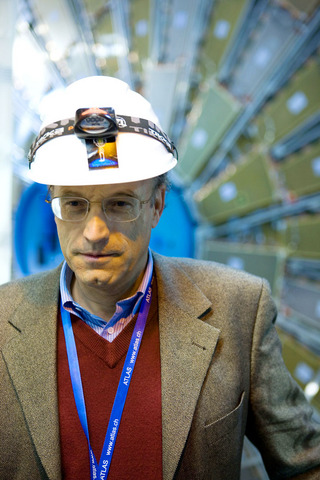
PHOTO: NY TIMES NEWS SERVICE
Again and again and again — 30 million times a second, in fact.
Starting sometime next summer if all goes to plan, subatomic particles will begin shooting around a 27km underground ring stretching from the European Center for Nuclear Research, or Cern, near Geneva, into France and back again — luckily without having to submit to customs inspections.
Crashing together in the bowels of Atlas and similar contraptions spaced around the ring, the particles will produce tiny fireballs of primordial energy, recreating conditions that last prevailed when the universe was less than a trillionth of a second old.
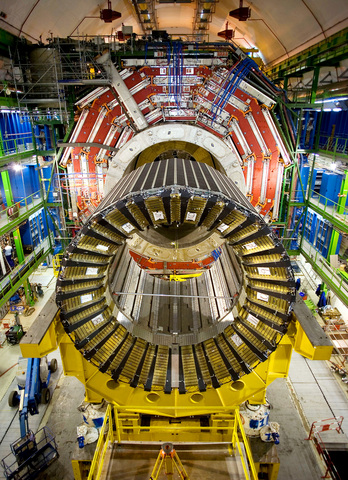
PHOTO: NY TIMES NEWS SERVICE
Whatever forms of matter and whatever laws and forces held sway Back Then — relics not seen in this part of space since the universe cooled 14 billion years ago — will spring fleetingly to life, over and over again in all their possible variations, as if the universe were enacting its own version of the Groundhog Day movie. If all goes well, they will leave their footprints in mountains of hardware and computer memory.
"We are now on the endgame," said Lyn Evans, of Cern, who has been in charge of the Large Hadron Collider, as it is called, since its inception. Call it the Hubble Telescope of Inner Space. Everything about the collider sounds, well, large — from the 14 trillion electron volts of energy with which it will smash together protons, its cast of thousands and the US$8 billion it cost to build, to the 116 tonnes of liquid helium needed to cool the superconducting magnets that keep the particles whizzing around their track and the 3 million DVDs worth of data it will spew forth every year.
The day it turns on will be a moment of truth for Cern, which has spent 13 years building the collider, and for the world's physicists, who have staked their credibility and their careers, not to mention all those billions of dollars, on the conviction that they are within touching distance of fundamental discoveries about the universe. If they fail to see something new, experts agree, it could be a long time, if ever, before giant particle accelerators are built on Earth again, ringing down the curtain on at least one aspect of the age-old quest to understand what the world is made of and how it works.
"If you see nothing," said a Cern physicist, John Ellis, "in some sense then, we theorists have been talking rubbish for the last 35 years."
Fabiola Gianotti, a Cern physicist and the deputy spokeswoman for the team that built the Atlas, said, "Something must happen."
The accelerator, Gianotti explained, would take physics into a realm of energy and time where the current reigning theories simply do not apply, corresponding to an era when cosmologists think that the universe was still differentiating itself, evolving from a primordial blandness and endless potential into the forces and particles that constitute modern reality.
She listed possible discoveries like a mysterious particle called the Higgs that is thought to endow other particles with mass, new forms of matter that explain the mysterious dark matter waddling the cosmos and even new dimensions of space and time.
"For me," Gianotti said, "it would be a dream if, finally, in a couple of years in a laboratory we are going to produce the particle responsible for 25 percent of the universe."
Halfway around the ring stood her rival of sorts, Jim Virdee from Imperial College London, wearing a hard hat at the bottom of another huge cavern. Virdee is the spokesman, which is physics-speak for leader, of another team, some 2,500 strong, with another giant detector, the poetically named Compact Muon Detector, which was looming over his shoulder like a giant cannon.
The prospect of discovery, Virdee said, is what sustained him and his colleagues over the 16 years it took to develop their machine. Without such detectors, he said, "this field which began with Newton just stops."
"When we started, we did not know how to do this experiment and did not know if it would work," he said. "Twenty-five hundred scientists can work together. Our judge is not God or governments, but nature. If we make a mistake, nature will not hesitate to punish us."
GAME OF COSMIC LEAPFROG
The most powerful accelerator now operating is the trillion-electron volt Tevatron, colliding protons and their antimatter opposites, antiprotons, at the Fermi National Accelerator Laboratory in Batavia, Ill. But it is scheduled to shut down by 2010.
Cern was born amid vineyards and farmland in the countryside outside Geneva in 1954 out of the rubble of postwar Europe. It had a twofold mission of rebuilding European science and of having European countries work together.
Today, it has 20 countries as members. Yearly contributions are determined according to members' domestic economies The vineyards and cows are still there, but so are strip malls and shopping centers.
The payoff for this investment, physicists say, could be a new understanding of one of the most fundamental of aspects of reality, namely the nature of mass.
This is where the shadowy particle known as the Higgs boson, aka the God particle, comes in.
In the Standard Model, a suite of equations describing all the forces but gravity, which has held sway as the law of the cosmos for the last 35 years, elementary particles are born in the Big Bang without mass, sort of like Adam and Eve being born without sin.
Some of them (the particles, that is) acquire their heft, so the story goes, by wading through a sort of molasses that pervades all of space. The Higgs process, named after Peter Higgs, a Scottish physicist who first showed how this could work in 1964, has been compared to a cocktail party where particles gather their masses by interaction. The more they interact, the more mass they gain.
The Higgs idea is crucial to a theory that electromagnetism and the weak force are separate manifestations of a single so-called electroweak force. It shows how the massless bits of light called photons could be long-lost brothers to the heavy W and Z bosons, which would gain large masses from such cocktail party interactions as the universe cooled.
The confirmation of the theory by the Nobel-winning work at Cern 20 years ago ignited hopes among physicists that they could eventually unite the rest of the forces of nature.
Moreover, Higgs-like fields have been proposed as the source of an enormous burst of expansion, known as inflation, early in the universe, and, possibly, as the secret of the dark energy that now seems to be speeding up the expansion of the universe. So it is important to know whether the theory works and, if not, to find out what does endow the universe with mass.
But nobody has ever seen a Higgs boson, the particle that personifies this molasses. It should be producible in particle accelerators, but nature has given confusing clues about where to look for it. Measurements of other exotic particles suggest that the Higgs' mass should be around 90 billion electron volts, the unit of choice in particle physics. But other results, from the Lep collider here before it shut down in 2000, indicate that the Higgs must weigh more than 114 billion electron volts. By comparison, an electron is half a million electron volts, and a proton is about 2,000 times heavier.
The new collider was specifically designed to hunt for the Higgs particle, which is key both to the Standard Model and to any greater theory that would supersede it.

In late October of 1873 the government of Japan decided against sending a military expedition to Korea to force that nation to open trade relations. Across the government supporters of the expedition resigned immediately. The spectacle of revolt by disaffected samurai began to loom over Japanese politics. In January of 1874 disaffected samurai attacked a senior minister in Tokyo. A month later, a group of pro-Korea expedition and anti-foreign elements from Saga prefecture in Kyushu revolted, driven in part by high food prices stemming from poor harvests. Their leader, according to Edward Drea’s classic Japan’s Imperial Army, was a samurai

The following three paragraphs are just some of what the local Chinese-language press is reporting on breathlessly and following every twist and turn with the eagerness of a soap opera fan. For many English-language readers, it probably comes across as incomprehensibly opaque, so bear with me briefly dear reader: To the surprise of many, former pop singer and Democratic Progressive Party (DPP) ex-lawmaker Yu Tien (余天) of the Taiwan Normal Country Promotion Association (TNCPA) at the last minute dropped out of the running for committee chair of the DPP’s New Taipei City chapter, paving the way for DPP legislator Su

It’s hard to know where to begin with Mark Tovell’s Taiwan: Roads Above the Clouds. Having published a travelogue myself, as well as having contributed to several guidebooks, at first glance Tovell’s book appears to inhabit a middle ground — the kind of hard-to-sell nowheresville publishers detest. Leaf through the pages and you’ll find them suffuse with the purple prose best associated with travel literature: “When the sun is low on a warm, clear morning, and with the heat already rising, we stand at the riverside bike path leading south from Sanxia’s old cobble streets.” Hardly the stuff of your

April 22 to April 28 The true identity of the mastermind behind the Demon Gang (魔鬼黨) was undoubtedly on the minds of countless schoolchildren in late 1958. In the days leading up to the big reveal, more than 10,000 guesses were sent to Ta Hwa Publishing Co (大華文化社) for a chance to win prizes. The smash success of the comic series Great Battle Against the Demon Gang (大戰魔鬼黨) came as a surprise to author Yeh Hung-chia (葉宏甲), who had long given up on his dream after being jailed for 10 months in 1947 over political cartoons. Protagonist


 RSS
RSS