


Continuing its ambitious project to highlight the crossbred offsprings of cinema and other art forms such as sound and theater that started last year, POP Cinema (國民戲院) kicks off its highly anticipated new film series with Moving Shadow-Dance Film Festival. This festival captures the mind, body and soul of the leading figures in contemporary dance scene in 37 rarely seen cinematic works.
For curator Wang Pai-chang (王派章), the program is a departure from documentaries on dance and a break from the customary practices when cinema and dance meet and the camera becomes a dancer rather than an observer and the dancer alters existing perceptions on bodily movements through filmic reflections.
"Unlike painters and musicians who use the body to create art, the cinema is without a corporeal form. Yet through filming and studying the body, the cinema morphs into the image with a body that can think and feel," said Wang.
PHOTOS: COURTESY OF SPOT
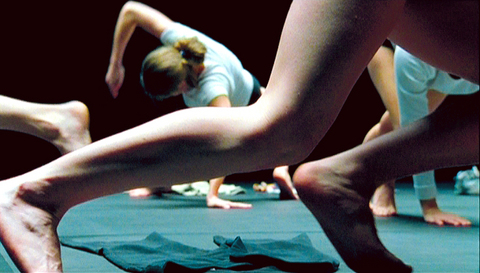
Freely adapted from the choreography of Swiss choreographer Gilles Jobin, The Moebius Strip is a fascinating example of the crossover between cinema and contemporary dance. Breaking the dance norms that include certain postures and a sense of balance, the performers overlap, cross, follow, step and hold onto each other's body to create a mosaic of human sculptures in relation to space. Such a strange spatial presentation of the body forces the camera to follow and dissect the fluid choreography in a participatory way.
A cinematic adaptation of Belgium choreographer Wim Vandekeybus' Blush, which was performed in Taiwan in 2003, is seen in the award-winning film of the same name. This illustrates how a dance piece can be adapted to the cinema to create completely different visual and visceral experiences. Jan Lauwers, also a leading figure in Belgium's theater and dance scene, will screen his feature debut, Goldfish Game.
Other featured films let the artists themselves speak for their creations. Dance Notes is the first film to examine the work of Anne Teresa de Keersmaeker, showing audiences the dialectical exchange between the creative ideas of choreographer and composer.

"Unlike the modern dance that carries with it a sense of content, contemporary choreography explores new vocabularies and forms. Through Dance Note, the viewer can learn to (re)think the contemporary dance in a non-modern light and understand what it is and is not," Wang said.
Similarly, Lucinada Childs is the first filmed portrait of Childs, a major choreographer and mastermind behind Bob Wilson's groundbreaking Einstein on the Beach with music by Philip Glass. Revealing the choreographer's intellectual adventures through her own words and those of her artist friends, the film does a remarkable job of marking the total emancipation of the body born out of the meticulous control over the body in the work of Childs, who in the eyes of Wang is the only existing choreographer able to work with the highly structured music of Glass.

In late October of 1873 the government of Japan decided against sending a military expedition to Korea to force that nation to open trade relations. Across the government supporters of the expedition resigned immediately. The spectacle of revolt by disaffected samurai began to loom over Japanese politics. In January of 1874 disaffected samurai attacked a senior minister in Tokyo. A month later, a group of pro-Korea expedition and anti-foreign elements from Saga prefecture in Kyushu revolted, driven in part by high food prices stemming from poor harvests. Their leader, according to Edward Drea’s classic Japan’s Imperial Army, was a samurai

The following three paragraphs are just some of what the local Chinese-language press is reporting on breathlessly and following every twist and turn with the eagerness of a soap opera fan. For many English-language readers, it probably comes across as incomprehensibly opaque, so bear with me briefly dear reader: To the surprise of many, former pop singer and Democratic Progressive Party (DPP) ex-lawmaker Yu Tien (余天) of the Taiwan Normal Country Promotion Association (TNCPA) at the last minute dropped out of the running for committee chair of the DPP’s New Taipei City chapter, paving the way for DPP legislator Su

It’s hard to know where to begin with Mark Tovell’s Taiwan: Roads Above the Clouds. Having published a travelogue myself, as well as having contributed to several guidebooks, at first glance Tovell’s book appears to inhabit a middle ground — the kind of hard-to-sell nowheresville publishers detest. Leaf through the pages and you’ll find them suffuse with the purple prose best associated with travel literature: “When the sun is low on a warm, clear morning, and with the heat already rising, we stand at the riverside bike path leading south from Sanxia’s old cobble streets.” Hardly the stuff of your
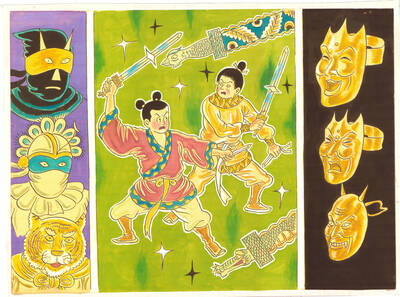
April 22 to April 28 The true identity of the mastermind behind the Demon Gang (魔鬼黨) was undoubtedly on the minds of countless schoolchildren in late 1958. In the days leading up to the big reveal, more than 10,000 guesses were sent to Ta Hwa Publishing Co (大華文化社) for a chance to win prizes. The smash success of the comic series Great Battle Against the Demon Gang (大戰魔鬼黨) came as a surprise to author Yeh Hung-chia (葉宏甲), who had long given up on his dream after being jailed for 10 months in 1947 over political cartoons. Protagonist


 RSS
RSS