


When L'Oreal, the world's largest cosmetic company, bought the Body Shop little more than a year ago, industry observers reacted with shock as a small, ethical brand was gobbled up by a huge multinational. They represent polar opposites of the US$197 billion global beauty industry: one has all the glamour of Paris and the promise of products to transform your looks; the other is a company formed in a garage in the town of Littlehampton on England's south coast selling products in recycled urine sample bottles.
But a year later it has become clear that the US$1.3 billion acquisition was the start of something new at L'Oreal — the group has taken a leaf out of Body Shop's book and has decided to go natural.
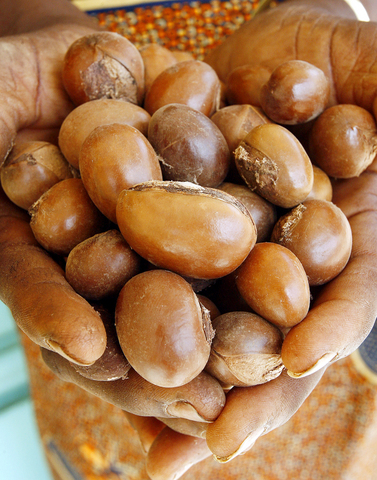
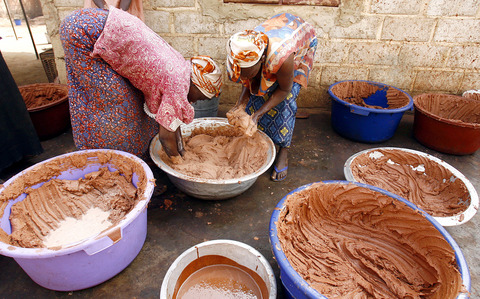
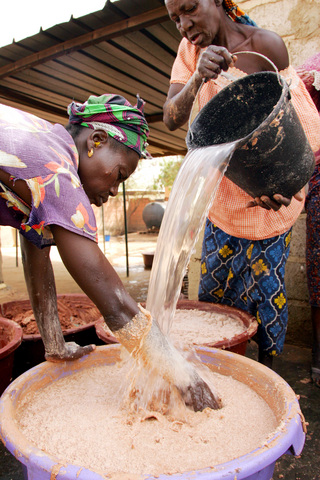
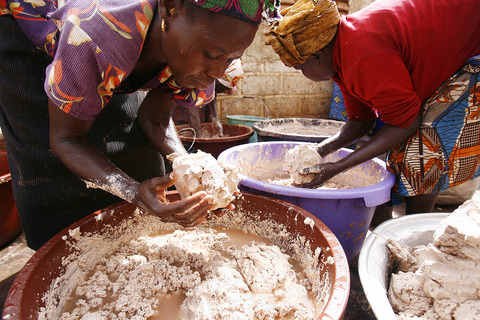
Once the preserve of a few hippies, the natural cosmetics phenomenon has gradually migrated into the mainstream and is now a booming market. Sales are only one percent of the global beauty market. But it is growing at 15 percent to 20 percent a year, and all the big cosmetic firms have started paying attention.
PHOTOSl AFP
Clarins, for example, bought a 10 percent stake in the French organic cosmetic firm Kibio last October and Colgate acquired Tom's of Maine, a producer of natural oral-care products, last March. All followed in the steps of Estee Lauder, which was an early trendsetter in 1997 when it bought Aveda. Private equity has even moved into the natural market in a sure sign that it is a growth area. JH Partners, a US private equity firm, acquired Australia's Jurlique, an organic skin-care company, last June.
Fears and concerns
"There's an increasing fear that certain ingredients can be harmful in the long term as potentially dangerous chemicals are linked with falling sperm counts, hormonal damage and cancers," said Daniel Bone, a consumer analyst at the market researcher Datamonitor. "These fears and concerns are some of the things that are contributing to the rise in natural personal care."
PHOTOS: AFP
Retailers have also caught on. Just as they adjusted to the growing demand for organic food, supermarkets are moving into the natural cosmetic market, with Tesco in Britain launching its own personal care range called Bnatural.
"The whole natural and ethical area has clearly been a huge growth area for the cosmetics and toiletries business," said Rita Clifton, chairwoman of the branding consultancy Interbrand. "It wouldn't be wise for a company like L'Oreal not to be present in that sector."
Jean-Paul Agon, chief executive of L'Oreal, said as much at the company's annual results this year: "2006 marked the group's entry more than ever into the natural market. It is a market in full development in the whole world."
The group's acquisition of Sanoflore, a French organic products company, in October only served to reinforce that.
The group is divided into four sections: mass-market products that include the L'Oreal Paris and Garnier brands; active cosmetics that incorporate dermatological products; the luxury division, to which Lancome belongs; and the professional care unit, which provides products to hairdressers around the world. The company has not yet integrated Body Shop in any of its divisions but Sanoflore has already been included in the active cosmetics unit, which includes brands such as La Roche-Posay and Vichy. This was L'Oreal's fastest growing unit last year, with sales rising 12.2 percent to pass the US$1.3 billion mark for the first time. Body Shop's figures were equally good and like-for-like sales rose 9.7 percent last year. By comparison, L'Oreal's other three units increased by 4 percent to 6 percent.
Even in the mass market range, which includes L'Oreal Paris, the firm plans to embrace the natural trend. Garnier is a brand that traditionally uses as many natural ingredients as is safely possible, and a US$59 million global advertising campaign is repositioning the brand in the market with a new slogan: "Take Care."
Patricia Pineau, communication director for L'Oreal's research division, claims the company's researchers had identified the potential of natural products 20 years ago but consumer demand was not forthcoming, and the idea was rejected at the marketing level. "We were 20 years too early; when we put forward a cream made from plants, it did not interest anyone."
She says 40 percent of L'Oreal's products are already derived from natural ingredients but rather than create a whole new brand to respond to the trend, the company decided to acquire other companies — the Body Shop and Sanoflore — that were established in that area and already had a following.
Bone said: "One of the positive things for L'Oreal regarding the Body Shop acquisition is the way that L'Oreal can grow the market by leveraging existing branded products with well-established wellness connotations rather than focusing on creating new brands under the L'Oreal name.
"After all, L'Oreal products are not associated with having particularly strong natural credentials and may well be rejected as a result. In contrast, Body Shop-branded products ooze and exude natural far more than a typical L'Oreal brand or many other mass market brands for that matter."
In short, experts agree that this year should be an active year in the natural cosmetic industry. "The growth rate says it all," said Amarjit Sahota, director of Organic Monitor. "The conventional cosmetic market is stagnating, whereas the natural cosmetic market is growing at a rate of about 20 percent a year."

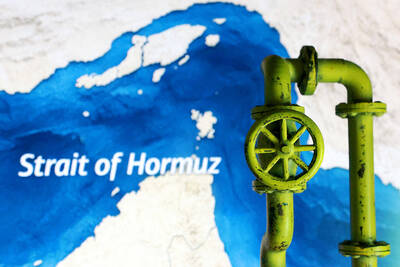
The US war on Iran has illuminated the deep interdependence of Asia on flows of oil and related items as raw materials that become the basis of modern human civilization. Australians and New Zealanders had a wake up call. The crisis also emphasizes how the Philippines is a swatch of islands linked by jet fuel. These revelations have deep implications for an invasion of Taiwan. Much of the commentary on the Taiwan scenario has looked at the disruptions to world trade, which will be in the trillions. However, the Iran war offers additional specific lessons for a Taiwan scenario. An insightful
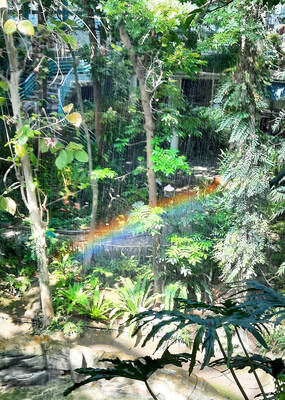
It’s only half the size of its more famous counterpart in Taipei, but the Botanical Garden of the National Museum of Nature Science (NMNS, 國立自然科學博物館植物園) is surely one of urban Taiwan’s most inviting green spaces. Covering 4.5 hectares immediately northeast of the government-run museum in Taichung’s North District (北區), the garden features more than 700 plant species, many of which are labeled in Chinese but not in English. Since its establishment in 1999, the site’s managers have done their best to replicate a number of native ecosystems, dividing the site into eight areas. The name of the Coral Atoll Zone might

Polling data often confirms what we expect, but sometimes it throws up surprises. When examined over time, some patterns appear that speak to something bigger going on. In this column, whenever possible, Formosa’s polls are used. Despite the sometimes cringeworthy antics of Formosa’s Chairman, Wu Tzu-Chia (吳子嘉), the data produced includes detailed breakdowns crucial for analysis. It has also been conducted monthly 11-12 times a year for many years with many of the same questions, allowing for analysis over time. When big shifts do occur between one month and the next it is usually in response to some event in

The problem with Marx’s famous remark that history repeats itself, first as tragedy, the second time as farce, is that the first time is usually farce as well. This week Chinese Nationalist Party (KMT) Chair Cheng Li-wun (鄭麗文) made a pilgrimage to the People’s Republic of China (PRC) “to confer, converse and otherwise hob-nob” with Chinese Communist Party (CCP) officials. The visit was an instant international media hit, with major media reporting almost entirely shorn of context. “Taiwan’s main opposition leader landed in China Tuesday for a rare visit aimed at cross-strait ‘peace’”, crowed Agence-France Presse (AFP) from Shanghai. Rare!


 RSS
RSS