


So many bands, so many stages, so little time.
That's about the shape of it. If you're wondering who to check out at this year's Spring Scream, here's a few bands we like who are scheduled to play today and tomorrow at the Kentington (小墾丁) venue in Manchou Township (滿州鄉). We complied this by-no-means-exhaustive list with the aid of demos sent to Spring Scream organizers, Myspace pages, bios plagiarized from the festival's Web site, and even more help from John Kuhel in Tainan, Rocketgrrl backup drummer Nathan Davis and especially former enPOTS columnist and The Deported vocalist Andy O'Brien.

PHOTO COURTESY OF OCTOPUS PROJECT
To a God Unknown (Taipei, Taiwan) Instrumental, reflective post-rock that evokes comparisons to Mogwai or early Pink Floyd. Their songs are long and you should listen to them with your eyes closed.
Atash (Texas, US) One of Austin's premier World Music ensembles, they play a fusion of traditional Iranian music and jazz. Nothing else like this is going on in Taiwan. Completely unique, completely different.
Octopus Project (Texas, US) Austin-based experimental space rock you can dance to. They blend laptops with indie guitar and have many imitators in Taipei, where there music is distributed through White Wabbit records.
Little Fat Pig (Hong Kong, China) This six-piece plays a twisted combination of cute Cantonese pop and 1970s punk. LFP keeps things simple, cheerful and rude.
Mimie Chan (Tokyo, Japan) Loved for their hard-driving ska, feared for a dancing, diaper-clad sumo wrestler and what he throws into the crowd. They dress up in all sorts of weird costumes and combine highly danceable ska with a rock-steady beat and punk's energy and attitude.
The Clippers (夾子) (Taipei, Taiwan) One of the pioneers of Taiwan's early underground rock movement, this band has been going for a decade on a combination of cheezy local flavor, dancing girls and heavy social satire.
Trash Box (Tokyo, Japan) Super-stylish Japanese psychobilly four-piece. 'Nuff said.
Hot Dog Buddy Buddy (Tokyo, Japan) Japanese rockabilly trio with the hair to prove it.
Rocketgrrl (Taipei, Taiwan) They pissed us off when they didn't tell us they'd cancelled their tour last month. But they promise to show up for Spring Scream. Psychedelic noise that sounds like punk rock in a space ship.
Red I and The Riddim Outlawz (Taidung, Taiwan) Music for island people. Red-I, Rintaro Masui and company lay down a rock steady beat of reggae, ska and jazz with local characteristics.
Heavy Smoker (老煙槍) (Taipei, Taiwan) One of the best representatives of the Taiwanese happy punk collective on ZMN Records. Their Green Day-influenced sound is backed up with a heavy dose of "whoa whoa whoa's," "hey hey hey's," "la la la's," and "let's go's."
Charlie Taylor and The Axis of Evil (Ontario, Canada) This Canadian folk singer writes dirty, irreverent songs. If you understand English, he's a lot of fun.
Double Negative (Tokyo, Japan) Crazy, hard-hitting Japanese ska punk.
Children Sucker (表兒) (Taipei, Taiwan) Unique, locally flavored punk influenced by anarchist rockers LTK (濁水溪公社) and sappy nakashi music with neo punk riffs.
Kanaras (Tokyo, Japan) Kentaro Saito from New York spazz-core band Dynamite Club and Takabe of Mimie-chan. One reviewer said Saito's music was "a schizophrenic hodge-podge of different styles moshed together" that sounded like "unfinished musical ideas channeled through someone with ADD." And that was supposed to be an insult.
Public Radio (Taipei, Taiwan) These expats always get good reviews for their instrumental funk, reggae, dance hall, alt-country, lounge, punk and "anything else they feel like hitting you with."
.22 (Taichung, Taiwan) Wicked indie legends who play goofy rock with goofy lyrics and lots of grooves.
Lustsluts Burlesque (Hualien, Taiwan) Burlesque dancers from Taiwan? Need we say more?
We Need Surgery (Seoul, South Korea) Leave it to the band from South Korea to have a slick, pulled-together sound. These Canadians play shimmering dance punk that sounds more like Franz Ferdinand than Gang of Four.
Mates of State (California, US) Adorable married couple whose innocent, charming indie rock is built around an electric organ, quirky drums and upbeat harmonizing. Don't see them if you're having relationship problems.
Bascoda (Tokyo, Japan) Amazingly tight blues punk, they have all the rock 'n' roll posturing down, just like a good Japanese band should. If they're actually playing, expect an awesome live show. Unfortunately, the band was on the Spring Scream schedule last week but now is not.


Taiwan’s English education system is being pulled apart by three opposing forces. Bilingual Nation 2030 pulls students toward English and global communication. Artificial Intelligence (AI) readiness pulls them toward digital judgment, verification and AI-mediated work. But Taiwan’s old exam culture pulls them back toward memorization, grammar drills, timed reading and correct answers. If the education system keeps using old exams to define success, it risks producing graduates who are neither genuinely bilingual nor genuinely AI-ready, but trained for tasks machines can already perform. The first force is Bilingual Nation 2030. Launched in 2018, the policy aimed to “help Taiwan’s workforce connect

“Taiwan’s Opposition Leader Comes to US With a Message Straight Out of Beijing” read a May 31 headline in the Wall Street Journal. Top US administration officials and members of Congress almost certainly read the WSJ, and if there was a bullet point takeaway that people in Washington should absorb ahead of Chinese Nationalist Party (KMT) Chair Cheng Li-wun’s (鄭麗文) arrival in DC on June 9, that headline is it. The last few columns have discussed this very topic, and the timing is not coincidental. While those top officials likely do not read the Taipei Times, judging by the number

With weighty, anxiety-inducing geopolitical topics dominating the headlines, checking in on the wild and weird state of local politics can take some of the edge off. This November’s elections will determine who will be in charge of fixing potholes in your neighborhood, not the potholes in Taiwan’s complicated geopolitical space. Recently, after an online interview with a Taipei-based journalist, I commented that Taipei journalists never go further than the MRT can take them. He laughed and agreed. Naturally, the Taipei mayoral race is eating up much of the press attention. TAIPEI CITY Democratic Progressive Party (DPP) candidate Puma Shen (沈伯洋) has
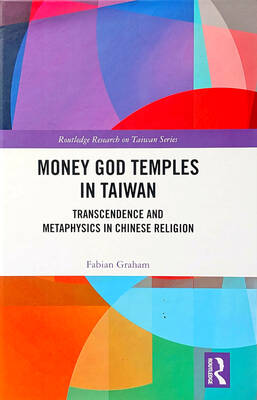
As someone who normally steers clear of books with “transcendence” or “metaphysics” in their subtitles, this reviewer — a casual observer of local belief systems since the 1990s — found Fabian Graham’s Money God Temples in Taiwan a challenging read. Those who’ve only dipped their toes into temple culture will likely need to parse several sections with special care if they’re to keep up with the author, a British ethnographic researcher whose previous books have investigated religious practices among ethnic Chinese in Southeast Asia. This scholarly volume examines a facet of Taiwan’s religious landscape that didn’t exist a century ago, and


 RSS
RSS