


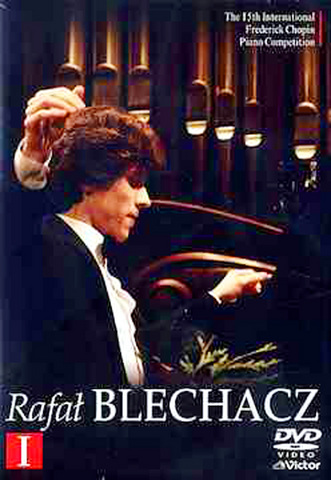
The young Polish pianist Rafat Blechacz was the winner of the 15th International Frederick Chopin Piano Competition in Warsaw in 2005. This enormously influential contest is only held every five years, and the victor is virtually guaranteed an international performance career. The winner in 2000 was China's Li Yundi (李雲迪), then aged 18. Blechacz won it at 20, being awarded first prize in all five sections of the competition.
Japan has been ahead of the competition in getting a DVD of this event onto the market. In it you see Blechacz playing a wide range of Chopin's piano music, then the judges announcing his victory, followed by an understandable roar of approval from the locals. He was the first Pole to win this competition, held in Poland and dedicated to the music of country's greatest composer, in 30 years.
Benjamin Britten's three string quartets (plus two early works in the genre) have lasted distinctly less well than the 15 of his friend Dmitri Shostakovich. Both men were prone to depression, though for different reasons, and as is common with composers, expressed their inner pain primarily in their chamber music. But Shostakovich's work in this intimate form is nevertheless a lot more distinctive than Britten's, and bears the stamp of a far stronger personality.
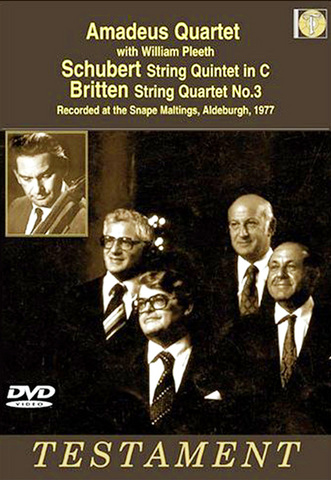
The performance by the Amadeus Quartet of Britten's String Quartet No.3, in 1977 in his UK home town of Aldeburgh, must have had a special poignancy. Britten had died the previous year, and many in the audience must have known him well. Even so, this isn't music that's going to attract many listeners, despite the fact that it was written specifically for the Amadeus, probably the world's most prestigious quartet at the time.
But Schubert's Quintet, with which it's coupled, is another matter altogether. This is enormously alluring music, a protracted wail of melodramatic grief, and was obviously chosen to complement an already funereal occasion. To watch and hear it played here by such masters — joined by celebrity cellist William Pleeth for the extra cello part that Schubert's version of the quintet form requires — is a very rewarding experience.
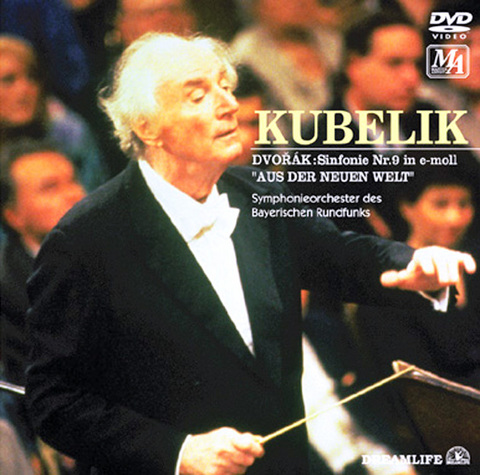
The Czech conductor Raphael Kubelik, who died in 1996, must be one of the most charismatic figures in classical music to watch at work. In a Japanese re-issue of a performance of Dvorak's New World Symphony, also from 1977, with the Symphonieorchester des Bayerischen Rundfunks (the Bavarian Radio Symphony Orchestra), his presence — both gentle and commanding — immediately establishes itself. This combination of qualities perfectly fits the famous music, which possesses both gentleness and strength in abundance.

Kubelik was a fascinating figure. He was with the Bavarians from 1961 to 1979, but found time for other work as well. He was even briefly Artistic Director of New York's Metropolitan Opera (from 1972-74) where he was James Levine's immediate predecessor. This DVD of the New World Symphony is a treasure. It's most memorable in the third and fourth movements, less often featured in popular selections than the first two. It comes from Japan's Dreamlife Corporation, and in Taiwan will probably have to be ordered directly from them.
Video Artists International continues to unearth valuable material from the archives of Canadian Broadcasting Corporation (CBC). Their Great Conductors in Rehearsal and Performance features a DVD of Karel Ancerl and Hermann Scherchen conducting Smetana and Bach respectively. The latter is especially interesting. Recorded in 1965, and put out on TV in 1966, it shows Scherchen struggling with the CBC's Toronto Chamber Orchestra in a rehearsal of his own version of Bach's Art of Fugue.
You might think that a composer conducting his own work would have a unique authority. Far from it. Where there's an established classic score, everyone involved implicitly acknowledges the fact and quietly gets down to the job of playing it as well as possible. But when a composer is conducting his own composition, he must always be afraid that the musicians are thinking "Well, if you can't make it sound any better than this, why don't you change it?" And so it appears here.
Scherchen, who had less than a major reputation, had made his orchestral version of Bach's last major work after playing two other versions for orchestra and finding them unsatisfactory. He then spent the last 12 years of his life performing his creation with whoever was willing play it.
In the rehearsal seen here the musicians are clearly skeptical, and Scherchen finally blows his top when someone lights up during a break. A personal insult, he declares, of which he'd never seen the like in an orchestra before! It's not as bad as Toscannini's outburst on the CD of rehearsals of Verdi's Falstaff, but in both cases it's the result of artistic work proving problematic, and the tension this produces. It's made the more embarrassing here because Scherchen clearly doesn't know the English word "smoke" and keeps using the French "fume" instead.
Everything flows smoothly by the end, however, with the caption "The fugue is unfinished but these are the last bars Bach ever wrote" scrolling up the screen as the music fades.

Sept.16 to Sept. 22 The “anti-communist train” with then-president Chiang Kai-shek’s (蔣介石) face plastered on the engine puffed along the “sugar railway” (糖業鐵路) in May 1955, drawing enthusiastic crowds at 103 stops covering nearly 1,200km. An estimated 1.58 million spectators were treated to propaganda films, plays and received free sugar products. By this time, the state-run Taiwan Sugar Corporation (台糖, Taisugar) had managed to connect the previously separate east-west lines established by Japanese-era sugar factories, allowing the anti-communist train to travel easily from Taichung to Pingtung’s Donggang Township (東港). Last Sunday’s feature (Taiwan in Time: The sugar express) covered the inauguration of the

The corruption cases surrounding former Taipei Mayor and Taiwan People’s Party (TPP) head Ko Wen-je (柯文哲) are just one item in the endless cycle of noise and fuss obscuring Taiwan’s deep and urgent structural and social problems. Even the case itself, as James Baron observed in an excellent piece at the Diplomat last week, is only one manifestation of the greater problem of deep-rooted corruption in land development. Last week the government announced a program to permit 25,000 foreign university students, primarily from the Philippines, Indonesia and Malaysia, to work in Taiwan after graduation for 2-4 years. That number is a

In a stark demonstration of how award-winning breakthroughs can come from the most unlikely directions, researchers have won an Ig Nobel prize for discovering that mammals can breathe through their anuses. After a series of tests on mice, rats and pigs, Japanese scientists found the animals absorb oxygen delivered through the rectum, work that underpins a clinical trial to see whether the procedure can treat respiratory failure. The team is among 10 recognized in this year’s Ig Nobel awards (see below for more), the irreverent accolades given for achievements that “first make people laugh, and then make them think.” They are not

This Qing Dynasty trail takes hikers from renowned hot springs in the East Rift Valley, up to the top of the Coastal Mountain Range, and down to the Pacific Short vacations to eastern Taiwan often require choosing between the Rift Valley with its pineapple fields, rice paddies and broader range of amenities, or the less populated coastal route for its ocean scenery. For those who can’t decide, why not try both? The Antong Traversing Trail (安通越嶺道) provides just such an opportunity. Built 149 years ago, the trail linked up these two formerly isolated parts of the island by crossing over the Coastal Mountain Range. After decades of serving as a convenient path for local Amis, Han settlers, missionaries and smugglers, the trail fell into disuse once modern roadways were built


 RSS
RSS