


The Museum of Contemporary Art (MOCA), Taipei, has been using its large space to showcase some of the best in contemporary art since it first opened in 2001. Less known is MOCA Studio, a space that focuses on up-and-coming local artists. It is an ideal place to showcase the recently opened exhibition called A Cactus in Yellow Bloom, an exhibition on contemporary metal art by four Taiwanese artists.
"We [want] to create a platform for young artists because they might not have a chance to show their works, especially in a museum of this scale," said Elaine Liu (劉怡伶), a spokesperson for MOCA.
According to the exhibit's curator, Hsu Mei-ing (徐玫營), contemporary metal arts originated in Europe and the US in the middle of the twentieth century as an escape from the traditional function and decorative approaches to using metal.
PHOTOS: NOAH BUCHAN, TAIPEI TIMES
"The liberation of material, transcendence of technique and expansion of type, acted as a catalyst pushing [the art form] beyond the confines of the discipline," Hsu said.
The artists assembled for this exhibit follow this tradition.
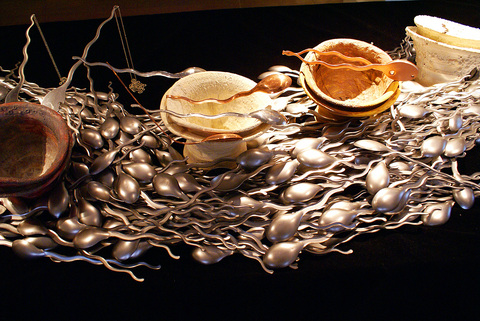
In Happy Together, Lin Li-chen (林例貞) has arranged hundreds of spoons on a table interspersed with ceramic bowls, all resting on top of a surface that looks like a table or bed, where the spermatozoa-shaped spoons and ceramic bowls symbolize the process of creating life. Though all spoons are essentially the same shape, a few are cast so as to create different colors, demonstrating that some are more successful in fertilization than others.
Lin's Massage Egg is a spoon embracing and protecting a metaphoric egg, a denouement to the struggle that is taking place in Happy Together. Both works are complementary and are sublime statements on the arbitrary nature of conflict and resolution, which are instrumental to creating life.
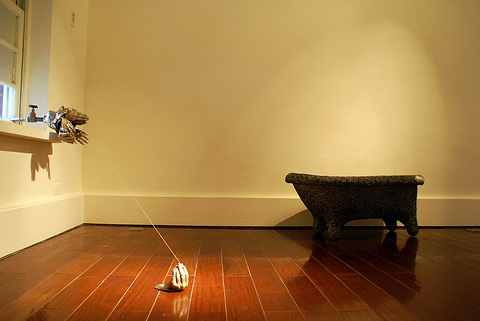
Explosions, or perhaps ejaculations, are the centerpiece of Hung Hsui-hui's (洪秀慧) stark nobody, an installation in three parts. Hung "dissected" a doll and cast the head as metal and attached the neck to a tap with a number of hands shooting out of the skull towards a separated body — symbolized by a tub that rests on the floor a few meters away. Completing this trinity of separation is a single hand resting on the floor pulling a string.
Hung implies that in the information age there is a constant flow of information from the external world that humans have to sift through and make decisions about. The single hand resting on the floor shows that we can only ever make one choice at a time, though we have an explosion of options to choose from and it is this multiplicity of choice that creates the separation with the self and others.
Chiang Mei-fang's (江枚芳) abstract triptych Inlaid Ridge was inspired by the scenery she encountered during her travels around Taiwan. Using thin metal lines, she creates an impression of the different places she has visited resulting in a conversation between the metal lines and the light emanating into the museum hall. The work hints at the beauty of Taiwan's natural landscape and the home that she has found.
In Stay together, Cheng Jing-yun (鄭景勻) combines silver, copper and timber to show an eternal connection between husband and wife. It is a Chinese tradition, rarely practiced anymore, for the husband and bride to combine their hair in an act of eternal love. The length of the copper hair in the sculpture suggests the eternal nature of love between a man and a woman.
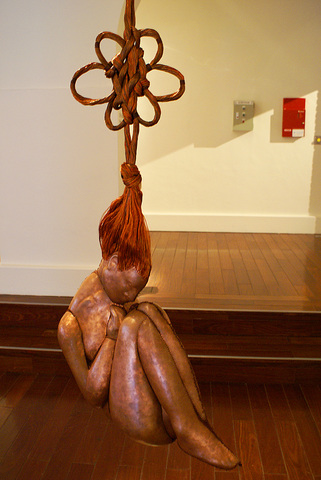
Cheng's Pray for Luck deserves a special mention as much for the statement it makes as for the quality of the craftsmanship. Using long strips of copper wire that become hair attached to a copper body suspended in the air, the work symbolizes the influence of luck in Chinese society.
But the work is ambiguous. On first glance it appears as a child in the womb or a naked woman suspended torturously from above. Only after the staff explains the symbolism behind the knot and color of the metal does it become apparent that it is a positive statement about fate.
Though overall the works display a high degree of skill, the exhibit suffers from a lack of thematic purpose. What has brought the artists together in this exhibition has more to do with where they live than the statements they are making with their works.
The name of the exhibit was inspired by the varieties of cactus that were brought to Taiwan from abroad and through an evolutionary process, propagated in the arid regions of the islands' south. Similarly, though all the artists originally hail from central and northern Taiwan, they now all live in the south — suggestive of a different kind of evolution.

Sept.16 to Sept. 22 The “anti-communist train” with then-president Chiang Kai-shek’s (蔣介石) face plastered on the engine puffed along the “sugar railway” (糖業鐵路) in May 1955, drawing enthusiastic crowds at 103 stops covering nearly 1,200km. An estimated 1.58 million spectators were treated to propaganda films, plays and received free sugar products. By this time, the state-run Taiwan Sugar Corporation (台糖, Taisugar) had managed to connect the previously separate east-west lines established by Japanese-era sugar factories, allowing the anti-communist train to travel easily from Taichung to Pingtung’s Donggang Township (東港). Last Sunday’s feature (Taiwan in Time: The sugar express) covered the inauguration of the

The corruption cases surrounding former Taipei Mayor and Taiwan People’s Party (TPP) head Ko Wen-je (柯文哲) are just one item in the endless cycle of noise and fuss obscuring Taiwan’s deep and urgent structural and social problems. Even the case itself, as James Baron observed in an excellent piece at the Diplomat last week, is only one manifestation of the greater problem of deep-rooted corruption in land development. Last week the government announced a program to permit 25,000 foreign university students, primarily from the Philippines, Indonesia and Malaysia, to work in Taiwan after graduation for 2-4 years. That number is a

In a stark demonstration of how award-winning breakthroughs can come from the most unlikely directions, researchers have won an Ig Nobel prize for discovering that mammals can breathe through their anuses. After a series of tests on mice, rats and pigs, Japanese scientists found the animals absorb oxygen delivered through the rectum, work that underpins a clinical trial to see whether the procedure can treat respiratory failure. The team is among 10 recognized in this year’s Ig Nobel awards (see below for more), the irreverent accolades given for achievements that “first make people laugh, and then make them think.” They are not

This Qing Dynasty trail takes hikers from renowned hot springs in the East Rift Valley, up to the top of the Coastal Mountain Range, and down to the Pacific Short vacations to eastern Taiwan often require choosing between the Rift Valley with its pineapple fields, rice paddies and broader range of amenities, or the less populated coastal route for its ocean scenery. For those who can’t decide, why not try both? The Antong Traversing Trail (安通越嶺道) provides just such an opportunity. Built 149 years ago, the trail linked up these two formerly isolated parts of the island by crossing over the Coastal Mountain Range. After decades of serving as a convenient path for local Amis, Han settlers, missionaries and smugglers, the trail fell into disuse once modern roadways were built


 RSS
RSS