


Takashi Suzuki has a reputation for being merciless when training his actors. The founder and director of the Suzuki Company of Toga (SCOT), a retreat in the forests outside Tokyo, produces some of the world's best actors.
But at a price.
In an interview with Anatoly Smeliansky, head of the Moscow Art Theater school, Anatoly Bely, an actor with the Moscow Art Theater, describes how immediately after landing in Japan following a long flight from Moscow, Suzuki brought the contingent of Russian actors through a two-hour training session that, "[was] so difficult that after 20 minutes, even the youngest, strongest men in our company started to collapse. Suzuki told us that we had to overcome this limit."
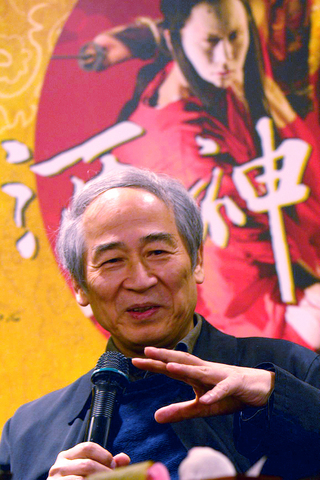
PHOTOS COURTESY OF CKS CULTURAL CENTER
The severe method Suzuki uses to train his actors is in marked contrast to the man who arrived in Taiwan on Monday for the first time in his 40-year career to prepare for his production of Dionysus this weekend at the National Theater. Dressed casually and joking with reporters, the 68 year-old performance theorist, director and "Japanese treasure" showed no evidence of jet lag.
The Suzuki Method is principally concerned with overcoming perceived limitations of the human body and applying what they've learned to the stage. By doing so, the actors uncover their innate expressive abilities through movement.
Using a diverse array of physical disciplines drawn from ballet, Japanese Noh and Kabuki and Greek theater as well as martial arts, the Suzuki Method seeks to heighten the actor's emotional and physical power and commitment to reach the right moment on the stage.
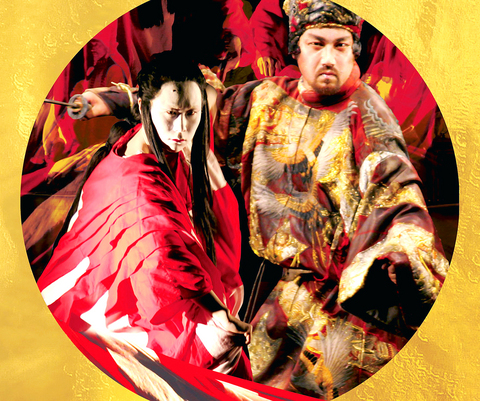
"The training is rigorous and many actors at first find it extremely difficult — if not impossible — to keep up. The Olympic athletes that come over have less problems with the training," Suzuki said.
As a performance theorist, Suzuki is often compared to Konstantin Stanislavsky. But where Stanislavski drew upon the actor's memory as a means of creating emotional and physical verisimilitude on the stage, the Suzuki Method begins with a system of exercises meant to tap into the expressive power of the body, or what Suzuki calls "animal energy."
"The body has its own physical grammar that the audience can follow," he said. "As such, we don't just need a verbal language to evoke meaning [on the stage]."
In addition to his work as a performance theorist, Suzuki is chairman of the Japan Performing Arts Foundation (JPAF), a lobby group for the performing arts in Japan. He has published 15 books about the theater in Japanese of which The Way of Acting: The Theater Writings of Tadashi Suzuki has been translated into English.
Together with Robert Wilson, Yuri Lyubimov and Wole Soyinka and a host of other internationally recognized theater artists he formed the International Committee of the Theatre Olympics in 1993, a yearly event that promotes the development of world theater.
Suzuki's internationalism is also evident in his expropriation of Greek drama for the stage. Works that he has adapted to the stage include Euripides' The Trojan Women and Clytemnestra, Sophocles' Electra and Aeschylus' Oresteia. By adapting Greek plays to a contemporary context, Suzuki seeks to overcome cultural and national barriers by universally based works.
Suzuki chose Dionysus for his Taipei production as he feels the relationship between politics and religion is relevant to contemporary society.
Dionysus is based on Euripides' Bacchae. In the original play, Euripides has Dionysus, the god of wine, appear on stage and speak as a character. Suzuki alters the work by making a group of priests speak the lines of Dionysus, thus transforming the god into cult.
This cult of priests, with its communal need for unity and desire to spiritually influence the masses creates what Suzuki calls, a "story called Dionysus." For Suzuki, the conflict between Dionysus and the young King Pentheus is not a battle between god and man, but an altercation between a religious sect and a political authority.
Suzuki says the Bacchae speaks to our contemporary condition because of the conflict between two communal value systems that exist on the same plane.
By adapting Greek theater to the contemporary stage, Suzuki manages to raise questions about our current political and social situation and done in a way that challenges the audience to look beyond national borders. It gives us a focus on the changing conditions of our own lives, as well as the lives of the ancient Greeks and modern Japanese thus illustrating a universalism that is often lacking in contemporary theater. This is probably why tickets for all his Taipei performances sold out before he arrived in Taiwan.
In late October of 1873 the government of Japan decided against sending a military expedition to Korea to force that nation to open trade relations. Across the government supporters of the expedition resigned immediately. The spectacle of revolt by disaffected samurai began to loom over Japanese politics. In January of 1874 disaffected samurai attacked a senior minister in Tokyo. A month later, a group of pro-Korea expedition and anti-foreign elements from Saga prefecture in Kyushu revolted, driven in part by high food prices stemming from poor harvests. Their leader, according to Edward Drea’s classic Japan’s Imperial Army, was a samurai

The following three paragraphs are just some of what the local Chinese-language press is reporting on breathlessly and following every twist and turn with the eagerness of a soap opera fan. For many English-language readers, it probably comes across as incomprehensibly opaque, so bear with me briefly dear reader: To the surprise of many, former pop singer and Democratic Progressive Party (DPP) ex-lawmaker Yu Tien (余天) of the Taiwan Normal Country Promotion Association (TNCPA) at the last minute dropped out of the running for committee chair of the DPP’s New Taipei City chapter, paving the way for DPP legislator Su

It’s hard to know where to begin with Mark Tovell’s Taiwan: Roads Above the Clouds. Having published a travelogue myself, as well as having contributed to several guidebooks, at first glance Tovell’s book appears to inhabit a middle ground — the kind of hard-to-sell nowheresville publishers detest. Leaf through the pages and you’ll find them suffuse with the purple prose best associated with travel literature: “When the sun is low on a warm, clear morning, and with the heat already rising, we stand at the riverside bike path leading south from Sanxia’s old cobble streets.” Hardly the stuff of your
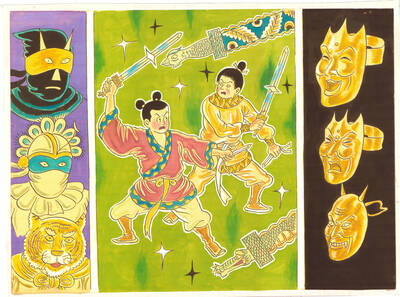
April 22 to April 28 The true identity of the mastermind behind the Demon Gang (魔鬼黨) was undoubtedly on the minds of countless schoolchildren in late 1958. In the days leading up to the big reveal, more than 10,000 guesses were sent to Ta Hwa Publishing Co (大華文化社) for a chance to win prizes. The smash success of the comic series Great Battle Against the Demon Gang (大戰魔鬼黨) came as a surprise to author Yeh Hung-chia (葉宏甲), who had long given up on his dream after being jailed for 10 months in 1947 over political cartoons. Protagonist


 RSS
RSS