


The request was simple enough: Lloyd's underwriters had been approached to insure the movement of seven paintings, including one by Cezanne, from Russia to London for valuation and sale.
So Lloyd's contacted the Art Loss Register, a small private company in London whose computer archive lists 180,000 items ranging from sculpture and silver to textiles, books, stamps and vehicles — and many of the great art works stolen or missing around the world.
What the insurance company discovered in 1999 was that the works, including Cezanne's Fruit and Jug, had been stolen in 1978 from the home of American collector Michael Bakwin in Massachusetts.
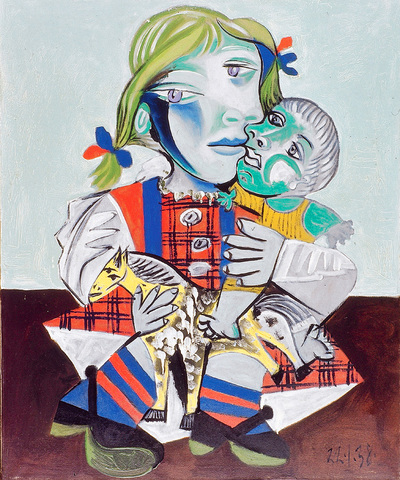
PHOTO: NY TIMES NEWS SERVICE
Thus began a long investigation, including Art Loss Register researchers and negotiators, that resulted in the FBI announcing last month the arrest of a lawyer. He allegedly had obtained the art from the thief, who had been murdered by another criminal after the robbery. In the end, Bakwin got his paintings back and sold the Cezanne for US$35 million.
Now the Art Loss Register is on the trail of two Picasso paintings stolen in Paris last week.
The register, which calls itself the only comprehensive searching service for stolen art, serves museums, art dealers and auction houses such as Sotheby's and Christie's that want to avoid handling stolen art; and theft victims, insurance companies and police hunting for the thieves.
When thieves stole Pablo Picasso's Maya With Doll (1938) and Portrait of Jacqueline (1961) from his granddaughter's home in Paris, their description and photo were added to the company's database within hours.
The paintings are valued together at around US$65 million, but the information in the register severely curtails their resale prospects and could help lead police to the thieves.
In the last 10 years, information supplied by the Art Loss Register has helped recover paintings by Manet, Delacroix, Giacometti, Constable; a Queen Anne cabinet; and a Roman marble head of Dionysius.
Two years ago, the Art Loss Register was vetting works to be sold at the renowned Maastricht art and antiques fair in the Netherlands, when it discovered that one of them, a painting by 17th-century Dutch artist Jan Linsen, had been missing from a German museum since 1946.
In 2002, an art dealer's routine search of the archive for a 1922 Picasso, Woman in White, owned by an American philanthropist, led to the discovery that it had been looted by the Nazi occupiers of Paris. Research by Art Loss Register staff in four countries provided valuable information to the complex litigation that followed over its ownership, which ended in a financial settlement.
The register is also a source for Jews seeking to recover art confiscated from them by the Nazis.
"We're the only comprehensive searching service in the world for stolen art,'' said Julian Radcliffe, chairman of the Art Loss Register.
"But even with our database, the recovery rate for really good paintings is only around 20 percent, and the owners may have to wait 30 years. The success rate for stolen jewelry, furniture and silver artifacts is much lower.''
Radcliffe said well-known art works are sometimes stolen by small-time thieves or drug dealers who quickly sell them cheap to criminal gangs that whisk them to another country and sell them through front men.
Director Steven Spielberg has been revealed as the unwitting purchaser of an oil painting by the American artist Norman Rockwell which was stolen more than 30 years ago.
Staff of the three-time Oscar winner contacted the FBI after it posted an alert about the painting, Russian Schoolroom, on the Internet last week. Spielberg, 60, is an avid collector of paintings by Rockwell, who is famous for his portrayals of innocent American life.
Now valued at US$700,000, the picture was first stolen from a gallery in St Louis, Missouri, in June 1973. Spielberg purchased the work from a legitimate art dealer 16 years later.
"They were gracious and responsible to come forward with that information," Assistant Special Agent Tom Noble told ABC News Monday.
Art Loss Register staff members mostly manage the computer archive, which the company says is immune to hackers, and preserve the many paper files for future court cases.
The company has another 25 employees at satellite offices in New York; Amsterdam, Netherlands; Cologne, Germany; New Delhi, and Bath, England.
The Art Loss Register was created 1991, taking over and expanding a database that had been operated since the 1970s by the International Foundation for Art Research in New York.

In late October of 1873 the government of Japan decided against sending a military expedition to Korea to force that nation to open trade relations. Across the government supporters of the expedition resigned immediately. The spectacle of revolt by disaffected samurai began to loom over Japanese politics. In January of 1874 disaffected samurai attacked a senior minister in Tokyo. A month later, a group of pro-Korea expedition and anti-foreign elements from Saga prefecture in Kyushu revolted, driven in part by high food prices stemming from poor harvests. Their leader, according to Edward Drea’s classic Japan’s Imperial Army, was a samurai

The following three paragraphs are just some of what the local Chinese-language press is reporting on breathlessly and following every twist and turn with the eagerness of a soap opera fan. For many English-language readers, it probably comes across as incomprehensibly opaque, so bear with me briefly dear reader: To the surprise of many, former pop singer and Democratic Progressive Party (DPP) ex-lawmaker Yu Tien (余天) of the Taiwan Normal Country Promotion Association (TNCPA) at the last minute dropped out of the running for committee chair of the DPP’s New Taipei City chapter, paving the way for DPP legislator Su

It’s hard to know where to begin with Mark Tovell’s Taiwan: Roads Above the Clouds. Having published a travelogue myself, as well as having contributed to several guidebooks, at first glance Tovell’s book appears to inhabit a middle ground — the kind of hard-to-sell nowheresville publishers detest. Leaf through the pages and you’ll find them suffuse with the purple prose best associated with travel literature: “When the sun is low on a warm, clear morning, and with the heat already rising, we stand at the riverside bike path leading south from Sanxia’s old cobble streets.” Hardly the stuff of your
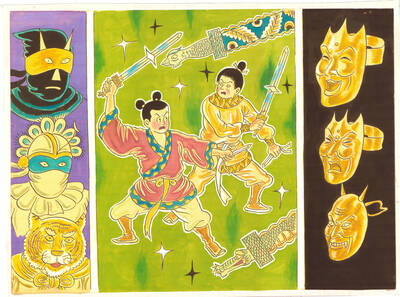
April 22 to April 28 The true identity of the mastermind behind the Demon Gang (魔鬼黨) was undoubtedly on the minds of countless schoolchildren in late 1958. In the days leading up to the big reveal, more than 10,000 guesses were sent to Ta Hwa Publishing Co (大華文化社) for a chance to win prizes. The smash success of the comic series Great Battle Against the Demon Gang (大戰魔鬼黨) came as a surprise to author Yeh Hung-chia (葉宏甲), who had long given up on his dream after being jailed for 10 months in 1947 over political cartoons. Protagonist


 RSS
RSS