


Last night's big gig at Zhongshan Soccer Stadium in Taipei was, conveniently, on a holiday to commemorate the 228 Incident. So, before everyone could get down to the serious business of enjoying British band Muse, there were a lot of speeches and films about whither-now Taiwan. The reward for staying to the end — after 11 hours of eight local and international acts — was a one-and-a-half hour performance from Matthew Bellamy and the lads. Ten thousand fans were inspired enough to do so, according to our sister paper The Liberty Times, which rated the show a big hit. It said Muse's set was a "special blend of baroque rock 'n' roll," citing Bellamy's background in classical music as inspirational.
Someone who didn't need a classical musical education is occasional singer, actress and model Lin Chi-ling (林志玲). Her 32-year-old 34D, 174cm assets and sweet smile were enough to get her where she is today. Last week Lin was named by Sina.com Web site as the hottest "middle-aged superwoman" on the planet. China and Hollywood's Gong Li (鞏俐) was second with 41 years and Hong Kong actress Athena Chu (朱茵), 34, was third.
Internet sites have been saying "Ice Cream" Lin was paid NT$1 million to hang from the arm of Terry Gou (郭台銘) at the Hon Hai Precision Industry Co (鴻海精密) chairman's recent year-end celebration (尾牙). TV personality Patty Hou (侯佩岑) fittingly ended up on Gou's other arm. Maybe Tsai Ming-liang (蔡明亮) was piqued because he never managed to end up as the filling in a Hou-Lin sandwich, but the director savaged Gou in the Apple Daily. He lambasted Taiwan's richest man for spending so much on a year-end party rather than on projects for the disadvantaged. Perhaps Tsai was thinking of himself as his latest NT$30 million movie Black Eyes (黑眼圈) has not been that well received and Gou has been talking about financing films. Coincidence? We think not.
Speaking of movies, most of the local entertainment sections dropped local news in favor of Oscar stories the day after the ceremony. One of the biggest talking points was the announcer's gaffe that Best Director Martin Scorsese's The Departed was based on a Japanese movie, rather than the three-part masterpiece Infernal Affairs (無間道), from Hong Kong. Patriotic Taiwanese at the Apple Daily started frothing in ink saying how could the Academy of Motion Picture Arts and Sciences confuse Chinese with Japanese? To be fair, the impeccable Scorsese did put the facts straight in his acceptance speech.
Pop Stop needs to keep an eye on TV star Sasa (斯容), aka Jennifer Sun, who has discovered a new activity called extreme cosmetic surgery. After getting a nose job at the end of 2006, Sasa is in South Korea recovering from a NT$700,000 operation that shaved off bone from cheek to chin. The shopping channel queen could not speak but this did not stop her from communicating with fans on her Web site: "Everything for me is OK now, and I think I will be better and better everyday." Pop Stop encourages readers to contact the Web site (blog.etmall.com.tw/blogs/jennifer_sun/default.aspx) and reassure Sasa she looks fine.
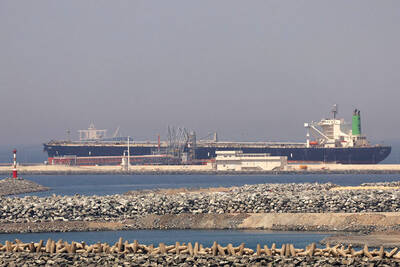
The breakwater stretches out to sea from the sprawling Kaohsiung port in southern Taiwan. Normally, it’s crowded with massive tankers ferrying liquefied natural gas from Qatar to be stored in the bulbous white tanks that dot the shoreline. These are not normal times, though, and not a single shipment from Qatar has docked at the Yongan terminal since early March after the Strait of Hormuz was shuttered. The suspension has provided a realistic preview of a potential Chinese blockade, a move that would throttle an economy anchored by the world’s most advanced and power-hungry semiconductor industry. It is a stark reminder of
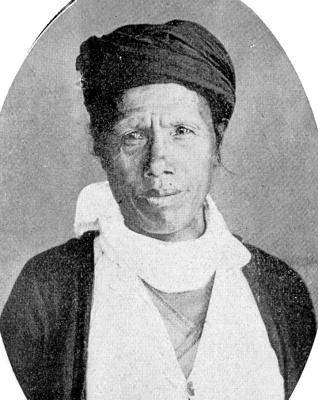
May 11 to May 17 Traversing the southern slopes of the Yushan Range in 1931, Japanese naturalist Tadao Kano knew he was approaching the last swath of Taiwan still beyond colonial control. The “vast, unknown territory,” protected by the “fierce” Bunun headman Dahu Ali, was “filled with an utterly endless jungle that choked the mountains and valleys,” Kano wrote. He noted how the group had “refused to submit to the measures of our authorities and entrenched themselves deep in these mountains … living a free existence spent chasing deer in the morning and seeking serow in the evening,” even describing them as
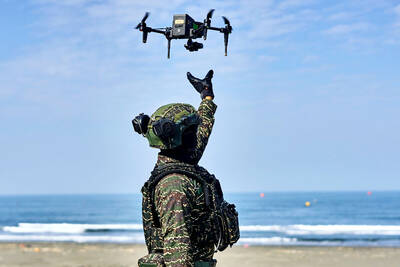
The last couple of weeks spectators in Taiwan and abroad have been treated to a remarkable display of infighting in the Chinese Nationalist Party (KMT) over the supplementary defense budget. The party has split into two camps, one supporting an NT$800 billion special defense budget and one supporting an NT$380 billion budget with additional funding contingent on receiving letters of acceptance (LOA) from the US. Recent media reports have said that the Taiwan People’s Party (TPP) is leaning toward the latter position. President William Lai (賴清德) has proposed NT$1.25 trillion for purchases of US arms and for development of domestic weapons

As a different column was being written, the big news dropped that Chinese Nationalist Party (KMT) caucus whip Fu Kun-chi (傅?萁) announced that negotiations within his caucus, with legislative speaker Han Kuo-yu (韓國瑜) of the KMT, party Chair Cheng Li-wun (鄭麗文), Taichung Mayor Lu Shiow-yen (盧秀燕) and Taiwan People’s Party (TPP) Chair Huang Kuo-chang (黃國昌) had produced a compromise special military budget proposal. On Thursday morning, prior to meeting with Cheng over a lunch of beef noodles, Lu reiterated her support for a budget of NT$800 or NT$900 billion — but refused to comment after the meeting. Right after Fu’s


 RSS
RSS