


What form might the remaining Horcruxes take and could the final one, as Professor Dumbledore predicted, be the great snake Nagini? Who is the mysterious “RAB”? Why is it significant that “scar” is the final word of the final chapter of the seventh and final book of the series? And, most important of all, is Harry going to die or will he slay Voldemort and get back together with Ginny Weasley and live happily (or at least less perilously) ever after?
If you didn't understand a word of what you have just read, it means you've developed a rare resistance to the most powerful and lucrative spell in the publishing industry and, unlike hundreds of millions of readers across the globe, you have never picked up a book by the elusive JK Rowling. As Harry Potter hurtles towards its grand finale, that spell is only getting stronger and its caster, who has learned to play the media game with consummate skill, has been laying out enticing little crumbs of information to stir up the excitement yet further.
In June, Rowling told interviewers of a British daytime television show, that at least two characters were going to die in the final installment. Ten days ago, she unveiled the title and since Harry Potter and the Deathly Hallows doesn't have a particularly cheerful ring to it, fan sites have been fretting more than usual about the schoolboy magician's fate.
Last week, bookmakers William Hill made Lord Voldemort (aka the most fearsome dark wizard ever known) odds-on favorite to kill our bespectacled hero. Deathly Hallows, which is expected to appear this summer, will undoubtedly outperform its predecessors. That's no mean feat: the last three were the fastest-selling books ever.
Rowling (pronounced “rolling,” as in “rolling in cash” — Forbes declared her a US dollar billionaire in 2004) has kept her creation in close check from the off. The stories have since solidified into legend: how Potter popped into her head fully formed during a delayed train journey from Manchester to London; how she planned the series in all its labyrinthine entirety at the beginning and wrote the very final chapter before the first book was even published.
Rowling has also maintained a remarkably strong grip on the Potter franchise. When a drooling and slavering Hollywood plunged its talons into the series, Rowling demanded that each film be shot in Britain, with an all-British cast.
Bloomsbury, the elf of a publishing house that put its faith in the first Potter book and turned, subsequently, into a giant, also knows the force of its star author's sway. “Book four was an absolute nightmare,” Rowling recalled. “I literally lost the plot halfway through ... and the idea of going straight into another Harry Potter filled me with dread and horror.” She took a break and told Bloomsbury to lay off the pressure. Her editors relented. Now they, along with many others, want the Potter magic to last as long as possible, but Rowling says she is stopping at number seven.
When the big secrets have long since been divulged, and the last movie can be fished out of DVD bargain bins, the entire economy founded upon the 41-year-old woman from Gloucestershire and her imaginary boy wizard is going to come tumbling down.
Rowling did not start out as a canny media operator, nor does she seem to relish the power she wields. She had a reputation early on “for being somewhat po-faced” (her own admission). Of fame, she says: “I never wanted it and I never expected it and certainly didn't work for it and I see it as something that I have to get through, really.” And: “I didn't think they'd rake through my bins; I didn't expect to be photographed on the beach through long lenses.”
Details of the difficult years between Potter's conception and his prodigious birth have always been heartily exaggerated in the press, with Rowling portrayed as a penniless nobody of Dickensian proportions (she and her daughter lived in a draughty two-bedroom flat in Edinburgh, not a freezing bedsit). The relationship soured a little as she struggled with her newfound celebrity — dissatisfied reporters found her dour and stand-offish — but now Rowling is firmly back in public favor.
Her interviews and public appearances are very carefully limited these days, and since her Portuguese ex-husband sold his story to the Mail on Sunday in 1999, there has been precious little indiscretion from the people who know her intimately.
In spite of all the bin-raking and long-lens photography, Rowling's private life has been guarded almost as assiduously as her beloved literary secrets, and because she has resisted exposure, whenever she does get involved with any cause, it becomes big news. For instance, earlier this year Rowling made waves when she went to Bucharest to raise funds for the Children's High Level Group, an organization dedicated to enforcing the human rights of children. It's not like she's a Pynchon or a Salinger, though. We know where she lives (a house in Edinburgh, another in Perthshire and a third in London). We have the basic details about her life (middle-class family; French and classics at Exeter; unhappy first marriage; a daughter; happy second marriage, to an anesthetist; two sons). Rowling would be the first to admit she's perfectly ordinary, but because the public doesn't have easy access to her, a tiny sparkle of magic is preserved.
People have wondered, with some justification, why Potter himself has been rewarded with such spectacular and enduring popularity. Take the formula apart and you will find nothing that hasn't been written before. Indeed, Rowling makes no effort to deny that her books are derivative: “I've taken horrible liberties with folklore and mythology,” she says. “But I'm quite unashamed about that.”
However, there is no questioning the fertility of her imagination. She has stories coming out of her ears, so much so there are moments when plot developments hit the reader so fast it's a struggle to draw breath and the bounty can seem excessive. AS Byatt has weighed in against the oeuvre, arguing that: “Ms. Rowling's magic world has no place for the numinous. It is written for people whose imaginative lives are confined to TV cartoons and the exaggerated [more exciting, not threatening] mirror-worlds of soaps, reality TV and celebrity gossip.” Critic Harold Bloom lamented that: “Harry Potter will not lead our children on to Kipling's Just So Stories or his Jungle Book. It will not lead them to Thurber's Thirteen Clocks or Kenneth Grahame's Wind in the Willows or Lewis Carroll's Alice.”
Both criticisms fall short of the mark. The Potter series does become progressively darker and more serious in tone, and in response to certain religious groups which have marked the books out as unsuitable reading material for children, Rowling has emphasized the importance of confronting fear early on: “That's a very important part of growing up, I think.” One might concede that Harry Potter is not great literature. But to witness the sheer pervasiveness of its appeal, which pays no attention to age, gender, language or cultural differences, and still to claim that it has little merit seems hugely wrong-headed.

In late October of 1873 the government of Japan decided against sending a military expedition to Korea to force that nation to open trade relations. Across the government supporters of the expedition resigned immediately. The spectacle of revolt by disaffected samurai began to loom over Japanese politics. In January of 1874 disaffected samurai attacked a senior minister in Tokyo. A month later, a group of pro-Korea expedition and anti-foreign elements from Saga prefecture in Kyushu revolted, driven in part by high food prices stemming from poor harvests. Their leader, according to Edward Drea’s classic Japan’s Imperial Army, was a samurai

The following three paragraphs are just some of what the local Chinese-language press is reporting on breathlessly and following every twist and turn with the eagerness of a soap opera fan. For many English-language readers, it probably comes across as incomprehensibly opaque, so bear with me briefly dear reader: To the surprise of many, former pop singer and Democratic Progressive Party (DPP) ex-lawmaker Yu Tien (余天) of the Taiwan Normal Country Promotion Association (TNCPA) at the last minute dropped out of the running for committee chair of the DPP’s New Taipei City chapter, paving the way for DPP legislator Su
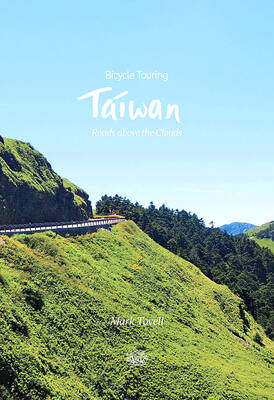
It’s hard to know where to begin with Mark Tovell’s Taiwan: Roads Above the Clouds. Having published a travelogue myself, as well as having contributed to several guidebooks, at first glance Tovell’s book appears to inhabit a middle ground — the kind of hard-to-sell nowheresville publishers detest. Leaf through the pages and you’ll find them suffuse with the purple prose best associated with travel literature: “When the sun is low on a warm, clear morning, and with the heat already rising, we stand at the riverside bike path leading south from Sanxia’s old cobble streets.” Hardly the stuff of your
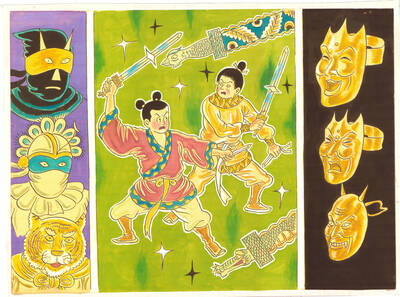
April 22 to April 28 The true identity of the mastermind behind the Demon Gang (魔鬼黨) was undoubtedly on the minds of countless schoolchildren in late 1958. In the days leading up to the big reveal, more than 10,000 guesses were sent to Ta Hwa Publishing Co (大華文化社) for a chance to win prizes. The smash success of the comic series Great Battle Against the Demon Gang (大戰魔鬼黨) came as a surprise to author Yeh Hung-chia (葉宏甲), who had long given up on his dream after being jailed for 10 months in 1947 over political cartoons. Protagonist


 RSS
RSS