


For Aileen Sun (孫筠湘) it was a dream come true. For a week, she would pass the window of a local pet store and admire a purebred basset hound. One day it was gone, sold to some college students. If ever she had the chance again, she told herself, to see that beautiful puppy she would buy it. A few days later, she got her wish. Passing by the store again she saw the same puppy in the window, returned because the parents of the students who bought it refused to allow them to keep the canine. That night, the puppy was given a new home after Aileen paid just over half the original price of NT$18,000.
Sun's dream quickly turned into a nightmare when Pete — who Sun affectionately calls her "daughter" — stopped eating and began to rapidly lose weight.
"She was so weak she could barely move," she said.
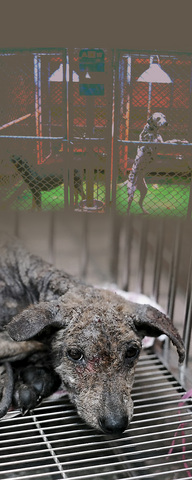
PHOTO COURTESY OF ANIMALS TAIWAN
Sun soon learned that her pet had Fanconi's syndrome, a genetic condition that leads to kidney malfunction. Four veterinarians, two operations, three weeks of drips and NT$100,000 in veterinary bills later, it still seemed likely that Pete was going to die.
"Everyone had just given up," Sun said. Eventually she brought her dog home where it miraculously recovered.
Sun's story is not unique. The cute, fuzzy appearance of many store-bought animals belies an array of genetic problems because the dogs and cats that are highly sought after — and carry the highest price tags — are purebreds.

PHOTO COURTESY OF CHEN HSIANG-YU
According to veterinarian Joey Hung (洪禜偉), genetic problems are more common in purebreds than mixed-breed animals because of overbreeding and inbreeding. When customers come to his office with an animal that has a genetic disease, the American-trained cardiologist immediately recommends neutering the animal so that the defect cannot be passed on.
Another issue Hung deals with in his practice is canine distemper, a virus that is spread in closed environments and easily infects puppies between the ages of three months and six months. The small spaces that pet stores often occupy increase the likelihood of infection.
Hung says it is common for new pet owners to try to return the animals to the store after being diagnosed with distemper. "Then [I] get an angry call from the pet shop saying 'Why did you say that? It's a common cold, not distemper. I'll take the puppy to my own [veterinarian] and prove you are wrong,'" he said.

PHOTO: NOAH BUCHAN, TAIPEI TIMES
It is hardly surprising that pet store owners selling animals would have this kind of reaction as they are loath to shatter the image that puppies may have birth defects. And though some pet-store owners have a genuine interest in the welfare of the animals they sell, the underlying aim is to turn a profit as quickly as possible.
In addition to distemper, another common disease that Hung encounters in his practice is parvovirus, a highly contagious febrile disease. First discovered in canines in 1967, it has spread rapidly.
"The parvovirus is so strong [that] … if you replace a dog you should keep it in a different environment for three to six months," says Hung.
He added that consumers are often mystified by the sickness of their animals because "they tend to believe that the dog looks healthy at the time that they buy [it, but] they do not [understand] the puppy is getting the disease from their home because of the previous sick dog."
Hung says that it is rare for pet stores to warn consumers about the potential health problems of the animals they sell.
Regulation
According to Yen I-feng (嚴一峰), Director of the Taipei Municipal Institute for Animal Health (臺北市動物衛生檢驗所), the municipal body that enforces and regulates the Animal Protection Law (動物保護法), there are 69 legal and roughly double that amount of illegal stores across Taipei selling pets. With this many stores, animal protection officers have their hands full trying to regulate pet stores and enforce the law. Many problem animals come from the illegal pet shops.
According to an animal protection officer, who spoke to the Taipei Times on condition of anonymity, it is often difficult for consumers to distinguish between legitimate and illegal pet shops. Indeed, the officer is frank about the ineffectiveness of the Animal Protection Law in curbing the problem of illegal pet shops.
"Some salons or pet stores that sell pet supplies will put cages with puppies inside but they [won't] put up price signs or a notice saying they are [for sale]. And we will ask them what the purpose is of the puppies. [The owners] say 'they are mine.'" There is little animal protection officers can do when proprietors give this kind of answer because it is difficult to prove that the store is selling animals if there is no price tag on the cage.
The officer says increasing education about animal care — and by extension animal rights — is the best way to reduce the number of illegal outlets selling pets. Consumers should first consider going to shelters before going to a pet store to purchase an animal, the officer said.
Alternatives
Yen agrees. His organization spends a lot of time educating members of the public about the importance of pet ownership and pet problems. His conclusion: It's better to adopt a dog from a place like the Taipei Animal Shelter (臺北市動物之家) in Neihu, than it is to buy one at a pet store.
If the nature of the pet store business is to turn a profit rather than care for animals, with shelters the reverse is true. And though shelters in Taiwan often receive bad press, the more consumers take an interest in the condition and treatment of animals, the more shelters can fill the niche of providing animals to the public.
Sean McCormack of Animals Taiwan, an animal rescue operation located in Shilin, says adopting a pet from shelters offers many benefits that aren't apparent in pet stores.
"There's actually nothing wrong with pet stores," he says, "provided they don't sell pets." McCormack says selling pet clothes, toys, leashes and other pet-related products is a viable way of making a living. But with a huge population of feral animals and shelters offering dogs for free or at extremely low prices, there is no need for pet stores to be selling animals.
He adds that people working at pet shelters aren't interested in making a profit and generally love animals. The corollary is shelter staff and volunteers will often know the animal's personalities and can help the consumer make the right match. If the consumer is interested in a prize breed, they should consider a shelter because as dogs grow older and the responsibility for their upkeep increases people often abandon them.
"The last time I was at the shelter in Neihu, I saw about five golden retrievers," he said. With 300 cages full of animals at the Neihu facility, there is obviously a huge selection of canines to choose from. And once a pet is adopted, it frees up room for other dogs, he said.

In late October of 1873 the government of Japan decided against sending a military expedition to Korea to force that nation to open trade relations. Across the government supporters of the expedition resigned immediately. The spectacle of revolt by disaffected samurai began to loom over Japanese politics. In January of 1874 disaffected samurai attacked a senior minister in Tokyo. A month later, a group of pro-Korea expedition and anti-foreign elements from Saga prefecture in Kyushu revolted, driven in part by high food prices stemming from poor harvests. Their leader, according to Edward Drea’s classic Japan’s Imperial Army, was a samurai

The following three paragraphs are just some of what the local Chinese-language press is reporting on breathlessly and following every twist and turn with the eagerness of a soap opera fan. For many English-language readers, it probably comes across as incomprehensibly opaque, so bear with me briefly dear reader: To the surprise of many, former pop singer and Democratic Progressive Party (DPP) ex-lawmaker Yu Tien (余天) of the Taiwan Normal Country Promotion Association (TNCPA) at the last minute dropped out of the running for committee chair of the DPP’s New Taipei City chapter, paving the way for DPP legislator Su

It’s hard to know where to begin with Mark Tovell’s Taiwan: Roads Above the Clouds. Having published a travelogue myself, as well as having contributed to several guidebooks, at first glance Tovell’s book appears to inhabit a middle ground — the kind of hard-to-sell nowheresville publishers detest. Leaf through the pages and you’ll find them suffuse with the purple prose best associated with travel literature: “When the sun is low on a warm, clear morning, and with the heat already rising, we stand at the riverside bike path leading south from Sanxia’s old cobble streets.” Hardly the stuff of your

April 22 to April 28 The true identity of the mastermind behind the Demon Gang (魔鬼黨) was undoubtedly on the minds of countless schoolchildren in late 1958. In the days leading up to the big reveal, more than 10,000 guesses were sent to Ta Hwa Publishing Co (大華文化社) for a chance to win prizes. The smash success of the comic series Great Battle Against the Demon Gang (大戰魔鬼黨) came as a surprise to author Yeh Hung-chia (葉宏甲), who had long given up on his dream after being jailed for 10 months in 1947 over political cartoons. Protagonist


 RSS
RSS