


All children dream, but few grow up to pursue their dreams with the kind of tena-city that has seen Kevin Spencer become one of the world's most prolific touring magicians.
As a child in the 1970s, he begged his parents for a magic set for more than a year before they bought him one. Early in his professional career he overcame a horrific car accident that left him in a wheelchair and had a doctor warning him he might never walk again. Now, after more than two decades on the road — a time when most magicians would have already "retired" to the comforts of a regular gig in a place like Las Vegas — Spencer keeps touring, because it's what he loves.
"I feel so privileged to do this," said Spencer, who was interviewed by phone from Hong Kong, where he and his wife Cindy were performing their Theatre of Illusion magic show before coming to Taipei for three performances starting tomorrow. "I take it very much as a big responsibility to stand on the stage every night and give the audience the best show that I can. I want them to walk out of there not just having had a good time but to know who we are, to have an idea of the kind of life we live, and to challenge them to not give up on their own personal dreams."
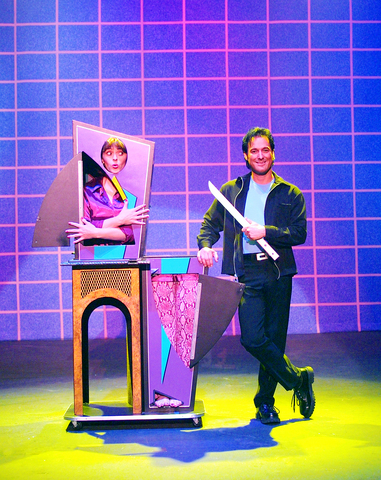
PHOTO COURTESY OF THE SPENCERS
It was exactly two years ago that Kevin and Cindy Spencer, the first woman to be recognized by the International Brotherhood of Musicians, first brought their high-tech Theatre of Illusion to Taipei. Combining dazzling special effects, comedy, choreography, scenery, lighting and music, the Spencers are known for stunts that leave audiences with mouths agape.
But Theatre of Illusion is more than a magic show. Working with some of the leading magic-trick creators and illusion inventors in the business, the Spencers' act is a thrilling roller-coaster ride that sees a woman folded into a 30cm box, cut in half while standing up, and has Kevin Spencer accomplish dangerous feats such as freeing himself from locked chains while submerged inside a tank of water. The duo encourages crowd participation, and their current show includes a mind-reading segment that will involve everyone in the audience.
While many of these tricks are similar to those of great illusionists like David Copperfield, Kevin Spencer said the shows are unique because they reflect different personalities. "David is very much the dramatic sort of magician who likes to pose with the wind blowing through his hair … . I'm pretty much a laid-back sort of performer," Spencer said. "I try to break down that wall between us and the audience. They get to know who I am as a person" and when the show ends with a dramatic underwater escape, "the audience feels that they know me and they have a relationship with me. And they care whether or not I die."
Spencer's career is a good example of what can happen when the separations between performer and audience are broken down. When he was six years old he asked his parents for a magic set after seeing a television show featuring Doug Henning, a Canadian credited with helping revive the magic show as a form of mass entertainment in North America. Spencer, who was small for his age and suffered from asthma, found that his magic tricks gained him the kind of acceptance that other American children attainted through playing sports.
He worked in magic shops to help pay his way through university, but it was seeing Henning perform live during a break from school that turned what he called an "unconscious decision" to pursue magic as a career into a "conscious" plan.
During the show Spencer scribbled a note requesting a meeting with Henning and handed it to an usher, who delivered it and instructed Spencer to wait at the stage door. When Spencer turned up backstage, he saw that lots of other fans were also waiting to meet the entertainer. His hopes were dashed and he was about to leave when the road manager emerged from Henning's room and called Spencer's name.
He spent an hour with Henning, talking about touring with a large show and life on the road. At the end of the meeting Henning told his staff to answer any questions Spencer had. "I'm looking forward to a long relationship with you," Spencer recalled Henning saying. "If it can help you get work don't be afraid to tell people you know me."
Spencer said he probably would not be where he is today if it were not for that meeting. "It was the simple fact that he believed enough in me. He kind of gave me this confidence that you can do anything that you put your mind to." When Spencer returned home he told his parents that he was going to go for it because "I didn't want to be 40 some day and look back and wonder if I was going to make it. If it works that would be really cool. If it doesn't at least I could say that I tried."
The Spencers were named Performing Arts Entertainers of the Year six times by US events programmers — more than any other artist. Their latest tour, which has been in Hong Kong since last Tuesday, includes new material and tricks that were designed especially for the husband-and-wife team. These include walking between the blades of a spinning industrial fan and walking through a wall, the latter a stunt that Houdini introduced in 1914 but gave up after a few performances.
Like their North American shows, the Spencers will end their Taipei performances with an inspirational message, one which was not heard by Hong Kong audiences because their translator there said it would be hard to convey its meaning in Cantonese.
"It's a message that someone shared with us a long time ago," Spencer said. "'Never ever, ever let anyone talk you out of your dreams — because even if you shoot for the moon and you miss, you'll still be among the stars.'"
What: The Spencers: Theatre of Illusion
Where: Novel Hall (新舞臺) at 3-1 Sungshou Rd, Taipei (台北市松壽路3-1號)
When: Tomorrow and Sunday at 8pm and Sunday at 2:30pm
Tickets: NT$600 to NT$2,000 and are available through ERA ticketing, at www.ticket.com.tw

In late October of 1873 the government of Japan decided against sending a military expedition to Korea to force that nation to open trade relations. Across the government supporters of the expedition resigned immediately. The spectacle of revolt by disaffected samurai began to loom over Japanese politics. In January of 1874 disaffected samurai attacked a senior minister in Tokyo. A month later, a group of pro-Korea expedition and anti-foreign elements from Saga prefecture in Kyushu revolted, driven in part by high food prices stemming from poor harvests. Their leader, according to Edward Drea’s classic Japan’s Imperial Army, was a samurai

The following three paragraphs are just some of what the local Chinese-language press is reporting on breathlessly and following every twist and turn with the eagerness of a soap opera fan. For many English-language readers, it probably comes across as incomprehensibly opaque, so bear with me briefly dear reader: To the surprise of many, former pop singer and Democratic Progressive Party (DPP) ex-lawmaker Yu Tien (余天) of the Taiwan Normal Country Promotion Association (TNCPA) at the last minute dropped out of the running for committee chair of the DPP’s New Taipei City chapter, paving the way for DPP legislator Su

It’s hard to know where to begin with Mark Tovell’s Taiwan: Roads Above the Clouds. Having published a travelogue myself, as well as having contributed to several guidebooks, at first glance Tovell’s book appears to inhabit a middle ground — the kind of hard-to-sell nowheresville publishers detest. Leaf through the pages and you’ll find them suffuse with the purple prose best associated with travel literature: “When the sun is low on a warm, clear morning, and with the heat already rising, we stand at the riverside bike path leading south from Sanxia’s old cobble streets.” Hardly the stuff of your
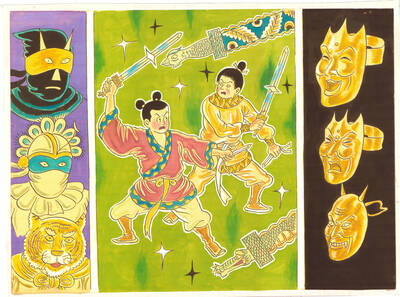
April 22 to April 28 The true identity of the mastermind behind the Demon Gang (魔鬼黨) was undoubtedly on the minds of countless schoolchildren in late 1958. In the days leading up to the big reveal, more than 10,000 guesses were sent to Ta Hwa Publishing Co (大華文化社) for a chance to win prizes. The smash success of the comic series Great Battle Against the Demon Gang (大戰魔鬼黨) came as a surprise to author Yeh Hung-chia (葉宏甲), who had long given up on his dream after being jailed for 10 months in 1947 over political cartoons. Protagonist


 RSS
RSS