


A bighorn sheep lay in a field not far from here, its head missing. In nearby Elko, three elk and five deer died from gunshot wounds, their carcasses rotting in the hills. And somewhere in the distant mountains, game wardens searched for another elk that a tipster said had been killed by illegal hunters, apparently just for the thrill of it.
The reports keep coming in — elk, deer, antelope, bighorn sheep and other big-game animals — killed in a wave of poaching that has alarmed state and federal wildlife officials in Nevada and several other Western states.
The authorities said they are seeing more organized rings of poachers and unlicensed guides chasing the biggest elk and mule deer, with the largest antler array, sometimes trading them on Internet auction sites or submitting pictures to glossy hunting magazines that prominently feature big kills.
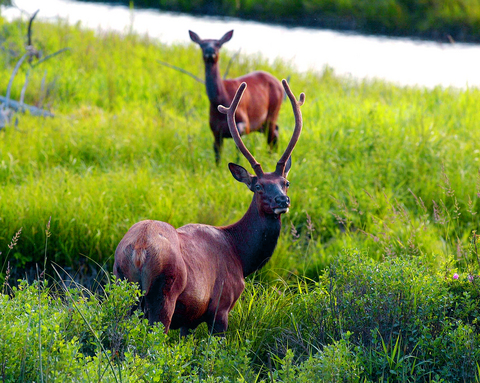
PHOTO: NY TIMES NEWS SERVICE
"There is almost a fixation on possessing or obtaining trophy-class animals," said Jim Kropp, the wildlife law enforcement chief for Montana, which this fall began a new public awareness campaign about poaching called Enough Is Enough.
"People," he added, "will go to any length to have these things in their possession. It's big antlers and big egos."
The federal government does not keep national statistics on poaching incidents, but wildlife law enforcement officials in several states, mainly those with large populations of elk, mule deer and other animals prized for their impressive antlers or girth, have raised concerns about the rash of complaints and the big money that seems increasingly a factor in the cases they investigate.
The officials said tight regulations on where and what can be hunted at various times of year, part of an effort to manage the size of big-game herds, have motivated some hunters to shoot game out of season or on restricted land.
The National Park Service wrote in a budget statement last year that poaching had contributed to the decline of 29 species of wildlife in the 390 parks and other sites it oversees.
An interstate compact set up 15 years ago in a few Western states to track and punish violators of hunting laws across state lines has grown to 24 states nationally, including New York, which joined this year. Big-game crimes, mostly related to poaching, accounted for 42 percent of the violations to the compact reported last year.
"We treat these as essentially homicides," said Lieutenant Jerry Smith, a Nevada supervising game warden. "But it is such a secretive crime. We have no witnesses to work with, just the bodies, when we find them."
A decade ago, Nevada tallied 50 or so animals poached or killed out of season and by hunters without permits. Last year, 70 such animals were found, the highest number ever; so far this year the tally is 65, and with a few weeks of the biggest hunting left, Nevada officials said the number could surpass last year's.
Nevada is not alone.
This year, Montana and federal investigators seized 30 elk heads and prosecuted 22 people in a poaching ring who drew fines and in the case of the ring leader, Danny McDonald of Gardiner, Montana, a year in federal prison. They had illegally led out-of-state hunters to trophy bull elks leaving Yellowstone National Park.
In Idaho, Ed Mitchell, a spokesman for the Department of Fish and Game, said poaching cases in the state had remained steady in recent years, but the crimes increasingly are carried out by people in the black market for antlers and heads, which can fetch tens of thousands of US dollars.
"Legitimate hunters don't find it entirely understandable, but some people will pay to have some critter on their wall they can claim they have shot," Mitchell said. "Hunters find that completely out of the realm of understanding." In part to better understand the scope of the problem, the Association of Fish and Wildlife Agencies is developing a database that will include closer tracking of the number and nature of poaching incidents nationwide.
In Nevada, officials said they suspect the strict regulation that has allowed the elk and deer population to flourish may also be driving up poaching. People who covet antlers as decorations or to sell on the market do not want to wait the decade or more it can take to get a tag, or permit, to hunt a single big elk or deer.
This year, 25,893 people requested an elk tag, but only 2,254 were issued, to the dismay of some hunter groups that have pushed for more tags. On average the department receives 15 applicants for every bull elk tag.
Like other states, Nevada has a sparse staff of field game wardens who cover vast swaths of territory, making it easier for poachers to get away with their crimes. Often, poached animals are not found until hunters deep in the backcountry come across something suspicious, said Rob Buonamici, the law enforcement chief for the Nevada Department of Wildlife.
But several of the finds in the past couple years have been close to growing, populated areas, leading him to suspect the culprits may have been newcomers taking advantage of easy targets close to home.
The rise in poaching here has come as Nevada has managed to greatly increase its elk and mule deer population in recent years and officials fear poaching will set back those efforts.
"Wildlife belongs to everybody," said Buonamici of the Nevada Wildlife Department. "If not for what the departments of fish and wildlife do and the sportsmen support through the fees they pay, the little old lady in LA would never be able to see a wildlife documentary because there would be no wildlife left."
Poaching also angers licensed hunters because it depletes the pool of animals they can potentially bag; by law they must carry away all the edible portions of their kill, which typically fill a freezer and provide steaks, burgers, jerky and the like for more than a year.
"I don't understand why they just go out there, kill it and leave it," said Lazo Pavlakis, 76, shaking his head as he stood triumphant over a bull elk he legally killed on the first day of an elk hunt here, 322km north of Las Vegas. He had waited 18 years for a permit, issued by annual lottery, to shoot a single elk, which he planned to consume with his grandsons.
"This is about once in a lifetime for me, so no, I don't appreciate hearing about elks killed and left out there," he said.
Up against the poachers are wardens like Joe Maslach, a 17-year veteran of the Nevada Wildlife Department and a devoted hunter himself.
On one recent tour, Maslach put 423km on his department-issued pickup truck, crisscrossing the mountains near here, checking the documentation of hunters, making sure that legally set traps complied with regulations and responding to a call from a tipster of poached chukars, a popular game bird.
Discovering 26 of the birds shot dead and tucked into bushes on a hillside, Weslach grew disgusted as he worked what in effect was a crime scene, photographing the position of the birds, measuring tire tracks and taking the internal temperature to determine roughly when they were killed.
"These are the kind of guys you would like to take to jail," he said, stuffing the birds, frozen stiff in the 20-degree chill, into a bag.
But it was also clear hunters were not accustomed to seeing Maslach or other wardens. Several said they had never had their hunting documents checked or it had been years since they had.
In 35 years of hunting in Nevada, Fred Perdomo, who was legally tracking an elk this weekend, said he had encountered a game warden only twice — 12 years ago and this month. "I heard about the poachings and could not believe it," he said. "It just doesn't make much sense."
Maslach checked his papers and then Perdomo set off down a ridge toward a stand of trees where an elk waited.

In late October of 1873 the government of Japan decided against sending a military expedition to Korea to force that nation to open trade relations. Across the government supporters of the expedition resigned immediately. The spectacle of revolt by disaffected samurai began to loom over Japanese politics. In January of 1874 disaffected samurai attacked a senior minister in Tokyo. A month later, a group of pro-Korea expedition and anti-foreign elements from Saga prefecture in Kyushu revolted, driven in part by high food prices stemming from poor harvests. Their leader, according to Edward Drea’s classic Japan’s Imperial Army, was a samurai

The following three paragraphs are just some of what the local Chinese-language press is reporting on breathlessly and following every twist and turn with the eagerness of a soap opera fan. For many English-language readers, it probably comes across as incomprehensibly opaque, so bear with me briefly dear reader: To the surprise of many, former pop singer and Democratic Progressive Party (DPP) ex-lawmaker Yu Tien (余天) of the Taiwan Normal Country Promotion Association (TNCPA) at the last minute dropped out of the running for committee chair of the DPP’s New Taipei City chapter, paving the way for DPP legislator Su

It’s hard to know where to begin with Mark Tovell’s Taiwan: Roads Above the Clouds. Having published a travelogue myself, as well as having contributed to several guidebooks, at first glance Tovell’s book appears to inhabit a middle ground — the kind of hard-to-sell nowheresville publishers detest. Leaf through the pages and you’ll find them suffuse with the purple prose best associated with travel literature: “When the sun is low on a warm, clear morning, and with the heat already rising, we stand at the riverside bike path leading south from Sanxia’s old cobble streets.” Hardly the stuff of your

April 22 to April 28 The true identity of the mastermind behind the Demon Gang (魔鬼黨) was undoubtedly on the minds of countless schoolchildren in late 1958. In the days leading up to the big reveal, more than 10,000 guesses were sent to Ta Hwa Publishing Co (大華文化社) for a chance to win prizes. The smash success of the comic series Great Battle Against the Demon Gang (大戰魔鬼黨) came as a surprise to author Yeh Hung-chia (葉宏甲), who had long given up on his dream after being jailed for 10 months in 1947 over political cartoons. Protagonist


 RSS
RSS