


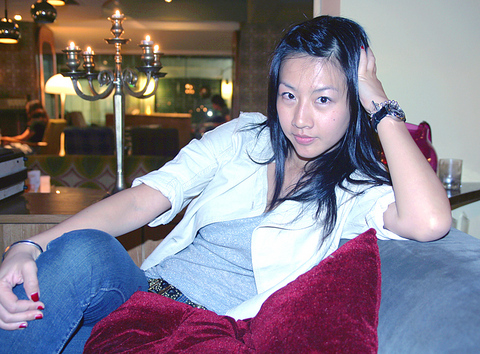
She makes the shoes that pop and movie stars like Jolin Tsai (蔡依林) and Vivian Hsu (徐若瑄) step out in. But Chloe Chen is heading west rather than east to expand her small fashion realm.
The director of Omni — a retro furniture and style store run in collaboration with Taiwan's chairman of pop Jay Chou (周杰倫) — Chen also heads up Honey Daniels shoes.
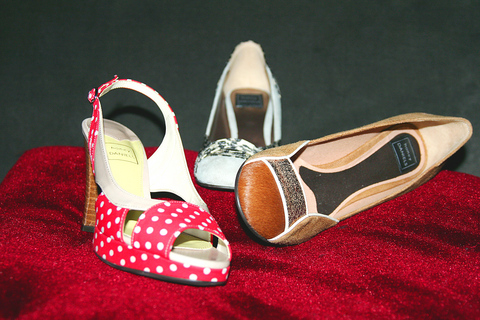
She has opened two outlets in the fashionable East District and Xinyi District, where her shoes sell for around NT$3,000 to NT$6,000.
PHOTOS: JULES QUARTLY, TAIPEI TIMES
And if the name Honey Daniels gives you deja vous it's because the company is named after the feel-good movie starring Jessica Alba, as a dancer who makes it in New York.
Chen says her current dilemma is whether to ship shoes to the US and compete with brands like Manolo Blahnik, or manufacture cheaper products at factories in China and take on the mass market.
As much as Chen is a designer of shoes she's also a pretty experienced 30-year-old businesswoman. Her philosophy is: “If it's a good product, it should sell.”
“Our pricing is kind of high, so our segment of the market is quite narrow. We've come to a point where there's no growth. So, either we sell just to stars and rich people, or we reduce our costs and go to China.”
The fact she recently attended an English-language school in the US indicates she has already made her decision.
“We would rather look at other markets and take our shoes to places like New York where prices are relatively expensive. For instance, Manolo Blahnik are not that well made. They just have great marketing. Sex and the City tripled their price.”
Chen says of a visit last week to the Big Apple that she went to the store Barneys and had a chance encounter with Gwyneth Paltrow's agent, who expressed an interest in her shoes.
Though Chen designs and has what one of her China-based agents calls “great taste,” she's also adept at marketing. She majored in advertising at Chinese Culture University in Taipei.
“Studying advertising gave me a lot of background, it was a major influence. If I had only studied arts I don't think I would have done this. I thought advertising was creative but actually it turned out to be business,” Chen says.
Her first job was gopher at an advertising firm, but she realized it wasn't her. Her businessman father said, “Follow your dreams” and instead of going to the office she opened her first shop in Tienmu, Taipei. She mainly imported Hong Kong fashion and it was a big hit.
While her father backed her financially, Chen credits her mother with inculcating a sense of fashion, nurtured by what she speaks of as a fairly idyllic childhood in Taitung.
“At school I was a fashion leader, a trend setter rather than a sheep. At university there was a nearby flea market run by foreigners with second-hand clothing and furniture, a lot of good stuff at reasonable prices. I used it and altered it to make it stylish.”
“I always buy what I like and I thought if couldn't sell the clothes then I could wear them myself. That's why I only bought a few items of a kind — in case they did not sell.”
“We were different from other stores. We picked a second-floor location because we did not want walk-in traffic. We wanted it to be special, alternative. I put up a big heart with our name and painted the window. We bought an old fridge and cleaned it out, using it for display. There wasn't a set formula.”
She opened a second store in an apartment with Hong Kong designer Toby Liu, who now works for D-Mop.
“I started to get frustrated because I couldn't find the clothes I wanted, so we co-operated in making clothes. We made what I wanted.”
But after two years she closed this store because its costs were too high for the market. It was her first and so far only failure.
“I realized it was easier to buy stuff than make myself. Also, I learned a lesson about marketing and selling. You have to think harder before you start something. You have to prepare well.”
So she moved to Taipei's East district five years ago and did it with a splash of publicity by starting Omni (“all things”) with Chairman Chou, who's into retro fashion, furniture and classic cars.
“When I was young I liked antiques and clothes and mother's shoes, but her feet were so small I couldn't wear them. I went abroad to find vintage shoes because customers wanted them. I realized shoes were the most important part of clothing.”
Chen decided to found her own label and her dad found a manufacturer of hand-made shoes in South Korea. She has her shoes made from drawn designs.
She designs the shoe, picks the materials and then works with the manufacturer to make a sample.
“I do not have formal training, that's why I'm different and successful. Comfort is very important, for the back and for the feet. My shoes are not cheap but I have repeat customers because they last a long time and are classic rather than trendy. Value is the important thing.”
“Obviously, though,” she adds, “they also need to be sexy. All women want to be sexy, the heel is sexy.”
Chen has one other policy when it comes to shoes. She does not discount since she believes they have the quality of, say, Manolo Blahnik, but sell for NT$10,000 less.
“Many people when they come in they want discounts. But we don't do them, there's too much work that goes into these shoes. That's the policy, they are limited editions, and you won't see them anywhere else. You can't borrow them, you can only buy them.”
Chen says this policy even applied to Vivian Hsu when she made The Shoe Fairy (人魚朵朵), a film about a cripple who is in love with shoes but can't wear them. Obviously, Honey Daniels shoes were featured, but they came at a price.

In late October of 1873 the government of Japan decided against sending a military expedition to Korea to force that nation to open trade relations. Across the government supporters of the expedition resigned immediately. The spectacle of revolt by disaffected samurai began to loom over Japanese politics. In January of 1874 disaffected samurai attacked a senior minister in Tokyo. A month later, a group of pro-Korea expedition and anti-foreign elements from Saga prefecture in Kyushu revolted, driven in part by high food prices stemming from poor harvests. Their leader, according to Edward Drea’s classic Japan’s Imperial Army, was a samurai

The following three paragraphs are just some of what the local Chinese-language press is reporting on breathlessly and following every twist and turn with the eagerness of a soap opera fan. For many English-language readers, it probably comes across as incomprehensibly opaque, so bear with me briefly dear reader: To the surprise of many, former pop singer and Democratic Progressive Party (DPP) ex-lawmaker Yu Tien (余天) of the Taiwan Normal Country Promotion Association (TNCPA) at the last minute dropped out of the running for committee chair of the DPP’s New Taipei City chapter, paving the way for DPP legislator Su

It’s hard to know where to begin with Mark Tovell’s Taiwan: Roads Above the Clouds. Having published a travelogue myself, as well as having contributed to several guidebooks, at first glance Tovell’s book appears to inhabit a middle ground — the kind of hard-to-sell nowheresville publishers detest. Leaf through the pages and you’ll find them suffuse with the purple prose best associated with travel literature: “When the sun is low on a warm, clear morning, and with the heat already rising, we stand at the riverside bike path leading south from Sanxia’s old cobble streets.” Hardly the stuff of your
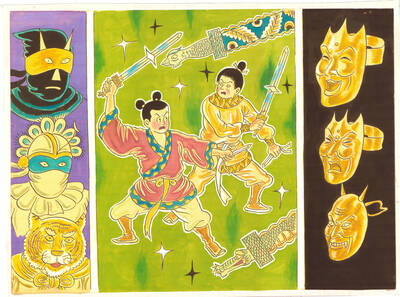
April 22 to April 28 The true identity of the mastermind behind the Demon Gang (魔鬼黨) was undoubtedly on the minds of countless schoolchildren in late 1958. In the days leading up to the big reveal, more than 10,000 guesses were sent to Ta Hwa Publishing Co (大華文化社) for a chance to win prizes. The smash success of the comic series Great Battle Against the Demon Gang (大戰魔鬼黨) came as a surprise to author Yeh Hung-chia (葉宏甲), who had long given up on his dream after being jailed for 10 months in 1947 over political cartoons. Protagonist


 RSS
RSS