


The Bayerisches Staatsballett (Bavarian State Ballet) kicks off the National Theater's Made in Germany festival next Tuesday night with the Taiwan premiere of William Forsythe's Limb's Theorem.
There is a long tradition of classical ballet in Munich, dating back to the mid-1880s. But for decades the state ballet company was the younger sibling of the Bavarian State Opera. The Bayerische Staatsballett has come a long way since it gained its independence from the opera in 1988 under the leadership of Konstanze Vernon. Now led by Ivan Liska, it has become a fully fledged performer on the international dance scene.
It is appropriate that its first visit to Taipei should begin with one of Forsythe's works, for over the past three decades the New York-born Forsythe has meshed Germanic precision with American radicalism to become one of the most talked about modern ballet choreographers in the world.
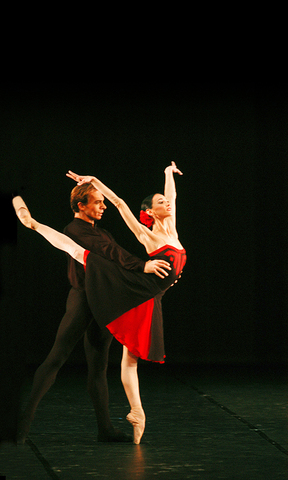
PHOTO COURTESY OF NTCH
He has been credited with revolutionizing the world of classical ballet in his two decades with the Ballett Frankfurt. But Forsythe had already begun to make a name for himself as a choreographer when he was still dancing with the Stuttgart Ballet in the 1970s.
He spent four years as a journeyman choreographer after leaving Stuttgart in 1980, creating works for the Nederlands Dans Theater, the Paris Opera Ballet, among others, before taking the helm in Frankfurt in 1984.
Over the next 20 years, the works he created for Frankfurt deconstructed classical ballet's language and combined it with very theatrical stagings. Each new ballet for Frankfurt became a major event for the dance world.
Unfortunately, Forsythe's sensibilities clashed with those of Frankfurt's burghers, who preferred something more classical, and he disbanded the company at the end of its 2004 season. He has since found a new home in Dresden.
A sign of his prominence, however, was that there was such an outcry about the Frankfurt company's closing that the authorities in Frankfurt and Dresden (and their respective states of Hesse and Saxony) reached an arrangement to provide 75 percent of Forsythe's new company's annual budget.
Limb's Theorem is a prime example of Forsythe's work. Created in 1991, the 82-minute, three-act ballet is a challenge for both dancers and the audience. It has attained an almost cult-like status in Munich since Forsythe revived it for the Bayerisches Staatsballett in December 2004.
To begin with, it doesn't have a score, it has a “sound installation” by Thom Willems. Second, the individual parts are based on improvisation, which may be commonplace in jazz but is almost unheard of in classical ballet. The Bayerisches Staatsballett dancers had to attend workshops on improvisation before they even began the formal rehearsal process for the piece.
Then there is the staging — a huge, rotating sail-like sculpture in the first act, a curved wall in the second and a telescopic installation in the third. All three change the dimensions of the performance space.
In Limb's Theorem Forsythe forces his audiences to make a choice about what to focus on; he doesn't want them to just sit back and watch as if this was the upteenth version of Swan Lake they are seeing.
From the radical modernism of Forsythe, the company changes pace for its final two performances. Its Gala Program presents a tantalizing menu of seven works that mix of classical and contemporary pieces and is designed to showcase the company's technical talent. On the menu are Five Tangos and Solo by Hans van Manen, George Balachine's Agon — Pas de deux and Balachine's heir Peter Martins' Zakouski. The world of English ballet is showcased with Sir Fredrick Ashton's Five Brahms Waltzes in the Manner of Isadora Duncan. The program wraps up with Stephan Thoss' My Way, set to ole' blue eyes' himself, Frank Sinatra, followed by Davide Bombana's Century Rolls.
So dance fans have a choice. They can choose risk and go for Limb's Theorem or they can play it safe with the gala; either way, they are unlikely to go home disappointed. A true dance fanatic, however, will hopefully been saving their cash so that they can afford tickets for both programs.
Performance Notes:
What: Bayerisches Staatsballett
Where: National Theater, Taipei
When: Limb's Theorem, Tuesday to Thursday at 7:30pm; Gala Program, Oct. 21 at 7:30pm and Oct. 22 at 2:30pm
Tickets: NT$1,200, NT$1,800, NT$2,000, NT$3,000 and NT$3,600

In late October of 1873 the government of Japan decided against sending a military expedition to Korea to force that nation to open trade relations. Across the government supporters of the expedition resigned immediately. The spectacle of revolt by disaffected samurai began to loom over Japanese politics. In January of 1874 disaffected samurai attacked a senior minister in Tokyo. A month later, a group of pro-Korea expedition and anti-foreign elements from Saga prefecture in Kyushu revolted, driven in part by high food prices stemming from poor harvests. Their leader, according to Edward Drea’s classic Japan’s Imperial Army, was a samurai

The following three paragraphs are just some of what the local Chinese-language press is reporting on breathlessly and following every twist and turn with the eagerness of a soap opera fan. For many English-language readers, it probably comes across as incomprehensibly opaque, so bear with me briefly dear reader: To the surprise of many, former pop singer and Democratic Progressive Party (DPP) ex-lawmaker Yu Tien (余天) of the Taiwan Normal Country Promotion Association (TNCPA) at the last minute dropped out of the running for committee chair of the DPP’s New Taipei City chapter, paving the way for DPP legislator Su

It’s hard to know where to begin with Mark Tovell’s Taiwan: Roads Above the Clouds. Having published a travelogue myself, as well as having contributed to several guidebooks, at first glance Tovell’s book appears to inhabit a middle ground — the kind of hard-to-sell nowheresville publishers detest. Leaf through the pages and you’ll find them suffuse with the purple prose best associated with travel literature: “When the sun is low on a warm, clear morning, and with the heat already rising, we stand at the riverside bike path leading south from Sanxia’s old cobble streets.” Hardly the stuff of your

April 22 to April 28 The true identity of the mastermind behind the Demon Gang (魔鬼黨) was undoubtedly on the minds of countless schoolchildren in late 1958. In the days leading up to the big reveal, more than 10,000 guesses were sent to Ta Hwa Publishing Co (大華文化社) for a chance to win prizes. The smash success of the comic series Great Battle Against the Demon Gang (大戰魔鬼黨) came as a surprise to author Yeh Hung-chia (葉宏甲), who had long given up on his dream after being jailed for 10 months in 1947 over political cartoons. Protagonist


 RSS
RSS