


While researching rural life more than 20 years ago, Paul Rosenblatt took his 12-year-old son with him to interview farm families in the Midwest. Father and son stayed in a farmhouse and had to share a bed.
“It was terrible,” said Rosenblatt, a professor of sociology at the University of Minnesota, Twin Cities, because his son thrashed and turned so much that “his feet were in my face all night.”
Tired and bedraggled the next day, he recalled thinking about how challenging it can be to adapt to sleeping with another person.
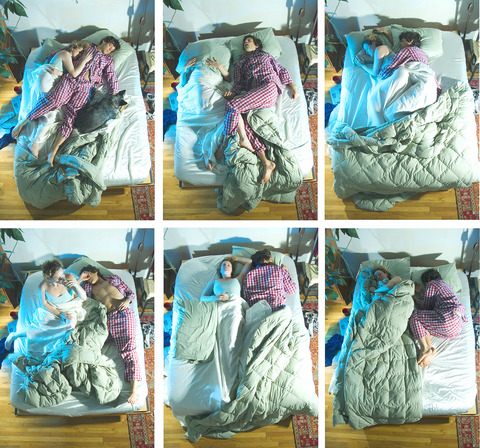
PHOTO: NY TIMES NEWS SERVICE
In more recent research — on grief — Rosenblatt interviewed couples whose children had died.
“They quite often would tell me that they dealt with their grief by holding each other and talking together in bed at night,” he said. “It seemed that I kept being reminded of how sharing a bed impacts our lives and sense of well-being.”
And yet, no one had really studied it, perhaps because sharing a bed is so mundane, Rosenblatt said. So he wrote Two in a Bed: The Social System of Couple Bed Sharing, published this summer by State University of New York Press.
“It’s not a self-help book,” he said, but an examination of some of the common and often humorous issues couples face when sharing a bed, including spooning, sheet-stealing and snoring.
“My hope is that the book will influence the world of sleep research so sleep is no longer viewed as an individual phenomenon,” Rosenblatt said.
There are thousands of studies on sleep, but only a handful on couples sleeping together.
The National Sleep Foundation, a nonprofit group in Washington that supports education and research on sleep and sleep disorders, estimates that 61 percent of Americans share their bed with a significant other. And while the very presence of another person in bed increases the chance of sleep disruption, 62 percent of those polled in the foundation’s annual sleep study said they preferred to bed down with their partner.
In researching his book, Rosenblatt said even though many couples said they slept better alone, they still shared a bed. “When I asked why, they looked at me as if I’d asked them why they keep breathing,” he said.
For Two in a Bed, Rosenblatt interviewed 42 couples. Most of them were married heterosexual couples but some were unmarried heterosexual or homosexual couples. Intimacy and comfort were the primary reasons couples gave for sleeping together.
“Some mentioned sex, but not a lot,” Rosenblatt said. Most reported that the bed is where they talked. “The bed is where they found privacy and were able to leave behind the distractions and separate interests that keep them apart during the day. There’s also something about late night that allowed them to open up and connect.”
Several interviewees reported that difficulty sleeping together or sleeping apart had led to the dissolution of previous marriages, and that sleeping together was essential to maintaining their relationships. Rosenblatt found that it might also save lives.
“It surprised me how many people thought they were alive today because they shared a bed,” Rosenblatt said.
For example, he said a woman’s seizure was noticed immediately by her husband with whom she spooned every night. Similar stories came from couples where one partner had a heart attack, stroke or went into diabetic shock.
The couples Rosenblatt interviewed described how they had had to adjust to sleeping with their partner. Many reported conflicts over bedroom temperature, where to locate the bed and how to make the bed. Watching television, reading and eating in bed were other contentious issues, as was sleeping in the nude. There were quarrels over the alarm clock and whether to allow children or pets into the bed.
“Each couple had to do a lot of problem solving to work out their systems for sleeping together,” Rosenblatt said. These systems, he said, usually became comforting routines of how couples prepared for bed, got into bed, behaved once in the bed, fell asleep and woke up.
The subjects he interviewed invariably had their own side of the bed, and responsibilities like putting out the cat or opening the windows before turning in. They usually had rituals like watching the television news before lights out or snuggling before falling to sleep. And they often had signals for when they wanted affection, wanted to talk or wanted to be left alone.
“How they arrived at these systems could be said to mirror their relationships,” said Rosenblatt. The most successful systems were those formed out of compromise and sensitivity to the other’s needs.
Whereas a woman might have always been cold at night when she was younger, she might feel like a furnace from menopausal hot flashes as she grows older. Prostate problems might cause a man to get up more often in the night to use the bathroom.
Not surprisingly, perhaps, those interviewed said dealing with a partner’s snoring and insomnia profoundly affected the couple’s sleep dynamic.
“These are all things that no one teaches you how to cope with,” said Neil Kavey, a psychiatrist and director of the Sleep Disorders Center at New York-Presbyterian/Columbia University Medical Center. “There’s no counseling in this regard, but there should be.”
Sleep centers are primarily concerned with treating disorders and don’t address the impact one partner has on the other. Whatever the cause of unrest, “sleep deprivation has consequences,” Kavey said. Those include impaired cognitive ability and irritability.
Though Rosenblatt has written five other books and scores of scholarly essays and papers, he said his book on couples’ sleep has gotten by far the most attention from the news media and fellow academics.
“I think it’s because it’s something most people have struggled with and can relate to,” Rosenblatt said. “And even though we may take sleeping with our partner for granted, it’s through these kinds of shared social systems that we build and nurture our relationships, and perhaps uncover the underlying meaning of our lives.”

Sept.16 to Sept. 22 The “anti-communist train” with then-president Chiang Kai-shek’s (蔣介石) face plastered on the engine puffed along the “sugar railway” (糖業鐵路) in May 1955, drawing enthusiastic crowds at 103 stops covering nearly 1,200km. An estimated 1.58 million spectators were treated to propaganda films, plays and received free sugar products. By this time, the state-run Taiwan Sugar Corporation (台糖, Taisugar) had managed to connect the previously separate east-west lines established by Japanese-era sugar factories, allowing the anti-communist train to travel easily from Taichung to Pingtung’s Donggang Township (東港). Last Sunday’s feature (Taiwan in Time: The sugar express) covered the inauguration of the

The corruption cases surrounding former Taipei Mayor and Taiwan People’s Party (TPP) head Ko Wen-je (柯文哲) are just one item in the endless cycle of noise and fuss obscuring Taiwan’s deep and urgent structural and social problems. Even the case itself, as James Baron observed in an excellent piece at the Diplomat last week, is only one manifestation of the greater problem of deep-rooted corruption in land development. Last week the government announced a program to permit 25,000 foreign university students, primarily from the Philippines, Indonesia and Malaysia, to work in Taiwan after graduation for 2-4 years. That number is a

In a stark demonstration of how award-winning breakthroughs can come from the most unlikely directions, researchers have won an Ig Nobel prize for discovering that mammals can breathe through their anuses. After a series of tests on mice, rats and pigs, Japanese scientists found the animals absorb oxygen delivered through the rectum, work that underpins a clinical trial to see whether the procedure can treat respiratory failure. The team is among 10 recognized in this year’s Ig Nobel awards (see below for more), the irreverent accolades given for achievements that “first make people laugh, and then make them think.” They are not

This Qing Dynasty trail takes hikers from renowned hot springs in the East Rift Valley, up to the top of the Coastal Mountain Range, and down to the Pacific Short vacations to eastern Taiwan often require choosing between the Rift Valley with its pineapple fields, rice paddies and broader range of amenities, or the less populated coastal route for its ocean scenery. For those who can’t decide, why not try both? The Antong Traversing Trail (安通越嶺道) provides just such an opportunity. Built 149 years ago, the trail linked up these two formerly isolated parts of the island by crossing over the Coastal Mountain Range. After decades of serving as a convenient path for local Amis, Han settlers, missionaries and smugglers, the trail fell into disuse once modern roadways were built


 RSS
RSS