


Goodbye yellow brick road, hello hip hop.
Elton John tells Rolling Stone magazine that he wants to record a hip-hop album with Grammy-winning producer Dr. Dre.
"I want to work with Pharrell, Timbaland, Snoop, Kanye, Eminem and just see what happens," the Rocket Man says in the Sept. 7 issue. "It may be a disaster, it could be fantastic, but you don't know until you try."
The 59-year-old says he is a fan of Blackstreet's No Diggity and Tupac Shakur's California Love.
"I want to bring my songs and melodies to hip-hop beats," John says. "I love these beats, but I have no idea how to get them."
Sir John performed Eminem's song Stan with the rapper during the 2001 Grammy awards.
His new album, The Captain and the Kid, is due in September.
Another star who seems to have lost touch with reality, Tom Cruise, has a new award from Australia to add to his collection -- for being the most sexist celebrity.
About 400 of Australia's most powerful women gathered in the New South Wales state parliament late Thursday to decide on the winners of the 14th annual Ernie Awards which are handed out for the worst derogatory public statements.
The awards were named after a trade union leader called Ernie whose union members included sheep shearers. He once famously said: "Women aren't welcome in the shearing sheds. They're only after the sex."
The Ernies have an international flavor -- and Cruise was awarded the 2006 Celebrity Ernie.
Dumped by Paramount Pictures for his erratic behavior, the kooky star won for a comment he made about his pregnant partner Katie Holmes: "I've got Katie tucked away so no one will get to us until my child is born."
The political award went to Bill Heffernan, a member of Prime Minister John Howard's conservative government in a hotly contested field.
Heffernan chastised opposition Labor MP Julia Gillard for being single and childless. "Anyone who chooses to deliberately remain barren ... they've got no idea what life's about," Heffernan said.
But the Golden Ernie for 2006 went to cruise liner company P&O for an advertising campaign that included postcards featuring bikini-clad women and the caption: "Seamen wanted."
The company has subsequently apologized for the campaign.
Another celebrity diaster in the making is Kevin Federline, who has been trying his hand at signing and acting.
The 28-year-old dancer who married singer Britney Spears will be shuffling over to the small screen where he will appear in an episode of CSI: Crime Scene Investigation this fall, People magazine reported.
Although Federline and Spears ventured into TV with their reality show Chaotic, which aired on UPN last year, this will be his first venture into acting.
Britney's boy started filming this week in Los Angeles. He will play a menacing, arrogant teen who harasses investigators Nick Stokes (George Eads) and Warrick Brown (Gary Dourdan) on a job.
The episode is tentatively scheduled to air in October.
Mr. Britney Spears recently performed at the Teen Choice Awards where he rapped one of the songs on his upcoming album Playing with Fire.
Introduced by his wife, who was dressed in a cleavage-baring mini-dress despite her late pregnancy, K-Fed stalked about the stage with attitude.
"Don't hate because I'm a superstar! And I'm married to a superstar! Nothin' come between us no matter who you are!" he declared, as dancers pop-locked as his side.
It was the most anticipated performance of the night -- and the most ridiculed. The next morning, videos of it were splashed on Web sites like YouTube.com and various blogs, accompanied by catty comments mocking both Federline and his wife.
If the Web world isn't exactly accepting of Federline's rap-star ambitions, the hip-hopsters are even less so.
Elliot Wilson, editor in chief of XXL magazine, called it a "YouTube disaster" -- something to be laughed off in hip-hop circles.
"I just think we ignore him," Wilson said. "He's a joke, basically."

Taiwan’s English education system is being pulled apart by three opposing forces. Bilingual Nation 2030 pulls students toward English and global communication. Artificial Intelligence (AI) readiness pulls them toward digital judgment, verification and AI-mediated work. But Taiwan’s old exam culture pulls them back toward memorization, grammar drills, timed reading and correct answers. If the education system keeps using old exams to define success, it risks producing graduates who are neither genuinely bilingual nor genuinely AI-ready, but trained for tasks machines can already perform. The first force is Bilingual Nation 2030. Launched in 2018, the policy aimed to “help Taiwan’s workforce connect

“Taiwan’s Opposition Leader Comes to US With a Message Straight Out of Beijing” read a May 31 headline in the Wall Street Journal. Top US administration officials and members of Congress almost certainly read the WSJ, and if there was a bullet point takeaway that people in Washington should absorb ahead of Chinese Nationalist Party (KMT) Chair Cheng Li-wun’s (鄭麗文) arrival in DC on June 9, that headline is it. The last few columns have discussed this very topic, and the timing is not coincidental. While those top officials likely do not read the Taipei Times, judging by the number

With weighty, anxiety-inducing geopolitical topics dominating the headlines, checking in on the wild and weird state of local politics can take some of the edge off. This November’s elections will determine who will be in charge of fixing potholes in your neighborhood, not the potholes in Taiwan’s complicated geopolitical space. Recently, after an online interview with a Taipei-based journalist, I commented that Taipei journalists never go further than the MRT can take them. He laughed and agreed. Naturally, the Taipei mayoral race is eating up much of the press attention. TAIPEI CITY Democratic Progressive Party (DPP) candidate Puma Shen (沈伯洋) has
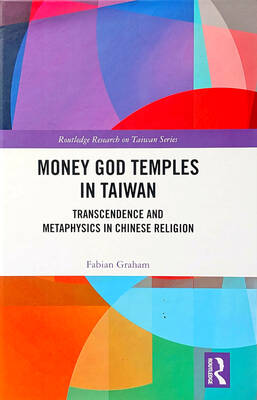
As someone who normally steers clear of books with “transcendence” or “metaphysics” in their subtitles, this reviewer — a casual observer of local belief systems since the 1990s — found Fabian Graham’s Money God Temples in Taiwan a challenging read. Those who’ve only dipped their toes into temple culture will likely need to parse several sections with special care if they’re to keep up with the author, a British ethnographic researcher whose previous books have investigated religious practices among ethnic Chinese in Southeast Asia. This scholarly volume examines a facet of Taiwan’s religious landscape that didn’t exist a century ago, and


 RSS
RSS