


As the twin scourges of AIDS and unemployment ravaged their rural district, the women of the South African fishing village of Hamburg fought back with the weapons they were given: embroidery needles.
What began as a simple plan to earn money for medicine through handicrafts has led to the creation of several massive and elaborate communal artworks — the most recent of which went on display here Sunday above the altar of St. James Episcopal Cathedral, the first stop of a US tour.
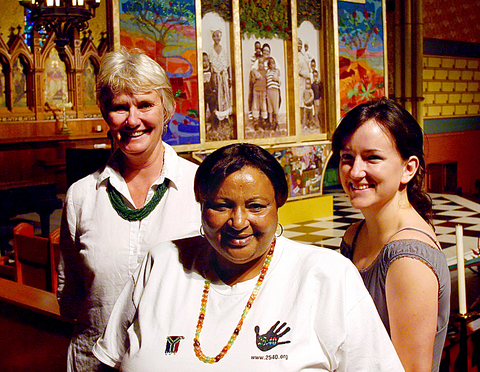
The Keiskamma Altarpiece, named after a river that flows past Hamburg, is a huge work — 3.9m high and 6.6m wide when fully extended. It combines intricate embroidery, applique and beadwork with life-size portrait photography to express both the horrors of the South African AIDS epidemic and the resilience of Hamburg's people.

PHOTOS: AP
“It took more than 120 women and three or four men about six months of full-time work to create this,” said the project's originator, Carol Hofmeyr, as cathedral staff opened the altarpiece like a cupboard to reveal all three of its layers. As she explained the piece's complex multiple images, Hofmeyr also told of how she came to Hamburg and became involved in the artwork.
“I was trained as a medical doctor and practiced for several years, but I burned out and found I could not stand it any more, so I went back to school and obtained a degree in fine arts,” the Johannesburg native said.
In 2000 she moved to Hamburg with her husband, Justus Hofmeyr, when he established an AIDS clinic and hospice in the village of 3,000 people, which is 48km from the nearest hospital. She soon learned that at least 30 percent of the adult population in the region was HIV-positive and modern health care was nonexistent.
Noting that the Xhosa women of the area use geometric needlework to decorate clothing, Hofmeyr thought embroidered items such as pillowcases might be sold to pay for antiviral drugs and other medical care. She enlisted two women from England to teach the village women European embroidery techniques.
“They learned very fast, and they loved it,” she said. “And then they were asking me, ‘Can't we do something bigger — something more important?’”
What they decided on was big, indeed — an African version of Normandy's famed Bayeux Tapestry. But instead of showing a military action like the Norman Conquest, it told the epic story of South Africa's Eastern Cape Province from legendary times to the end of apartheid in 1994. That tapestry, over 100m long, now hangs in a government building in Cape Town.
“Then they wanted to know, ‘What next?’” Hofmeyr recalled.
Her suggestion — and the seed of the Keiskamma Altarpiece — came from a recent trip she had made to Alsace, in eastern France. There, in the city of Colmar, she had seen one of the greatest works of the German Renaissance, Matthias Grunewald's Isenheim Altarpiece of 1515. That huge piece, too, had been created in response to a horrifying disease, a mysterious affliction called St. Anthony's Fire.
“There were suddenly so many analogies,” Hofmeyr said. “They didn't know it at the time, but St. Anthony's Fire was caused by ergot, a fungus that grows on damp rye. It caused arterial constriction, horrible sores and gangrene. It didn't kill quickly, like the plague, it killed slowly and agonizingly, like AIDS.
“And like AIDS in South Africa, St. Anthony's Fire afflicted mostly the poorer people, who ate more rye than wheat, which was expensive.”
The women quickly adopted the altarpiece idea, and chose to duplicate the exact dimensions of the original in Colmar. But instead of Christ and the saints in Grunewald's masterpiece, they depicted the residents of their own village — an AIDS widow, an eccentric “prophet” who dances on the sand dunes, and several of Hamburg's most respected older women.
“It's a way of showing people that they're the same as the saints,” Hofmeyr said.
At the bottom of the altarpiece, where Grunewald painted the Entombment of Christ, the women showed the funeral of Dumile Paliso, who died of AIDS at age 35. Paliso's body is covered with festering sores, just like that of Christ in Grunewald's painting.
The innermost layer of Grunewald's altarpiece is hollow to show statues of several saints, but the innermost layer of the modern work consists of photos of Mangwane and two other grandmothers who raise some of Hamburg's many AIDS orphans.
“These are strong, strong, strong women,” Hofmeyr said.
The Keiskamma Altarpiece was shown at St. James Anglican Cathedral in Toronto during a recent international AIDS conference. It will be on display in Chicago until Sept. 20, when it will move on to Los Angeles for several months at UCLA, which partly underwrote the cost of the tour. Later stops may be arranged.
“We want to bring it back to Hamburg, but we have no church there,” said Mangwane. “We Anglicans take turns meeting in one another's homes, and the Methodists and Baptists do the same. We also have no post office, and only one tarred street, but that doesn't bother us, because we also have no cars.”
On the Net:
Keiskamma Trust: www.keiskamma.org
St. James Cathedral: www.saintjamescathedral.org

In late October of 1873 the government of Japan decided against sending a military expedition to Korea to force that nation to open trade relations. Across the government supporters of the expedition resigned immediately. The spectacle of revolt by disaffected samurai began to loom over Japanese politics. In January of 1874 disaffected samurai attacked a senior minister in Tokyo. A month later, a group of pro-Korea expedition and anti-foreign elements from Saga prefecture in Kyushu revolted, driven in part by high food prices stemming from poor harvests. Their leader, according to Edward Drea’s classic Japan’s Imperial Army, was a samurai

The following three paragraphs are just some of what the local Chinese-language press is reporting on breathlessly and following every twist and turn with the eagerness of a soap opera fan. For many English-language readers, it probably comes across as incomprehensibly opaque, so bear with me briefly dear reader: To the surprise of many, former pop singer and Democratic Progressive Party (DPP) ex-lawmaker Yu Tien (余天) of the Taiwan Normal Country Promotion Association (TNCPA) at the last minute dropped out of the running for committee chair of the DPP’s New Taipei City chapter, paving the way for DPP legislator Su

It’s hard to know where to begin with Mark Tovell’s Taiwan: Roads Above the Clouds. Having published a travelogue myself, as well as having contributed to several guidebooks, at first glance Tovell’s book appears to inhabit a middle ground — the kind of hard-to-sell nowheresville publishers detest. Leaf through the pages and you’ll find them suffuse with the purple prose best associated with travel literature: “When the sun is low on a warm, clear morning, and with the heat already rising, we stand at the riverside bike path leading south from Sanxia’s old cobble streets.” Hardly the stuff of your
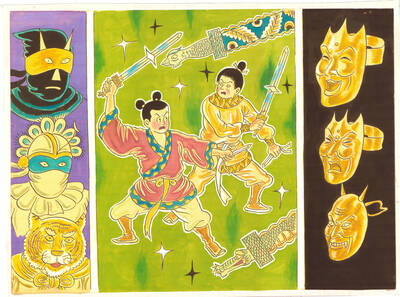
April 22 to April 28 The true identity of the mastermind behind the Demon Gang (魔鬼黨) was undoubtedly on the minds of countless schoolchildren in late 1958. In the days leading up to the big reveal, more than 10,000 guesses were sent to Ta Hwa Publishing Co (大華文化社) for a chance to win prizes. The smash success of the comic series Great Battle Against the Demon Gang (大戰魔鬼黨) came as a surprise to author Yeh Hung-chia (葉宏甲), who had long given up on his dream after being jailed for 10 months in 1947 over political cartoons. Protagonist


 RSS
RSS